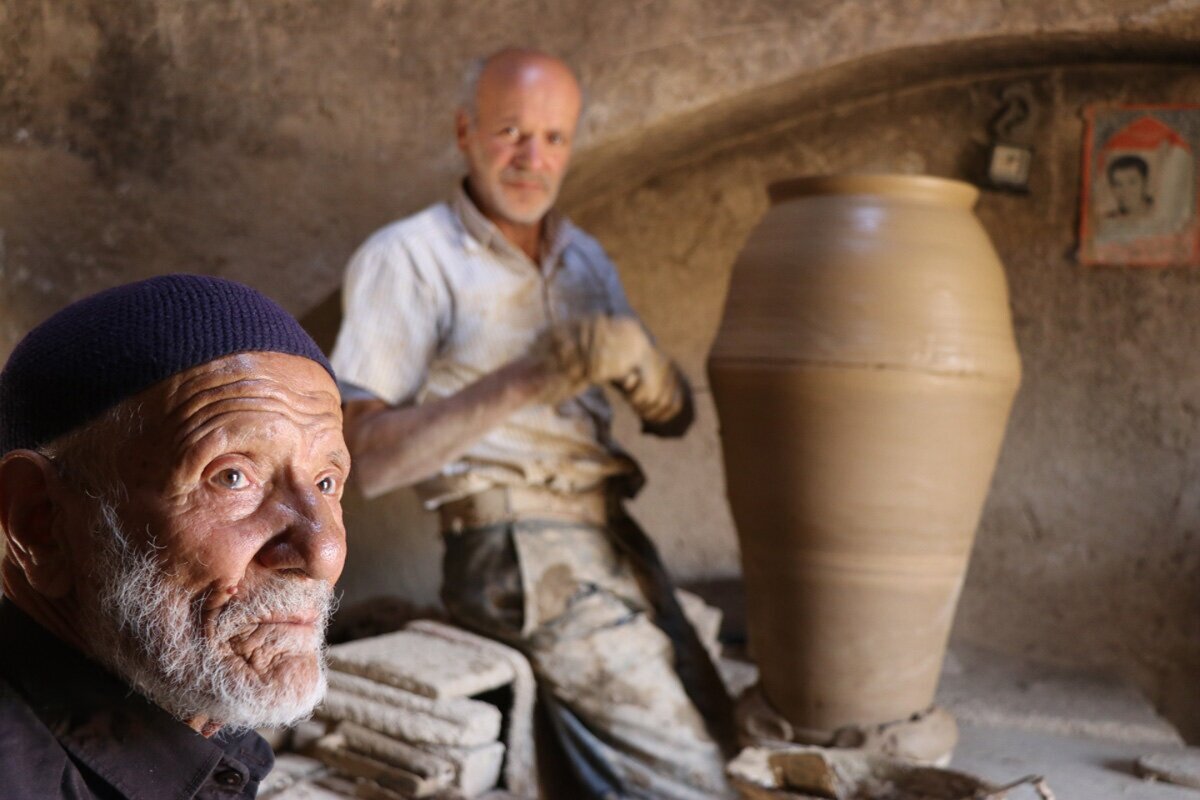
TEHRAN – Pottery is among the oldest forms of human craftsmanship, transforming ordinary clay into vessels and objects of practical use and artistic expression.
In Iran, this ancient art has evolved over thousands of years, reflecting the country’s changing civilizations, cultural exchanges and artistic traditions. From prehistoric earthenware to elaborately decorated ceramics of the Islamic period, Iranian pottery offers a glimpse into the country’s long history of innovation and craftsmanship.
The craft involves shaping clay by hand or on a potter’s wheel, followed by drying and firing. Depending on the raw materials, techniques and intended use, finished pieces may retain the natural colors of the clay or receive decorative coatings and glazes. Across Iran, potters have developed distinctive styles, forms and motifs, creating a diverse tradition that remains alive in several parts of the country.
Although the precise beginnings of pottery in Iran remain uncertain, archaeological evidence places its origins in prehistoric times, possibly as early as the eighth to fifth millennia BC. Regions including Gilan, Kordestan and Sistan-Baluchestan have played important roles in the development of the craft. The emergence of painted pottery on the Iranian Plateau also demonstrates how early communities combined practical skills with an increasingly sophisticated sense of design.
During the Achaemenid period (c. 550–330 BC), pottery production developed alongside other artistic traditions. Vessels took on varied shapes, while rhytons, drinking vessels often fashioned in animal forms, became part of the broader repertoire of ancient Iranian craftsmanship.
Pottery continued to develop during the Parthian period (247 BC–224 CE), when different production techniques and decorative styles circulated across a vast geographical area. Excavations at the Anahita Temple in Kangavar, western Iran, have yielded evidence of both unglazed vessels and glazed pottery. The latter included pieces with red, gray and greenish finishes, reflecting the range of materials and techniques available to potters of the time.
Under the Sassanids (224–651), pottery makers produced bowls, jars, jugs, figurines and animal-shaped objects. Some vessels featured geometric and vegetal patterns, carved designs and raised decorations. Others carried inscriptions in Middle Persian, also known as Pahlavi. Glazed pieces decorated with fish and animal motifs were among the characteristic products of the period.
Sassanid artistic conventions also influenced pottery produced in subsequent centuries. Winged animals, mythical birds, arabesque-like patterns and the Sassanid eagle became part of a visual vocabulary that continued into the Islamic period. Some later ceramics decorated with motifs associated with pre-Islamic Iran became known as Gabri ware, a historical term used for certain types of pottery. Examples of pottery from different periods are preserved in the National Museum of Iran.
The arrival of Islam brought further changes, as potters adapted earlier decorative traditions and experimented with new techniques. Iranian ceramic production reached a notable level of technical sophistication during the Seljuk period (11th–13th centuries), often regarded as a golden age of Persian ceramics. Craftspeople employed methods including incising, relief decoration, pierced designs, painting beneath or over glazes, gilding and enameling. These techniques enabled the production of vessels with intricate patterns and a wide range of finishes.
Ceramic production continued to evolve under the Safavids (1501–1736). Shah Abbas I encouraged artistic and commercial links with China, including efforts to develop Iranian porcelain production. Chinese ceramics influenced the tastes and practices of Iranian workshops, illustrating how pottery traditions developed through both local innovation and international exchange.
Over time, pottery became an established profession in many Iranian communities, with skills and techniques passed from one generation to the next. Despite the introduction of modern equipment and changing markets, some workshops continue to rely on traditional methods, preserving distinctive regional practices.
One notable example is Kalporgan village in Sistan-Baluchestan, where pottery-making traditions are often associated with techniques believed to have ancient roots. Women potters in the village are particularly known for shaping vessels by hand without using a conventional potter’s wheel, while distinctive geometric designs are applied to the surfaces. The resulting earthenware reflects a close relationship between local materials, inherited knowledge and everyday life.
Other important centers include Lalejin in Hamadan province, widely recognized for its pottery and ceramics, as well as Shahreza in Isfahan province and communities in Gilan. Their products range from plain household vessels to colorful jugs, bowls and decorative objects sold in local markets and beyond.
For researchers, these regional traditions help connect archaeological discoveries with contemporary craftsmanship. Iranian pottery is more than a record of ancient domestic life: it is a continuing cultural practice in which materials, techniques and designs preserve memories of the past while adapting to the needs of the present.
AM
Disclaimer : This story is auto aggregated by a computer programme and has not been created or edited by DOWNTHENEWS. Publisher: tehrantimes.com