
1 Plant, 100 Uses explores the many ways familiar Indian plants, leaves, fruits and trees have been part of everyday life — from food and farming to homes, traditions and natural remedies. Each story takes one plant and uncovers the surprising ways people have found it useful, often across generations.
In many Indian homes, the banana plant is a familiar sight. People buy its fruit at local markets, and they use its leaves during festivals and family gatherings. But the plant has uses that go well beyond what most people see in their kitchens.
Farmers and artisans have found ways to use parts usually left behind after harvest. Some have been part of Indian food traditions for generations, while others are helping turn farm waste into useful products.
Here are a few ways the banana plant is used across India.
1. Ripe bananas make an easy snack
Bananas are eaten across India as a snack or alongside breakfast. They are easy to carry and can be eaten without cooking once ripe.
The fruit is also used to make products that last longer than fresh bananas. The ICAR National Research Centre for Banana documents the processing of bananas into products such as juice and banana fig. Banana pulp can also be used in jams and other preparations.
2. Raw bananas are a kitchen staple
Raw bananas are cooked in homes across India. They are added to curries and dry vegetable dishes and are used in fried snacks.
In Kerala, raw bananas are used to make the much-loved banana chips. The Nendran variety is particularly popular for this purpose. Raw bananas can also be dried and milled into flour for use in different food products.
The Indian Council of Agricultural Research has documented ways to process bananas into products with a longer shelf life. Such methods can help reduce losses when fresh produce cannot be sold or consumed in time.
3. The banana flower is cooked as a vegetable
The purple flower that hangs beneath a bunch of bananas is used in several regional cuisines. Once the outer bracts are removed, the small florets can be cleaned and cooked in curries and stir-fries.
Banana flower dishes are found in parts of southern and eastern India. The flower can also be made into pickles. The ICAR National Research Centre for Banana has documented banana flower pickle as a value-added product.
Preparing the flower takes time because the florets need to be cleaned individually. But in households where it is a familiar ingredient, this is normally part of cooking with the plant.
4. The tender inner stem is eaten
The part commonly called the banana stem is actually a pseudostem made up of tightly packed leaf sheaths. At its centre is a tender core that is used in cooking.

In southern Indian kitchens, the core is chopped and cooked as a vegetable. It is also used in juices and other preparations. The ICAR National Research Centre for Banana has documented products such as candy and pickles made from the central core.
Using the inner core for food gives households another way to make use of the plant after its fruit has been harvested.
5. Banana leaves are used to serve food
A meal served on a banana leaf is a familiar sight in many parts of southern India. The broad leaf holds rice and several accompaniments and is widely used during weddings and festivals.
Banana leaves are also used to wrap certain foods and serve meals at community gatherings. Their size makes them convenient for serving a complete meal on one surface.
The leaves have a place in traditional food practices as well as in everyday hospitality. Their use varies by region and occasion.
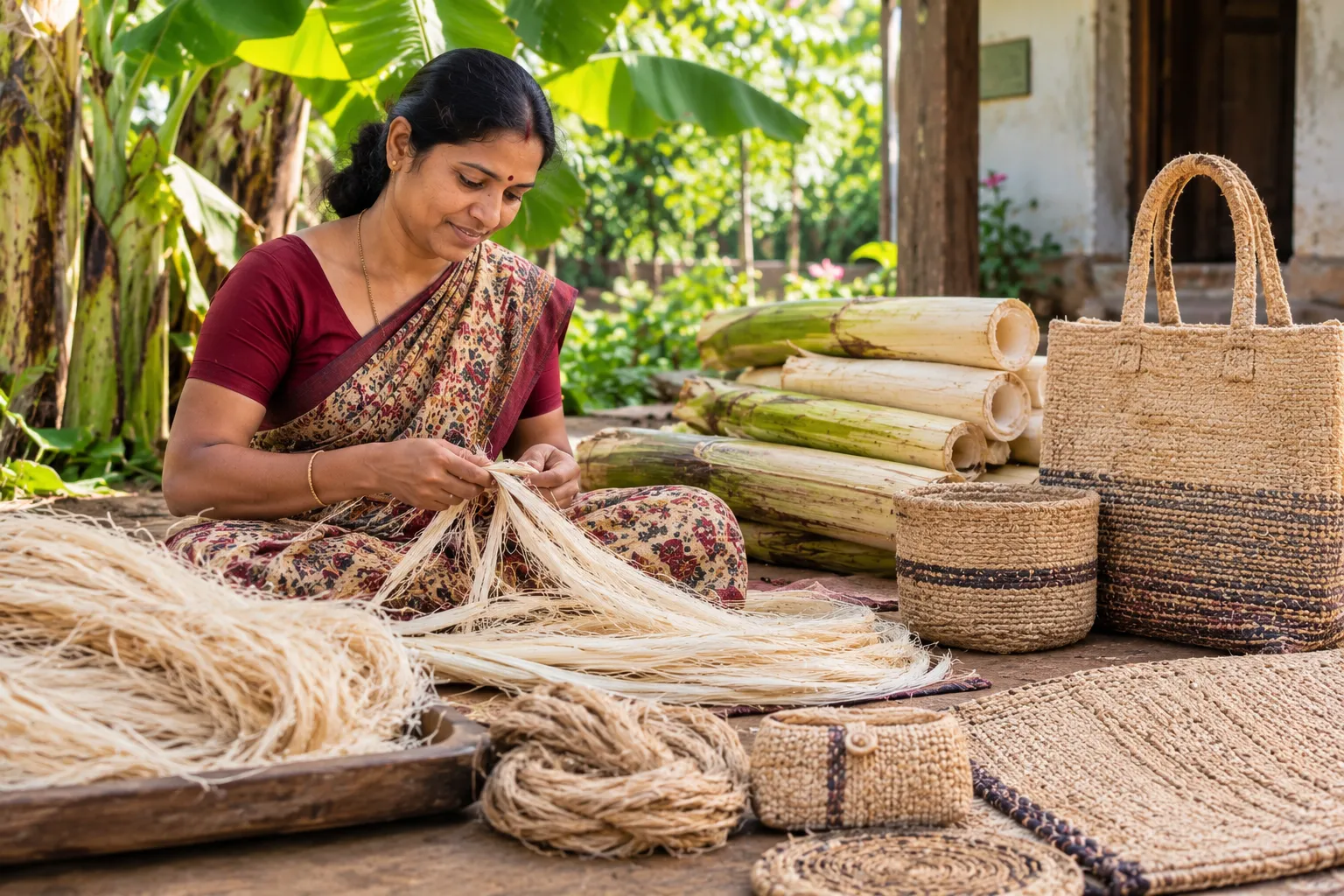
6. The pseudostem is turned into fibre
After the banana bunch is harvested, the pseudostem is cut down. Instead of leaving all this material unused, farmers and entrepreneurs can process it to extract natural fibre.
The Indian Council of Agricultural Research has documented banana fibre processing technology and its transfer to an entrepreneur in Uttar Pradesh. The fibre can be used to make ropes and garments as well as mats and carpets. Bags and baskets are other possible products.
Processing the pseudostem requires equipment and suitable facilities. Where these are available, the material can become a source of raw material for small businesses.
7. Banana fibre is used in handicrafts
The fibre extracted from banana plant material can be used to make items such as table mats and cushion covers. These products offer another use for material left behind after harvesting.
In January 2024, the ICAR National Research Centre for Banana organised a training programme in Tamil Nadu on banana fibre craft and value addition. The programme aimed to help women learn skills that could be used to make products from banana sheath and its by-products.
The ICAR report on the programme describes the initiative and its focus on developing craft skills. For those with access to training and buyers, such work can provide an additional source of income.

8. Banana peels need not go straight into the bin
Banana peels are usually discarded once the fruit has been eaten. Yet they can be put to use in food processing and composting.
The ICAR National Research Centre for Banana has documented banana peel pickle as one way of using this part of the fruit. At home, the peels can be chopped and added to a compost bin along with other kitchen scraps and dry material.
As the organic matter breaks down, it becomes part of the compost. This is a practical option for households that grow plants or maintain a garden.
9. Banana plants are used during ceremonies
Banana plants are commonly used to decorate entrances and ceremonial spaces during weddings and religious occasions in several parts of India. Their green leaves and upright pseudostems are a familiar part of these arrangements.
The plant is associated with auspicious occasions in many communities. The exact customs differ across regions, but banana plants continue to feature in traditional celebrations.
Their role during these occasions is distinct from their use as food or raw material. They are part of the way families mark important events.
10. Banana residue can be used on farms
Harvesting bananas leaves behind considerable plant material. The pseudostem and other suitable residues can be considered for composting or other forms of farm use rather than being discarded without thought.
Research published through the Indian Council of Agricultural Research discusses banana plant parts and their place in integrated farming systems.
The best use depends on the farm and the resources available. Some growers may be able to supply material to fibre processors while others may find composting more practical.

Making use of what remains
The banana plant serves different purposes in different parts of India. Its fruit and flower are cooked in homes while its leaves are used for serving food. These uses also offer farmers and small businesses ways to get more value from a crop. With suitable processing and local demand, parts of the plant that are left behind can become useful materials.
Disclaimer : This story is auto aggregated by a computer programme and has not been created or edited by DOWNTHENEWS. Publisher: thebetterindia.com




