How great and accessible is the golf? After clearing customs, you can be on the grounds of a likely future Open Championship venue in less than 30 minutes.
SITTING ON A SANDY PENINSULA just seven miles from Dublin Airport is Portmarnock Golf Club, the city’s highest rated course and one of the world’s best links. The club has hosted over a dozen Irish Opens, the Amateur Championship and Women’s Amateur Championship, but the R&A’s marquee event — the Open Championship — has yet to be played on Irish soil. That may soon change. In April, R&A Chief Executive Mark Darbon said he’s “cautiously optimistic” about hosting the game’s oldest major at Portmarnock. Rumors swirl that this could happen as early as 2030, and anticipation colors every interaction at the club. “There’s feasibility work going on and discussion between the R&A and the government,” says General Manager Kyle Cannon. “And we’re sitting and waiting for all of this to pan out.” Should the Open come to Portmarnock, it will be played on a banger of a course, a winding layout with water on three sides and greens that run fast and true. Portmarnock is a relatively flat affair, without the towering dunes Americans associate with Irish seaside golf. That means fewer odd bounces, making the subtle beauty as equitable a links as there is.

Bill Hornstein
Bernard Darwin once declared that there is “no greater finish in the world than that of the last five holes at Portmarnock.” That run still astonishes, and in a nod to the times, the old-school club has installed cameras on holes 1 and 15. Portmarnock emails visitors videos of those tee shots, a great way to remember how the breeze kissed your cheek as your slice drifted into the sea.
NEXT TO PORTMARNOCK SITS another stellar links with even deeper ties to Ireland’s golfing past. In 1847, John Jameson III, the grandson of the namesake distillery’s founder, bought 600 acres of land on Portmarnock Peninsula and built a family estate. In the 1850s, he laid out nine holes in the dunes, one of the first golf courses in Ireland.
That course eventually fell into disrepair, but in 1995 an early Bernhard Langer design opened on the site as part of the new Portmarnock Resort. That routing went through a significant renovation in 2023 and is now known as Jameson Golf Links.

Bill Hornstein
The resort course abuts Portmarnock, but its terrain is much more dramatic, with taller dunes and more elevated tee shots. The layout is less penal than its famous neighbor but hardly a pushover. The resort saves tee times for last-minute play, making it the perfect track for golfers who need a keep-me-awake round after a red-eye arrival or an 18 to settle bets before heading home.
Throughout the property, there are nods to the area’s rich history. The first fairway runs along the old Jameson family cemetery, meaning a wayward shot could end up beside the patriarch’s grave. A nearby sign warns golfers not to enter, so the burial ground will be your Titleist’s final resting place. The links’ eastern boundary is a gorgeous three-mile stretch of beach known locally as the Velvet Strand. Its smooth sand is packed so hard that in 1930 the first east-to-west transatlantic flight took off from there.
Carved into wild and woolly dunes just north of Portmarnock, the Island regularly ranks in the top 12 courses in Ireland. How good is it? Lowry once brought Dustin Johnson and Harold Varner III there to tune up before the Open Championship.
Despite all the acclaim, the course often flies under visitor radar, but it may be winning the popularity contest. Many locals say it’s their favorite course to play.

Bill Hornstein
The Island was founded in 1890 and was so named because the only way to reach it was by boat. Word is players would conveniently miss the last ferry home, forcing them to overnight at the club. That led to more golf and revelry and, inevitably, an earful from their wives the next morning. A local access road was built in 1973, making it much easier to visit the club and saving countless marriages.
The front nine is terrific, and the back is even better, with a stretch of holes from 13 to 16 that is one of the tastiest in Ireland. Remnants of the club’s old pier are still visible by the 14th tee, a par 4 with a fairway roughly 10 yards wide. That’s not a typo.
The turf at the Island is so firm that the smart play is usually to forget the lob wedge and putt, even from 50 yards out. Visitors can take an entire round to learn that lesson, but members take the resulting slow play in stride.
“I don’t mind getting stuck behind Americans,” says one, “because you usually end up finding six new Titleists.”
FIVE MILES EAST OF THE CITY CENTER, a rickety wooden bridge takes visitors across Dublin Bay to another storied links deeply connected to the game’s history. The drive feels like a trip back in time and ends at one of the great clubhouses in golf.
The Royal Dublin Golf Club dates to 1885. Its current course was laid out by the legendary Harry Colt in 1920 and received a full refresh from links specialist Martin Hawtree in the early 2000s. The classic out-and-back routing has hosted the Irish Amateur Open Championship a record 29 times, and Seve Ballesteros won two Irish Opens there.
On a weekday afternoon, Royal Dublin’s stylish bar is bursting with energy. When the conversation turns to the differences between golf in Ireland and Scotland, you might wish you brought earplugs. The Dubliners concede that the top courses in both countries are equally great, then grudgingly acknowledge Scotland has better second-tier courses. But, in the end, everyone insists the Irish game wins out because it excels at the sport’s most important element — the après-golf scene.
The argument is simple: The great Irish courses are all in towns that are much more charming than their Scottish counterparts. “I played Carnoustie,” one member roars. “The course is fantastic, but after your round, there’s nothing to do!”
Shade always sounds better when thrown with an Irish accent.

Bill Hornstein
GIVEN THE EXPLODING DEMAND for tee times, Royal County Down could be excused for keeping itself encased in amber. But even that Northern Ireland all-timer — 90 minutes by car from the Dublin Airport — is changing with the times.
The club’s subtle efforts to improve guest services pop up everywhere, from the hoodies for sale in the pro shop to a new focus on how employees interact with visitors. “The staff here are all passionate but were sometimes reserved,” says General Manager Bill Donald. “Now we’re trying to project that passion forward.”
That passion extends to the caddies, who are as gifted with the needle as they are at reading the course’s slick greens. After finally puring a shot eight holes into your round, don’t be surprised if your cheerful looper chirps, “I was starting to think I wasn’t going to hear that sound today.” For a moment you wish he wasn’t projecting their passion quite so strongly, then you laugh your a– off all the way to the green.
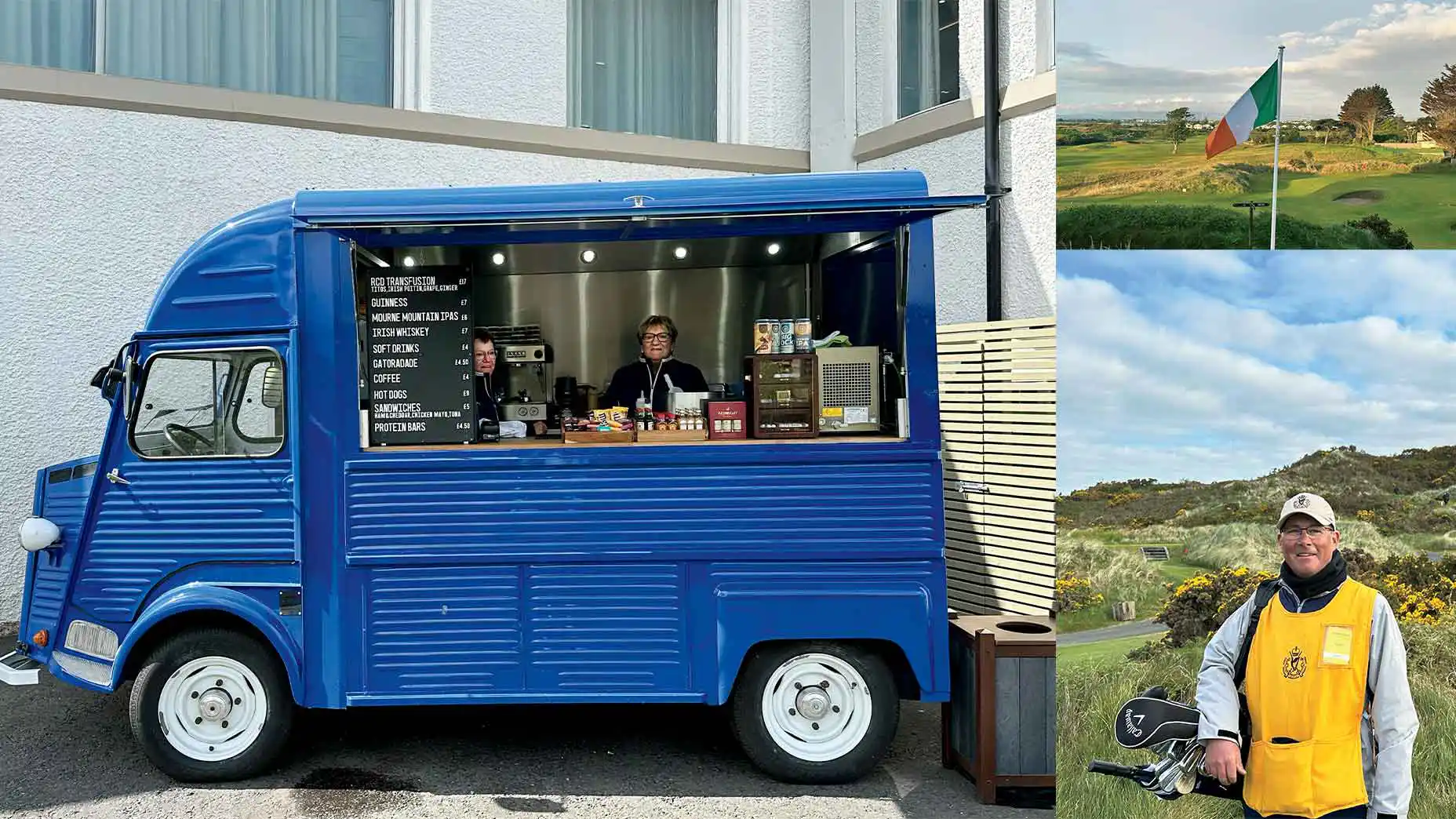
If Royal County Down’s food truck captures where the game is right now, the question remains — Where is this all going? One answer sits on the shores of the Irish Sea 40 miles south of Dublin, where Ireland’s golfing past is being transformed into its future.
When the European Club opened in 1992, the course didn’t have a clubhouse, and the green fee was £10. But it wasn’t long before the modern links brought new attention to Irish golf. Some critics called it too penal, a tricked-up ball gobbler. But it regularly made World Top 100 lists, and Padraig Harrington won the 2008 Irish PGA Championship there.
Last year Irish businessman Raymond Conlan and his family bought the European Club for a reported $39 million. Now the Conlans are redeveloping the land into what they hope will become the next must-play destination on the Irish rota. The family renamed the club Brittas Bay and hired architect Kyle Phillips, best known as the visionary behind Kingsbarns. Phillips is hard at work shaping the breathtaking 180-acre site into a new course with wide, rugged fairways and water views from every hole. The layout will provide plenty of drama, but Phillips also wants it to be a fun, playable walk. “Hopefully it feels traditional in style but with the scale of a modern course,” he says. Brittas Bay is scheduled to open in summer 2027 and should be yet another reason to bucket list a trip to Dublin.
Golf tourism in Ireland has never been bigger, but given how many booms and busts the sport has seen over the years, is co-owner Nicky Conlan nervous about making such a large investment at what could be a market peak? “We actually felt this was less risky than a lot of other ventures,” he says with the passion of a man on a mission. “No matter what happens in the world, there’s going to be a ball on the
ground and a club in someone’s hand.”
Disclaimer : This story is auto aggregated by a computer programme and has not been created or edited by DOWNTHENEWS. Publisher: golf.com