
Alex Burchmore
It’s one of the great ironies of the contemporary art world that the more transgressive an artist is seen to be, the more likely it is they’ll find success. The more they challenge the mainstream, the more recognition they’ll enjoy from those who control that fast-moving and fickle current. There’s “transgression”, however, and then there’s transgression. The system can tolerate and even requires some subversion, especially if there’s money to be made (there’s always money to be made). Refuse to play the game, however, and you can expect a short career.
This irony lies at the heart of The Hooligans, an exhibition premised on the Maoist definition of this term as a catch-all label for those troublemakers and deviants who threatened to upend the status quo. In contemporary Australia, we tend to use the term “hooligan” to dismiss those who commit acts of violence and chaos with no clear aim. Soccer fans rioting after their team loses (or wins) a game, overindulged barflies brawling in the gutter, disaffected teens roaming suburban backstreets in the twilight hours.
These violators of the peace share some defining traits. Their actions appear to lack any merit or motivation. They seem driven by appetite and impulse alone. Above all, they’re united by a commitment to the act as an end in itself, not a means to something else. No higher purpose or underlying ideology guides their hand.
The same could be said of the “hooligans” of the art world. The firebrands who stage one-off art-events and resist any attempts at explanation or co-option. Several such misfits appear in The Hooligans.
The second-floor galleries open with a photograph of the culminating moment in the arresting display of artist Xiao Lu’s Dialogue. On the first day of the landmark show China/Avant-Garde in February 1989, the artist fired a gun directly at her installation, bringing the exhibition to a premature end just two hours after the doors opened. These galleries also feature works by Zhu Yu and He Yunchang, once two of the most well-known names on the Chinese contemporary art scene. Both gained notoriety for their incorporation in gruelling works of performance and installation art of human body parts and voluntary surgical procedures.
These career-defining acts of art world “hooliganism”, however, don’t lend themselves to easy display after the event. Their infamy is prolonged only by documentary photographs and an ever-growing mass of critical commentary.
The works shown in The Hooligans, on the other hand, represent another side to their practice – one that all artists who want to make a living from their work must cultivate. Zhu Yu’s 2015-2020 (2019) series of lustrous images in oils on canvas of gilded plates stained by the remnants of an unknown ritual or partially eaten meal are a far cry from his performance Eating People (2000). The painterly allusion to this work, however, for which the artist allegedly cooked and consumed a preserved human fetus, is likely a key part of their appeal.
This bind is directly confronted elsewhere in the exhibition by Hu Yinping. For her installation Qiao Xiaohuan (2007), the artist presents a selection of neon-hued figurines in a commercial-style wall-mounted Perspex display case. Miniature collectibles for the art aficionado with an eye for novelty but a limited budget.
It’s a strategy of market manipulation pursued with most success in the Chinese artworld by Xu Zhen®, who registered his name as a trademarked brand in 2013 under the management of his nebulous “art corporation” MadeIn Company. Xu’s Small Change (One-Renminbi Tank) (2014) and The Venus of Willendorf (2024) appear here opposite Zhu Yu’s paintings, conjuring seductive illusions of bountiful abundance and irresistible military might. Like the pretence of Xu’s artistic persona, these are revealed to be hollow fantasies. A tank patched together from one-yuan banknotes (about 20c each) and an ancient fertility figure drained dry by her crown of neoclassical flexi straws.
Hu Yinping, too, works under a series of pseudonyms. In addition to the market-friendly Qiao Xiaohuan, there’s also the more socially-minded Hu Xiaofang – a generous patron invented to purchase the hats knitted by her mother and other women. This act of anonymous patronage evolved into a sustained commitment to a “craftivist” project of social activation, supporting rural women to create knitted replicas of agricultural staples in Potatoes, Potatoes and Wheat, Wheat (both 2024).
The apparently impulsive collectivism of these works, however, like the lack of accountability attributed to the hooligan, has deeper historical roots. The celebration of agricultural surplus in Hu’s knitted installations could be read both as a parody and homage to the “activation” of rural workers for Chairman Mao’s ill-fated Great Leap Forward in 1958-62. While the masses are labelled hooligans when they prove unmanageable, this very same volatility has long been central to the success of revolutionary change.
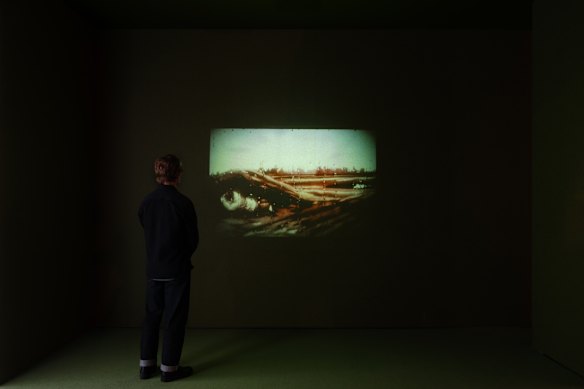
On the first floor of the exhibition, further historical precedents are evoked in the combination of Huang Yongping’s creaking carousel Les Consoles de Jeu Souveraines (2017), Li Wei’s eerie Once Upon a Time (2019), and Feng Mengbo’s cryptic video 195806 (2015). The hooligans in these works are not the people but the imperial powers and global leaders who hold control over the direction of our lives. The artists trace a clear continuity from the “Great Game” of the 19th century to the “Mutually Assured Destruction” that defined 20th-century Cold War politics, and which seems now to be making a comeback.
These two narrative threads implied by the exhibition theme come together in the top-floor gallery. Here, in a display of eight monumental canvases from Song Yongping’s History Series (2012-16), key events and personalities in China’s modern history – the atrocious as well as the beloved – are simultaneously celebrated, caricatured, and commodified. Imperial, Maoist, post-Maoist, and contemporary blend together, exposing generational legacies and recurring cycles of dissent and co-option. The hooligan, in the end, is a convenient fiction, a paper tiger, a marketable persona, yet also a force for positive change, a voice for the voiceless, a resident of the shadowy zones between the stasis of the status quo and the promise of chaos beyond.
The Hooligans is at the White Rabbit Gallery, Chippendale, until May 17.
Dr Alex Burchmore is an art historian at the Australian National University, Canberra, specialising in the study of Chinese art.
From our partners
Disclaimer : This story is auto aggregated by a computer programme and has not been created or edited by DOWNTHENEWS. Publisher: www.smh.com.au


