
It’s the 1980s in a Thai jungle. An explorer saves a young woman from being sacrificed by a ruthless “worm tribe”. As punishment, he’s damned with seven blood curses, the last of which will kill him. With no other choice, he returns to the jungle to find a permanent cure.
This is the premise of The Seventh Curse, a 1986 horror-comedy by Hong Kong filmmaker Lam Ngai Kai. Believe it or not, it’s just the beginning of the weirdness. Kung-fu Xenomorph beasts, ancient skeleton spirits, giant Buddha statues crying blood and flying demon babies made from the blood of 100 children – in this film, realism need not apply.
It may sound wild and preposterous, especially in comparison to the straight-cut haunted houses filling Western cinema screens. But such surreal outrageousness is part and parcel of Hong Kong horror – a subgenre which remains one of the region’s most enduring exports.
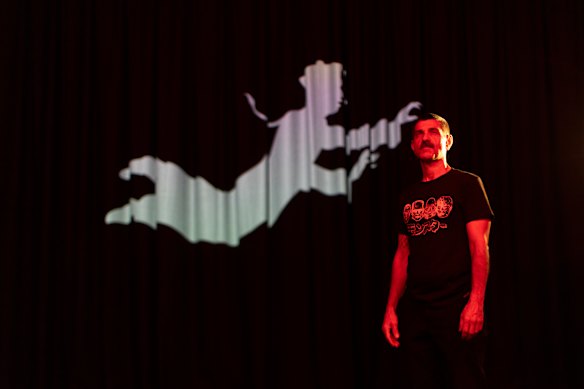
“It’s an incredible genre-mash, particularly one that blends supernatural elements with martial arts. It swings from horror to comedy to action to wild practical effects,” says film programmer Spiro Economopoulos, who curated the upcoming Spotlight on Hong Kong Horror program at Melbourne’s ACMI (formerly the Australian Centre for the Moving Image). “It’s so big in every way.”
Despite its grand nature, however, Hong Kong horror almost didn’t exist. Films containing supernatural elements, often referred to as “wuxia shenguai” films, were banned in mainland China in the 1930s following government concerns they would make people superstitious, and impede the nation’s modernisation efforts. This worsened throughout the communist revolution, and continued until the ban was lifted in the 1980s.
But this censorship didn’t eliminate horror; it merely shifted it. Economopoulos says Chinese filmmakers sought refuge in Hong Kong, which was then under British rule. (The UK returned the territory to China in 1997.) There, scary movies were free to become increasingly weird and wonderful.
“They took a lot of the traditional storytelling already [in China], remixed it and took it to another place … far away from the eyes of the censors,” he says.
The subgenre experienced a major surge between the ’70s and ’90s, as local studios like Shaw Brothers and Golden Harvest distributed titles around the globe.
“Shaw Brothers were putting out more films than Paramount, Warner Brothers and MGM combined. En-masse, that was eventually going to bleed into other markets,” Economopoulos says. “The martial arts elements of the films also really tapped into American consciousness, particularly black culture and music. The films were coming into that market through the grindhouse or double bills, and resonating in a way that probably wasn’t expected.”
They had such an impact that some western filmmakers remade Hong Kong horror titles. David Moreau and Xavier Palud’s 2008 film The Eye (starring Jessica Alba) is an English remake of Danny Pang Phat and Oxide Chun Pang’s 2002 film of the same name.
Here are five classics of the genre to familiarise yourself with the strangely sublime world of Hong Kong horror.
Mr. Vampire
The hopping vampires in Ricky Lau’s 1985 slapstick horror-comedy have come to define Hong Kong horror, inspiring an immensely popular franchise with four sequels.
It follows Master Kau, a Taoist priest with the ability to control “jiangshi” – a type of zombie vampire from Chinese folklore. While relocating a client’s deceased father, he realises the man is undead, and brings him back to his house to guard. However, after failing to properly vampire-proof his coffin, the vampire rises and all hell breaks loose.
It not only features one of the most impressive monobrows in movie history, it also encapsulates the difference in horror tropes across borders. While vampires are also popular in the West, Hong Kong vampires are a very different beast. Jiangshi hop, have severe rigor mortis, and can be controlled by candles and talismans.
Encounters of the Spooky Kind
Without this witchy caper, we never would have had Mr. Vampire.
“Big Guts” Cheung, known by his neighbours as a courageous fellow, is hunted down by a witch who was hired by his wife’s secret lover. After facing myriad malevolent forces, like hopping vampires and possessed hands, Cheung becomes the disciple of a rival sorcerer who helps him take on the witch in a battle of supernatural magic.
Encounters of the Spooky Kind (1980) popularised the horror-comedy trend in Hong Kong, introducing Sammo Hung Kam-Bo as a tour de force within the genre. It’s genuinely funny, showcases Hung’s brilliant martial arts skills, and is an eye-opening demonstration of witchcraft according to Chinese folklore. It also arguably has one of the best (albeit slightly problematic) freeze-frame final shots in cinematic history. You must see it to believe it.
The Boxer’s Omen
What begins as a revenge mission ends up a hallucinatory trip of epic proportions in Kuei Chih-Hung’s 1983 cult classic.
A Hong Kong gangster travels to Thailand to enact revenge on the man who paralysed his brother. However, visions of a mysterious monk distract him, leading him to a temple where he discovers he’s the past-life twin of the deceased temple leader. With this knowledge, he must go on to defeat a gang of evil sorcerers.
This film brings you on a rollercoaster of sensations. The obviously fake bats and spiders make you crack up (it’s like watching a child’s puppet show); a man vomiting out a live eel makes you queasy; and its martial arts sequences genuinely amaze. It’s a worthy addition to the woefully underrated psychedelic cinema.
The Legend of the 7 Golden Vampires
Roy Ward Baker and Chang Cheh joined forces to create this 1974 delight that blends British gothic horror and kung-fu spectacle.
It begins in Transylvania in 1804. A man seeks the help of Count Dracula to revive the legendary seven vampires and wreak havoc on the people of rural China. One hundred years later in Chungking, a professor specialising in such supernatural forces, Professor Van Helsing, discovers the vampire legend is true, and joins seven brothers to battle against Dracula and his undead army.
A co-production between British film company Hammer Films and Shaw Brothers, this film is further proof of Hong Kong horror’s global reach in the ’70s. It injects tropes and characters from Bram Stoker’s literary classic with a healthy dose of Chinese folklore and surreal martial arts. In other words, it’s the best of both worlds.
Dumplings
Think The Substance, but even more disturbing.
Fruit Chan’s grisly 2004 feature follows an ageing actress who discovers her husband is cheating on her with a younger woman. Desperate to reclaim her youth, she resorts to black-market dumplings that contain mysterious anti-ageing properties. She quickly becomes hooked on them, and stops at nothing to keep consuming the secret ingredient.
Contemporary Hong Kong horror tends to have a more socio-political edge, Economopoulos says. Dumplings, for instance, digs at China’s one-child policy, the beauty myth and tensions within a post-handover Hong Kong.
Shot mostly in close-up (by Australian cinematographer Christopher Doyle), the film simultaneously elicits feeling of disgust and awe. You’ll never look at dumplings the same way again.
Spotlight on Hong Kong Horror will take place at ACMI from April 30 to May 18. You can buy tickets here.
Must-see movies, interviews and all the latest from the world of film delivered to your inbox. Sign up for our Screening Room newsletter.
 Nell Geraets is a Culture reporter at The Age and The Sydney Morning Herald.Connect via X or email.
From our partners
Disclaimer : This story is auto aggregated by a computer programme and has not been created or edited by DOWNTHENEWS. Publisher: www.smh.com.au