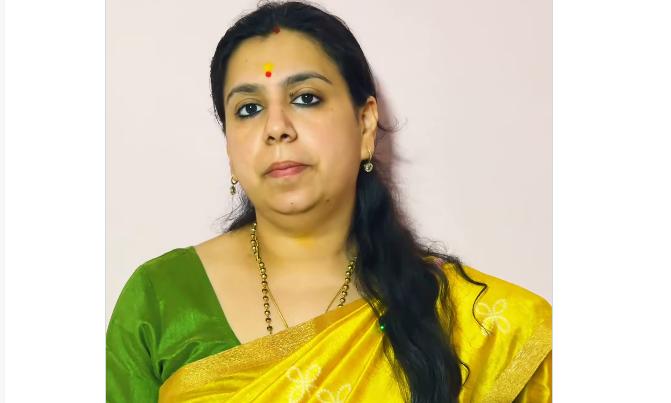
Lucknow: Former IAS officer Divya Mittal announced her political party, Jan Neeti Bharat, on Thursday, over a month after she opted for voluntary retirement from service, and said it will contest the 2027 Uttar Pradesh assembly elections.In an 8.27-minute-long video message on X, Mittal said the party will focus on making people central to policymaking and ensuring that the government remains accountable to them throughout its five-year term and not just on election day.
“Politics rules over you. In Jan Neeti, you will be the ones who rule,” she said, announcing the party’s name and its decision to contest the state polls due early next year.
Mittal, an alumna of IIT Delhi, IIM Bengaluru and a former Wall Street trader, resigned from the Indian Administrative Service (IAS) after a 13-year career on August 30. She announced her entry into politics on September 29.
She said her appeal to people to enter politics received an overwhelming response, with many sending messages to a phone number she shared.
Explaining the rationale behind announcing the new party, Mittal said, “The problem is not a shortage of parties; the problem is a lack of people being heard. Some people are heard, but not everyone.”
She claimed that unlike the existing arrangement, in which legislators often act as intermediaries between the government and the public, Jan Neeti Bharat representatives will have to remain accountable to the citizens.
She said necessary reforms have not been implemented not because of technological limitations, but because they threaten established power structures.
“Political parties may appear to compete with one another, but agree on keeping decision-making out of the hands of ordinary people,” she said.
She said Jan Neeti Bharat lacks the money needed for extensive advertising and will instead rely on a door-to-door campaign, with every household serving as an office and every supporter acting as a campaigner.
Inviting people to call her to their villages and towns, she urged them to share her message with three people and promote the slogan “Not politics, but Jan Neeti”.
Mittal was serving as the special secretary in the Revenue Department in Lucknow when she tendered her resignation. She earlier served as district magistrate of Deoria, Mirzapur and Sant Kabir Nagar.
During her tenure as Mirzapur district magistrate, she gained attention after tap water was brought to Lahuriadah, a remote hill village in Halia block, 75 years after independence.
Locals remember her tenure in Deoria for her efforts to implement government schemes at the grassroots level and for her decisive administrative actions.
In her message, Mittal said that for the Jan Neeti Bharat party, public participation will guide policymaking, decisions will be based on needs rather than identity and people will be able to hold the government accountable for its work.
Under the first pledge, she said, policies should be shaped by the people affected by them, with experts helping determine how they can be implemented.
Recalling the case of Devkali Devi, who had sought a school despite the absence of water at her home, Mittal said work on the school began after she highlighted the issue in a video, but it was subsequently halted after it was found that the plot where it was being built was forest land.
Questioning the disparity in the pace of clearances for industrial projects and public facilities for the poor, the former IAS officer said, “Policies should reflect the concerns of farmers, small traders and future generations alike.”
Under the second pledge, she proposed “a needs-based decision-making system” in which people can collectively identify priorities for public works.
Citing an instance in which the alignment of a road was allegedly changed to benefit one individual, displacing several households, she said decisions should not be dictated by the influence or identity of a select few.
She also proposed a mobile application through which women can mark locations where they felt unsafe.
Once a location receives 100 reports, lighting and cameras should be installed there and police patrolling should be ensured. The decision will be guided by women’s experiences rather than by officials or politicians, she said.
The same approach can be used to prioritise roads, hand pumps and other public works, she added.
Under the third pledge, Mittal proposed a system that will allow people to track government works in their villages, including their cost, timelines and the officials responsible.
“Information about welfare schemes, including housing assistance, should reach beneficiaries directly on their mobile phones to reduce the role of middlemen,” she said.
She also suggested a public feedback mechanism under which people could rate services and infrastructure using three colours — green for satisfactory, yellow for incomplete and red for poor.
The ratings can cover schools, hospitals, ration shops and public works, helping officials and ministers identify deficiencies and take corrective action, she said.
“Under the proposed system, elected representatives will be responsible for reaching out to people, assisting those unable to use digital tools and ensuring their concerns are recorded,” Mittal said.
Disclaimer : This story is auto aggregated by a computer programme and has not been created or edited by DOWNTHENEWS. Publisher: deccanchronicle.com