NEWYou can now listen to Fox News articles!
In November 1966, 12 American soldiers stationed at an isolated outpost in a Vietnamese war zone were about as far from a traditional Thanksgiving at home as they could get.
Their only means of resupply was by air. But the U.S. military was determined to get them Thanksgiving dinner anyway.
A mess sergeant at Bien Hoa prepared turkey and all the trimmings, packed the meal into insulated containers and sent it by helicopter into War Zone D, where three officers and nine enlisted men of a 5th Special Forces detachment sat down to Thanksgiving dinner, according to Defense Department records preserved by the National Archives.
The delivery was one piece of a massive logistical effort the U.S. military has undertaken during wars spanning generations to get traditional Thanksgiving meals to troops serving in combat zones.
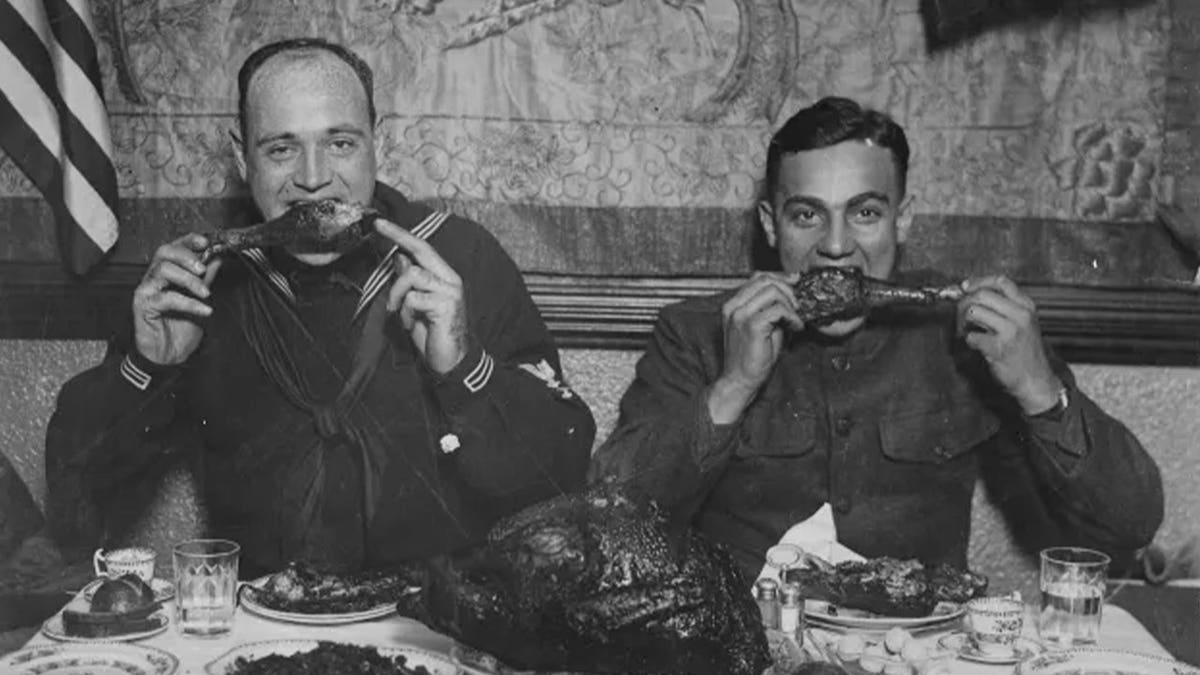
Soldiers are pictured eating Thanksgiving dinner during World War I, in 1918. (National Archives)
From civilians sending tens of thousands of turkeys to Union troops during the Civil War to helicopters carrying hot meals to soldiers in Korea, the holiday has been observed through some of the nation’s most consequential conflicts.
Thanksgiving became a national tradition in the midst of war. President Abraham Lincoln issued his 1863 Thanksgiving proclamation as the Civil War entered its third year, calling on Americans to observe the final Thursday of November as a day of “Thanksgiving and Praise.”
By the following year, Americans on the home front were mounting a massive effort to get Thanksgiving dinner to Union troops.
Former War Department official Charles A. Dana later recalled the “great turkey movement” of November 1864. In New York alone, organizers reported having 20,000 turkeys ready to send to the front, according to Dana’s account. A Philadelphia committee sought transportation for another 4,000 destined for troops serving under Gen. Philip Sheridan.

U.S. service members stationed at an airbase in Norfolk, England, select turkeys for their Thanksgiving dinners at a local farm on Nov. 6, 1943. (National Archives)
By World War II, the effort to put turkey on troops’ Thanksgiving tables had grown so large that it affected whether Americans at home could find one for their own.
In August 1943, the War Food Administration restricted most civilian turkey sales as the government sought millions of pounds for the armed forces. An initial goal of at least 10 million pounds for troops overseas was expanded to include military installations at home, and the government ultimately obtained roughly 30 million pounds before the order was lifted in October, according to wartime government records.
A year later, delivering Thanksgiving dinner near the front could carry its own risks.

Sailors Leo F. DesJarlait, left, Eulice E. Wheeler, center, and G.J. Lindner eat turkey and trimmings at an advanced U.S. Navy base in the Aleutian Islands on Nov. 24, 1944. Lindner gives a “4.0” sign, meaning “perfect,” in response to the Thanksgiving meal. (National Archives)
In Germany’s Hürtgen Forest, Lt. Paul Boesch of the 121st Infantry Regiment later recalled being told that hot turkey dinners had arrived for his men amid some of the European campaign’s most grueling fighting. Boesch protested that sending soldiers to collect the food would expose them to German artillery, but the order to distribute the meal stood.
His fears proved well-founded. As troops gathered to retrieve the food, German artillery struck the area, killing and wounding several men, according to Boesch’s account.
Six years later, American troops were again eating Thanksgiving dinner near the front, this time in the bitter cold of North Korea.
On Thanksgiving Day 1950, Marines around the Chosin Reservoir were served turkey and cranberry sauce, candied sweet potatoes, fruitcake and mince pie. In the subzero temperatures, the food quickly began to freeze.
The dinner came as U.S. commanders remained optimistic that the war could soon be over. The following day, Gen. Douglas MacArthur launched an offensive that became known as the “Home-by-Christmas” campaign.
Instead, Chinese forces entered the fighting in massive numbers. Within days of Thanksgiving, Marines around Chosin were surrounded and battling through one of the most brutal engagements of the Korean War.

Pfc. John A. Arnett, left, receives a turkey leg from Cpl. Fred Burks during Thanksgiving dinner in Korea on Nov. 22, 1951. The chow line was set up on the back side of a hill roughly 200 yards from the main line of resistance. (National Archives)
More than half a century later, another generation of American troops was spending Thanksgiving at war in Iraq and Afghanistan.
In 2003, President George W. Bush secretly flew into Baghdad to surprise roughly 600 troops gathered for Thanksgiving dinner at Baghdad International Airport. Air Force One approached with its cabin shades drawn and lights dimmed amid tight security surrounding the trip.
“I was just looking for a warm meal somewhere,” Bush joked before addressing the troops and helping serve Thanksgiving dinner.
In Afghanistan, getting that dinner to troops stationed far from major bases could require a different kind of operation.

President George H.W. Bush eats Thanksgiving dinner on the hood of a Humvee while visiting U.S. troops in Saudi Arabia during Operation Desert Shield on Nov. 22, 1990. (National Archives)
On Thanksgiving 2007, helicopters carried turkeys and traditional fixings from Bagram Airfield to soldiers at remote firebases in the Tagab Valley, according to a contemporaneous U.S. military account.
It was the first hot meal some of the soldiers had eaten in months. Because the positions still had to be defended, troops rotated between Thanksgiving dinner and standing watch.
“The white meat was magnificent,” Pfc. Matt Lorimer of the 82nd Airborne Division said.
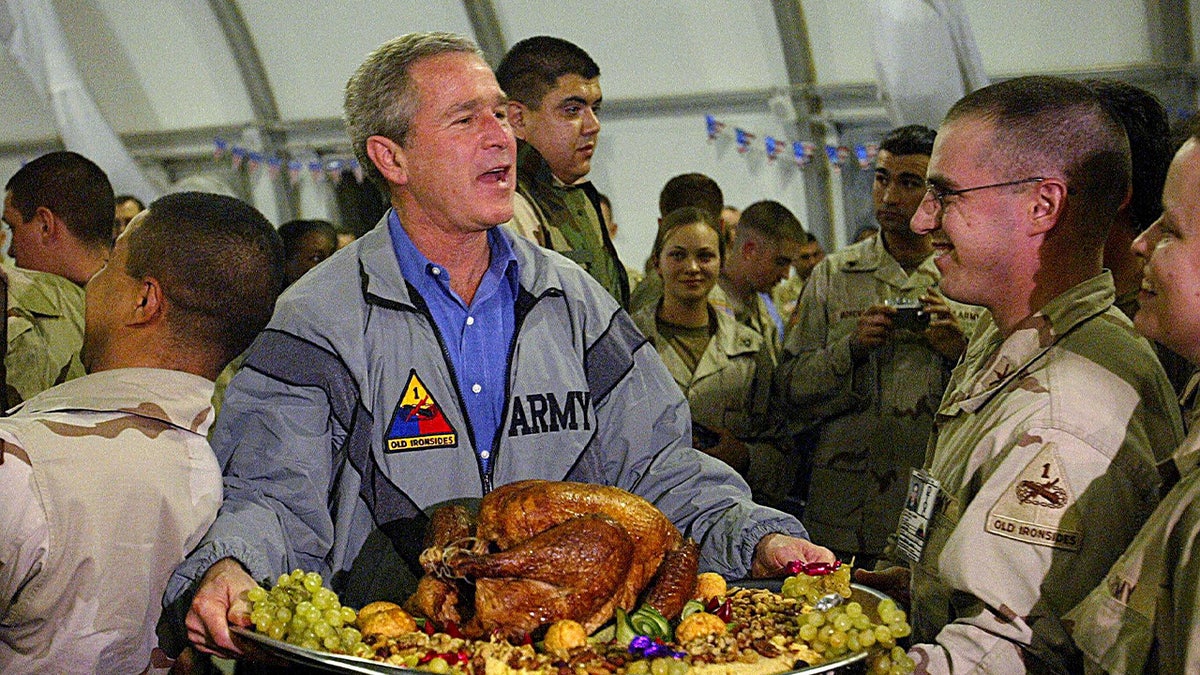
President George W. Bush traveled to Iraq in 2003 to meet with troops without the public’s knowledge. (Tim Sloan/AFP/Getty Images)
At another remote Afghan outpost two years later, troops spent a month fattening five scrawny turkeys purchased locally for Thanksgiving. But five birds were not enough to feed roughly 150 soldiers.
Additional turkey was flown from the United States to Bagram Airfield and then transported to the outpost. Even that was not the end of the journey.
CLICK HERE TO DOWNLOAD THE FOX NEWS APP
A handful of soldiers were manning an observation post on a mountain spur roughly 6,900 feet above sea level. Their Thanksgiving dinner was packed up and flown by helicopter up the mountain to them.
Disclaimer : This story is auto aggregated by a computer programme and has not been created or edited by DOWNTHENEWS. Publisher: moxie.foxnews.com