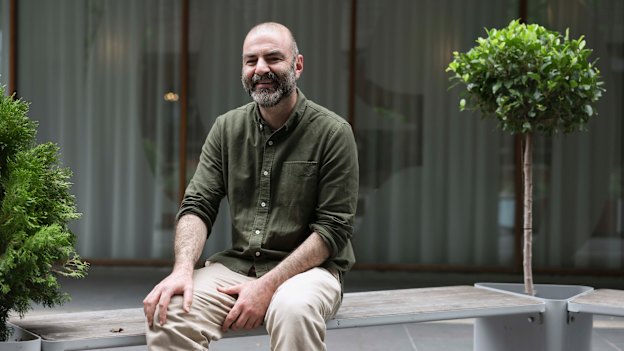
Joseph Abboud almost skipped the awards night that crowned him a Good Food Guide Legend. Over lunch, he reflects on two decades of feeding Melbourne.
It’s the speech that very nearly wasn’t. Joseph Abboud’s invitation to last month’s Good Food Guide awards got lost in his spam folder. When he was prompted to dig out the email, the chef and restaurateur wasn’t too keen to go.
“Every other night that week, I’d been rostered on to work. That Monday was the only night with my boys,” he explains to me at Rocket Society, his all-day lunch spot and bar in East Brunswick Village. This casual hangout adjoins Abboud’s flagship Rumi restaurant, which has just clocked up 20 years of serving free-roaming Middle Eastern cuisine.
Abboud received enough nudges to clear his calendar and attend the awards, but he didn’t have any expectations. “I was standing at the back, oblivious to anything, and the presenter started reading out some stuff. He mentioned a restaurant that ‘opened three doors down from a brothel’. I was standing with [chef and mate] Shane Delia, and I said to him, ‘I think he’s talking about me.’”
In Rumi’s first location on Lygon Street, there were indeed some notable neighbours.
He kept listening. Age editor Patrick Elligett was presenting the award. The citation mentioned that the winner had worked in hatted European restaurants before leaning into his Lebanese heritage to open his own place in 2006. There was talk of dark-roasted cauliflower, and the skewered quail praised by food adventurer Anthony Bourdain in 2009.
Elligett called the awardee’s as-yet-unnamed restaurant “an industry training ground of distinction, and a pinnacle of generous hospitality delivered in borderless Middle Eastern banquets”.
Restaurant reviews, news and the hottest openings served to your inbox.
It could only be Abboud.
The 48-year-old chef was presented the 2027 Legend award, for an outstanding long-term contribution to the hospitality industry. “It definitely wasn’t expected, but it also felt good,” he says of the honour. “I didn’t feel like I didn’t deserve it.”
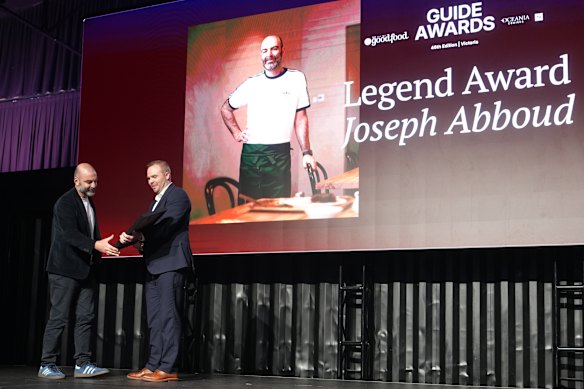
Abboud made his way to the stage, collected his certificate and gave an off-the-cuff speech that ended up being an impromptu vote of confidence in his field of choice. “The hospitality industry gets a lot of shit,” he said. “But I love it.”
He also noted that he’d never been invited to a Good Food Guide awards before. Oh – awkward. Rumi has been a perennial inclusion in the Guide but because it never earned a hat or a prize, the owner didn’t make it to the guest list until this year’s gong.
“Rumi has an interesting standing,” he says over today’s lunch. “I know we are well respected, but we’re like the nice cousin. We don’t make waves. It bothered me in the early days, but you get to a point where you stop waiting for approval and get comfortable with what you’re doing.”
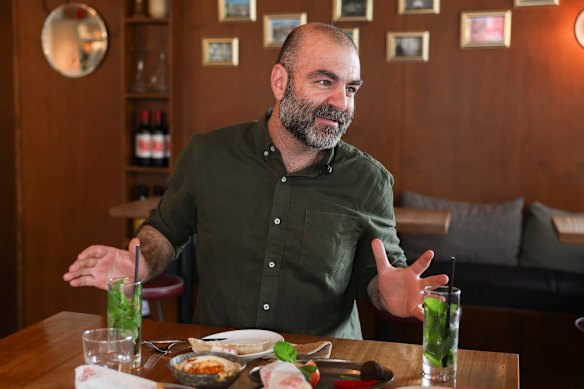
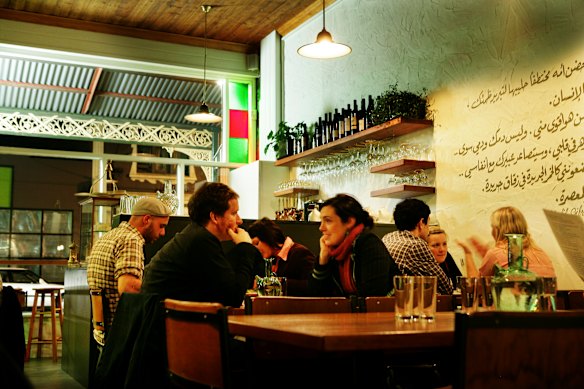
We’re sitting on stools at one end of the large communal table at Rocket Society. It’s a typical Wednesday afternoon in Melbourne springtime. Steely sunshine on gunmetal clouds is followed by sheeting rain that clears to birdsong, even in the medium-rise cluster of retail, restaurants and residences that makes up this modern village.
At 6pm, BYO Record Night will begin: anyone can bring in a favourite vinyl disc and add it to the stack that will be spun for the room. Locals will order skewers, swipe flatbread through toum, dunk fries into “tahinaisse”, maybe share a bottle of orange wine from the Bekaa Valley in Lebanon with friends old and new.
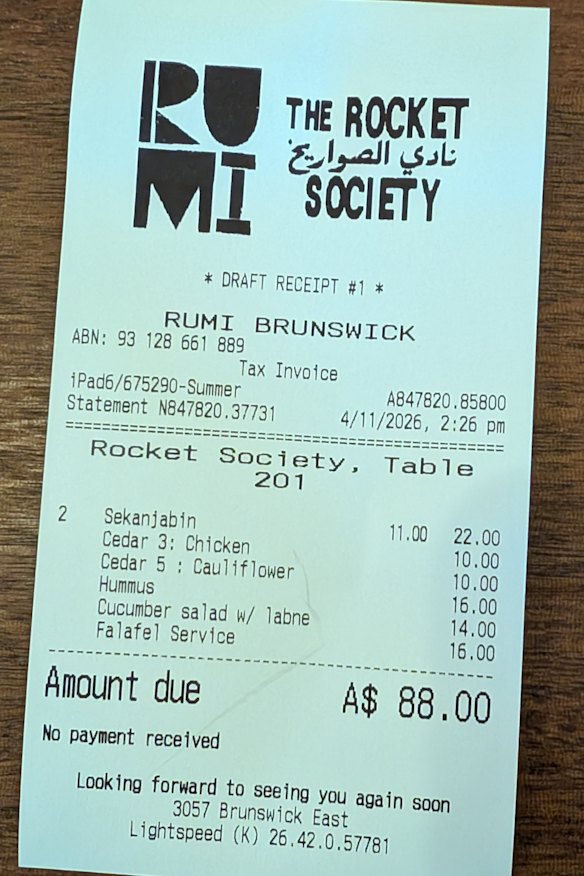
We’re eating from the daytime menu and the table fills with food. There’s a falafel plate with pickles and tahini, roughly chopped cucumber tumbled with labne to make a fresh, chunky salad, hummus under a little mound of spice-buttered chickpeas, and some $10 filled pita rolls called “sondwishes”, just as they would be in Lebanon.
I reach for the sondwish with cauliflower, a blackened floret peeping from its flatbread nest. I’ve loved this cauliflower for 20 years, ever since I ate it in the first little Rumi. Like many customers back in the day, I looked at the cauli with uncertainty. Was it … burnt? But then I tried it and learnt something about cooking.
It’s the same today. The tiny cluster of black buds is crunchy and caramelised, a canny balance of sweet and bitter on the edge of ashen oblivion. The stalky bits are soft and juicy, as though the liquid at the perimeter has shrunk back inside to preserve itself, concentrating the flavour. Slow-cooked onion, tahini and rocket add to the bright culinary cacophony. Is there a better $10 bite in Melbourne?
“The cauliflower is a very clear inspiration from mum’s cooking,” says Abboud. “The way I cook is influenced by mum’s warmth and generosity. She’s not a fine cook – she does things that taste good and make you feel good.”
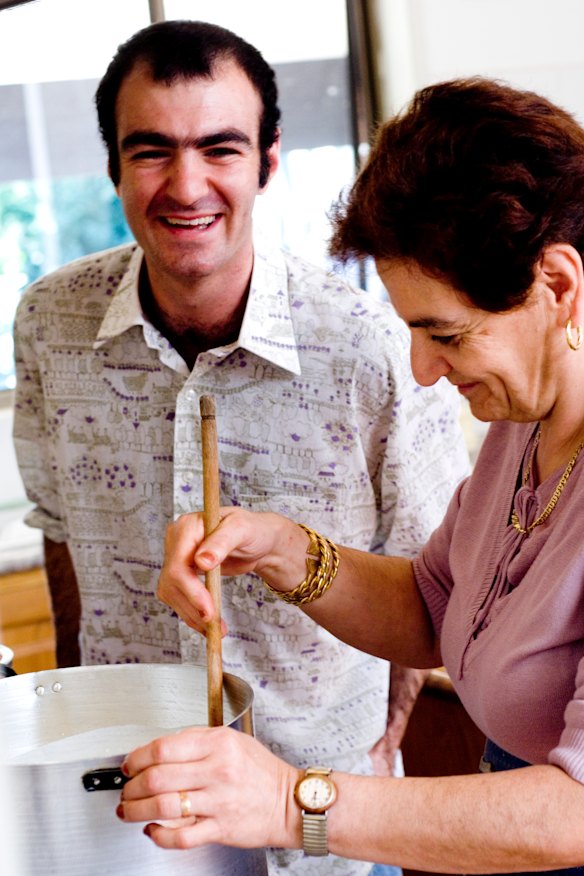
His mother, Malaky, has always cooked so her family could eat.
“We never used to speak about what we were eating or dissect it,” remembers Abboud. “It was either good or not good.”
Abboud didn’t love her cauliflower when he was little, but it slowly grew on him. “And then when we opened Rumi, everything was golden brown, so we kept the cauliflower in the fryer longer and longer until it felt right.”
Building a career in food was very far from the legend’s plan. He grew up in Craigieburn, the youngest of four, and his parents ran fish-and-chip shops nearby. Early cheffing indications weren’t promising. “I was uncoordinated,” he says. “I couldn’t even pick up a spatula to squash a hamburger.”
Still, after leaving school in year 11 in 1993, he followed a couple of mates into work at city restaurant Oz Frog. It was dodgy. “We’d get $50 a week if we were lucky and think, ‘Oh well, maybe next week we’ll get paid.’”
One day, he showed up for a shift and the doors were chained shut: the employees weren’t the only ones missing out. There was a spark, though, and Abboud started working his way around pubs and pizza places, eventually talking himself into a job at late-’90s proving ground Est Est Est. Co-owner Donovan Cooke pushed the young chef hard.
“The pressure was full on, but he taught me work ethic and quality control,” says Abboud. Stints at hatted restaurants Circa and Ondine followed, then a period at wood-fired pizza originator Ladro, while the idea for Rumi slowly solidified.
A journey along the Silk Road as a 23-year-old was formative. “I wasn’t thinking of it as a research trip, but I felt at home as soon as I hit Iran, and it awoke something in my soul,” he says. “I soaked up the warmth and generosity. There’s a constant giving of food, as communication, as a show of care.”
One day in Isfahan, a man befriended him on the street and insisted on taking him for dinner. “We jumped on a bus in daylight and arrived in the middle of nowhere in the dark,” says Abboud. The man led the young traveller to his sister’s place.
“He hadn’t visited her for a year but somehow thought it was OK to bring a random foreign guy for dinner.” And it was. “I was welcomed with open arms, the table filled with food.”
‘I felt at home as soon as I hit Iran, and it awoke something in my soul. I soaked up the warmth and generosity. There’s a constant giving of food, as communication, as a show of care.’Joseph Abboud
His travels continued through Syria, then Lebanon and Turkey, and he discovered more similarities than differences across borders. “It was so inspiring,” he says. “I wanted to learn more and share more.”
Undoing Middle Eastern tropes has been an abiding motivation too. “We all know the stories of the angry, terrorist Arab,” says Abboud. “But that trip showed me there were other stories that weren’t being told.”
Abboud embedded the alternative narrative in Rumi, that “pinnacle of generous hospitality”.
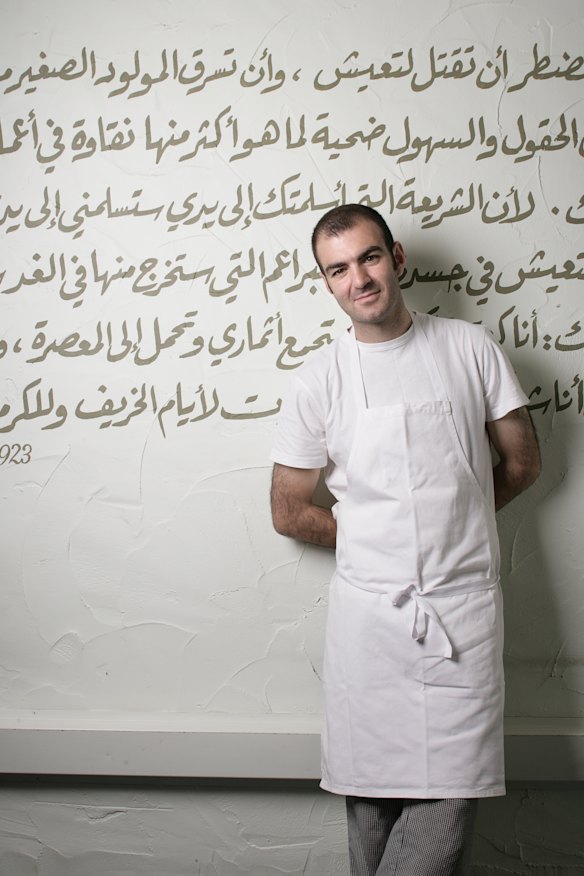
As I finish my cauliflower in pita, Abboud reflects on two decades of responses to this signature veg. “We don’t get many people telling us it’s burnt any more,” says Abboud. “Melbourne has changed. Diners eat more confidently. They ask fewer questions.”
That’s partly a product of an overall higher calibre of restaurants.
“You have to try pretty hard to get a shit meal these days.” On the other hand, he doesn’t think Melbourne’s dining public is as adventurous as we might hope we are. “People don’t always go for new things,” he says.
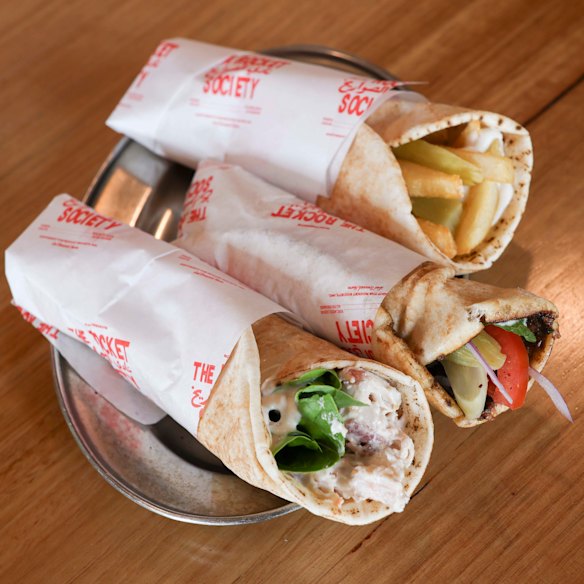
Rocket Society’s sondwishes and skewers have been a slow burn. “This isn’t a standard wine bar but not everyone gets it,” says Abboud. “One of the staff even asked whether we should serve anchovy on toast.”
The tinned fish snack is a European wine bar staple, so ubiquitous that it’s a cliche – a delicious one, and I’ll still order it, but it doesn’t fit here. Abboud tells his version of a horror story: “I saw a dish on Instagram that I thought at first was ours, but it was at another restaurant.” The dish was a skewer with a condiment piped on top in a picturesque squiggle.
“Chefs are influenced by what they see online,” he says. “They don’t even copy consciously – it just happens. Straight away I said to everyone, ‘You’re not piping anything onto the plate any more. Stop.’”
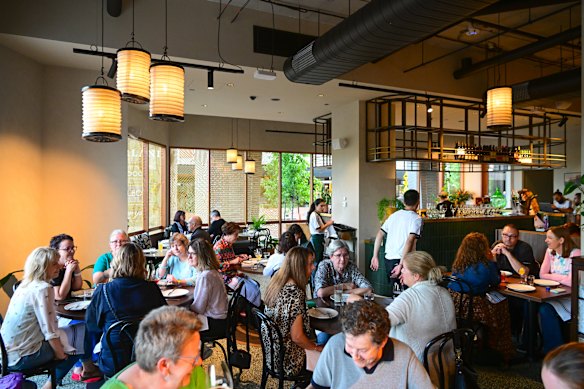
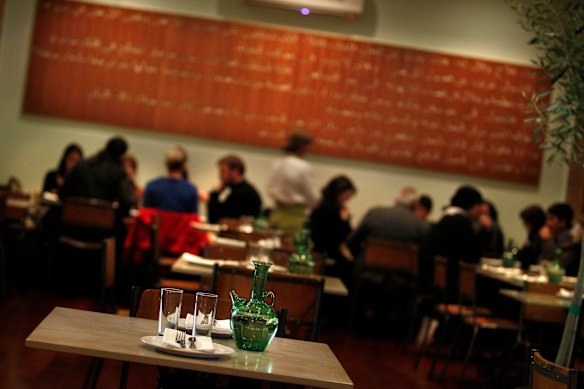
Next door at Rumi, the classics are bolted to the menu and regulars stick to the tried and true. “The challenge then is to keep the quality because chefs get bored making the same food all the time.”
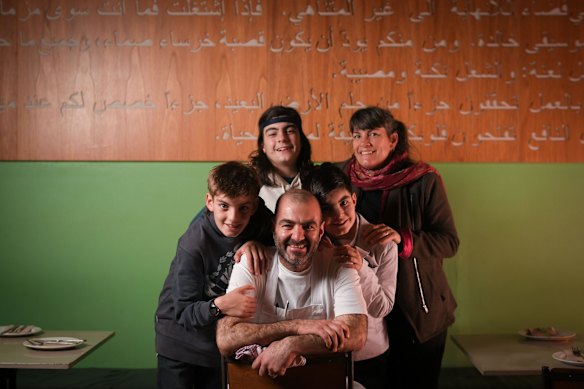
On that score, Abboud has some trusty lieutenants: his teenage sons Malachy, Patrick and Percy, all of whom have worked at Rumi since their little fingers could peel a prawn. “They have been eating this food their whole lives,” says Abboud. “When something is different, they’ll tell me. One might say, ‘The meatballs don’t taste the same today.’ Oh, really? So I go check.”
The meatballs are made with lamb mince, medium-grain rice, parsley and advieh, a spice mix that includes cinnamon and rose powder. A bedrock Rumi dish, I’ve eaten them at every iteration of the restaurant and always been beguiled by their charms.
Straightforwardly meaty on first mouthful, the lamby flavour emerges from a simple tomato sauce that the meatballs are cooked in, followed by lifted spice notes – pepper and cumin, saffron and rose – all held in confident suspension by the rice. When they’re good, they’re amazing, the epitome of a hug in a bowl.
“But the most common problem is they get too firm, which happens if the rice is less cooked to begin with, or there might be a seasoning imbalance,” Abboud tells me. “You don’t necessarily get to the bottom of it, but everyone revisits the recipe.”
The rigour becomes a lesson about the soul of a successful chef, or his food anyway.
“When chefs start here they often don’t take the meatballs very seriously,” he says. “I say to them, ‘Look, this is the story of Rumi. It’s simple, it’s tasty, but if you don’t look after it, it will let you know.’”
This detail and care is aligned with a broader philosophy that Abboud instils in his team. “Every once in a while, I’ll address the staff. I remind them that people could go to so many restaurants tonight but they’ve chosen to come here,” he says. “Think about times when you go out, you’ve dressed up, you feel great. We’re here to give people a good time.”
It’s an extended version of his brief paean to hospitality on stage at the Good Food Guide awards. “Whatever the food may be, whatever the atmosphere is, however it’s changed in 20 years, the essence is the same: you’re looking after people. It’s a pretty honest craft.”
The winners of the 46th Age Good Food Guide Awards, presented by Oceania Cruises and T2 Tea, were announced on October 12.
The home of the Good Food Guide, the app is free for premium subscribers of The Age and also available as a standalone subscription. You can download the Good Food app here.
Disclaimer : This story is auto aggregated by a computer programme and has not been created or edited by DOWNTHENEWS. Publisher: www.smh.com.au