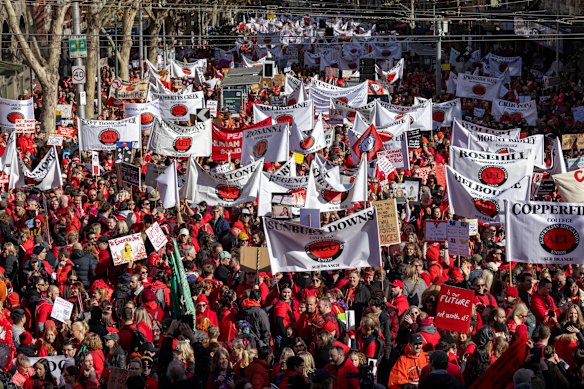
Victoria’s powerful education union has kept alive the prospect of further strike action as its leadership pushes its message that the battle with the government is not just about pay but improved funding for state school students.
Thursday’s industrial action, the second walkout this year, saw about 20,000 teachers, principals and education support staff clog Melbourne’s CBD in a river of red that flowed to Parliament House.
Most of the state’s 1570 government schools were operating, but the majority did not have the staff to offer classes to the fraction of students who attended.
Speaking to the crowd from the steps of parliament, Australian Education Union Victorian President Justin Mullaly warned of more industrial action if the government failed to budge on funding state schools and education staff.
“We will escalate our campaign if we need to,” he told thousands of applauding educators.
“We will stop work again if we need to, to keep the pressure on this government to get the outcome that we need to see, that Victoria needs to see.”
Union members have rejected multiple offers from the state government, which was hoping to resolve the dispute in May, after reaching an in-principle agreement that would have seen teachers’ wages rise between 28 and 32 per cent over four years.
That offer was rejected, as was last week’s offer of 28.3 per cent over four years, which came with improved conditions for education support staff. But the protracted campaign has also placed internal pressure on the union.
No date had been set for negotiations to resume, and it remained unclear what the government could change to get an offer over the line.
Mullaly was keeping his cards close to his chest, conceding there was a range of competing expectations from members.
Union leadership has been battling to keep its Left faction in line to present a united front when negotiating.
The faction escalated its split from leadership on Thursday by promising to raise a motion to strike again within a fortnight, and every subsequent pay cycle, until its demands are met.
The Fight the Crisis group has pushed for class-size reductions, reduced teaching time, an equal pay rise for teachers and support staff of 35 per cent over three years and better conditions for education support staff.
The group of rank-and-file unionists promised to take the motion to its sub-branches, regions, councils and union networks.
A second motion it promised to put forward demanded the inclusion of its members in the bargaining team with the government.
Union officials, who initially asked for a 35 per cent increase over three years when enterprise bargaining began, have not named a new figure.
But while the government has moved on pay and some conditions – including cutting meeting hours in half – the union and its membership want more.
Among the unresolved issues are improved pay recognition for employees at the top of their salary range; reduced class sizes; increased pay if inflation is more than annual pay rises; increased planning and preparation time; and more work flexibility, including working from home when possible.
Livingstone Primary School teacher Maddi Vantarakis said the mood among members and their supporters was “cautiously hopeful”.
“It’s a long time since we’ve done this. We’re not just rolling over this time,” she said, adding that education staff would have no hesitation in striking again.
“Fund the schools so we can do our job, and I’m not having to go out to Kmart every other day to buy things to help my kids learn.
“While it takes a toll on our own hip pocket…we’re fighting for the kids,” she said.
A stubborn sticking point has been the government’s insistence on a four-year deal, rather than the union’s preferred three-year deal.
“It’s also clear to me that they want support and relief from excessive workload. They want investment that will see more staff in our schools, which equals more support for students,” Mullaly said.
Victoria’s Deputy Premier and Education Minister Ben Carroll kept a low profile on Thursday, reiterating that the revised offer of 28.3 per cent over four years would make Victoria’s educators the best paid in the country.
He said that his door was always open to the union leadership.
“The best way to recognise the work of our teachers and education support staff is good pay and conditions,” he said.
An agreed pay deal would allow the government to sign the long-awaited Better and Fairer Schools Agreement with the Commonwealth, which would bring the state’s schools up to the minimum funding standard.
The deal dates back to November 2023 when the Victorian and Commonwealth governments signed an agreement which committed Victoria to provide 75 per cent of the School Resource Standard by 2028. This is the amount of state government funding a school requires to meet the needs of its students under the Gonski reform model.
Victoria quietly abandoned this commitment four months later and is not planning to reach the benchmark until 2031.
Victoria and the Commonwealth are still negotiating on the terms of the agreement, while every other state and territory has signed a long-term funding deal.
While the Victorian government argues that the impasse on signing an in-principle agreement on salaries is stalling the signing because the majority of funding goes towards wages, that is disputed by the union.
A government spokesperson said Victoria led the way in advocating for the Commonwealth to lift its funding for public schools, repeating the Allan government’s often-stated position that the priority is that “every child, no matter where they live, has access to a world-class public school”.
The government says negotiations with the Commonwealth are ongoing so it’s inappropriate to comment further.
Federal Education Minister Jason Clare, who is standing by to ratify the Better and Fairer Schools Agreement, said teachers deserved to be paid as well as they could be.
“We want to make sure that our teachers are paid what they deserve, as well as taking some of that unnecessary admin burden off them, so they get more time to teach,” he said.
Opposition Leader Jess Wilson said the fact that negotiations remained unresolved reflected poorly on the government.
She would not be drawn on what a Liberal government would offer teachers, should the party win the November election and the teacher dispute remained unresolved.
Be the first to know when major news happens. Sign up for breaking news alerts on email or turn on notifications in the app.
 Bridie Smith is an education reporter at The Age. A former desk editor, she has also reported on science and consumer affairs.Connect via X, Facebook or email.
From our partners
Disclaimer : This story is auto aggregated by a computer programme and has not been created or edited by DOWNTHENEWS. Publisher: www.smh.com.au