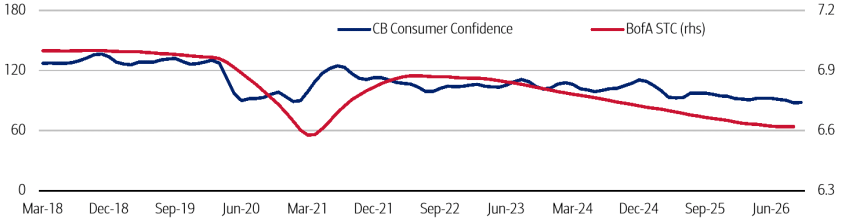
American shoppers are hunting for cheaper stores harder than at any point since the pandemic-throttled period of early 2021, according to Bank of America card data. By BofA’s measure, they’re trading down more now than at any point since 2022, including June of that year, when inflation peaked at 9.1%, the biggest jump in more than 40 years.
It should make for a particularly diminished holiday spending season, as millennials and Gen Z come of age in the economy of the 2020s. The two cohorts now account for 50% of holiday spending, a first in Deloitte’s annual holiday survey, and both groups are planning double-digit increases this year.
At the same time, BofA finds that since 2022, millennials have been trading down faster than Gen X or baby boomers, particularly in apparel and groceries, “suggesting greater sensitivity to rising costs.” Apparel shows some of the clearest trading down overall, and the bank said some households may be putting off clothing purchases and “shopping closer to need.”
BofA Institute’s Spending Tier Composite, built from card and deposit data on apparel, dining, groceries and travel, tracks how much spending goes to value-tier merchants. It “suggests consumers are trading down at the highest level since 2021,” the bank wrote Nov. 9. “Rather than spending less, many appear to be changing where – and how – they spend.”
Courtesy of Bank of America Institute
Hunting for deals doesn’t mean spending less. Deloitte classifies 38% of shoppers as “holiday value seekers” who chase promotions, redeem rewards and buy store brands. They expect to spend 12% more than other shoppers. Gen Z and millennials also report better household finances than a year ago, after pulling back last year, Deloitte said.
In Deloitte’s survey, households earning $200,000 or more plan to spend $3,607 on the holidays, more than five times the $693 planned by households under $50,000. Goldman Sachs economist Pierfrancesco Mei recently wrote that benefit cuts, softer nominal wage growth and bigger exposure to gas prices weighed disproportionately on lower-income households in 2026. Middle- and higher-income households held up better because they captured most of the boost from last year’s One Big Beautiful Bill Act.
A $1 trillion holiday, half of it prices
The National Retail Federation expects November and December retail sales to grow 4.2% to $1.01 trillion, after a 3.1% gain last year. NRF chief economist Mark Mathews said “inflation, rising gas prices and pressure on household spending will affect consumers differently across income groups.”
Mastercard SpendingPulse forecasts 5.5% growth from Nov. 1 to Dec. 24, excluding autos and gas. It estimates “about half the growth in spending will be due to higher prices.” In other words, it’s only bigger on paper; it won’t be a holiday season full of more stuff, just more expensive stuff.
In NRF’s October survey of 8,094 adults, 56% said the economy will affect their holiday spending. Among those, 43% plan to shop sales more often. Discount stores are on the list for 43% of all holiday shoppers.
Real disposable income fell 0.3% in September, and PCE prices were up 3.6% from a year earlier, according to the Bureau of Economic Analysis.
Goldman’s bet
Goldman expects spending to hold up anyway. In a Nov. 9 note, Mei estimated spending will rise 2.5% in 2026 (fourth quarter over fourth quarter) and 2.2% in 2027. He called the consumer “more resilient than looked likely when the Iran war began and energy prices spiked.” Higher inflation hasn’t been matched by faster wage growth this year, so Goldman forecasts real disposable income growth of just 1.4% in 2026. It expects that to pick up to 2.3% in 2027 as price pressure from tariffs, energy and AI-related costs fades, and as higher net interest income and cost-of-living adjustments to Social Security and other transfers kick in.
The cushion is thinner than in 2021. The personal saving rate hit 26.2% in March 2021, the month the third round of stimulus checks began going out, and was still 6.8% that December, according to BEA data compiled by the St. Louis Fed. It was 3.8% in September. Goldman estimates the true rate is “closer to 5%” once timelier source data are counted.
Spending has also had help from the stock market. Goldman estimates the wealth effect added over 0.4 percentage point to spending growth in 2026. It expects about half that next year, and says the effect “could weigh on spending if AI-related stocks continue to decline.”
Travel is the exception in BofA’s data. There, some households “may be opting out of trips entirely rather than shifting to lower-cost options.”
Generative AI was used for research assistance and/or transcription of this article. The reporter independently reported and verified the factual claims in this article, and a human editor reviewed it before publication.
Disclaimer : This story is auto aggregated by a computer programme and has not been created or edited by DOWNTHENEWS. Publisher: fortune.com