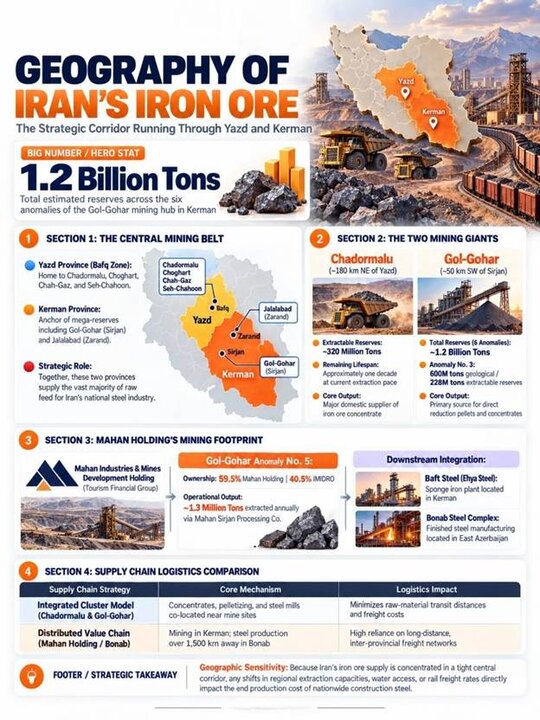
The strategic corridor traversing Yazd and Kerman forms the backbone of Iran’s steel industry, anchored by massive deposits including the 1.2-billion-ton Gol-Gohar mining hub in Kerman. Operational development across this mineral belt is driven by two competing logistical frameworks: co-located integrated clusters and nationwide distributed value chains.
An analysis of Iran’s mining geography highlights the central corridor as the critical foundation of domestic steel feedstock:
1. The Central Mining Belt and Key Upstream Producers:
Yazd Province (the Bafq zone, home to Chadormalu, Choghart, Chah-Gaz, and Seh-Chahoon) and Kerman Province (anchored by Gol-Gohar in Sirjan and Jalalabad in Zarand) collectively supply the vast majority of raw feed for national steel manufacturing. Chadormalu, holding approximately 320 million tons of extractable reserves and an estimated operational lifespan of roughly one decade at current extraction rates, serves as the primary domestic supplier of iron ore concentrate. Conversely, the Gol-Gohar hub commands an estimated 1.2 billion tons across six anomalies—highlighted by Anomaly No. 3 with 600 million tons of geological and 228 million tons of extractable reserves—functioning as the principal source for direct reduction pellets and concentrates.
2. Mahan Holding’s Footprint and Downstream Integration:
Within this corridor, Mahan Industries & Mines Development Holding (Tourism Financial Group) holds a 59.5% controlling stake in Gol-Gohar Anomaly No. 5 alongside state-owned IMIDRO (40.5%). Producing approximately 1.3 million tons annually through Mahan Sirjan Processing Co., the holding channels this output into an integrated downstream network: supplying the Baft Steel (Ehya Steel) sponge iron plant in Kerman and feeding the Bonab Steel Complex in East Azerbaijan for finished steel manufacturing.
3. Logistics Models and Supply Chain Sensitivities:
While Chadormalu and Gol-Gohar utilize an “Integrated Cluster Model” by co-locating concentrators, pelletizing plants, and steel mills near extraction pits to minimize transit distances and freight tariffs, Mahan Holding employs a “Distributed Value Chain”. This operational structure connects extraction in Kerman with manufacturing facilities in Bonab situated over 1,500 km away, creating high reliance on long-distance, inter-provincial freight networks.
Because Iran’s iron ore resources are concentrated in a tight central corridor, regional variations in extraction capacity, water availability, or rail freight tariffs directly affect the end production cost of construction steel nationwide.
Disclaimer : This story is auto aggregated by a computer programme and has not been created or edited by DOWNTHENEWS. Publisher: tehrantimes.com