Germany’s interior minister announced plans to toughen laws just two days after an extremist attack on Berlin’s Pride parade. Within the justice system, however, voices warn against hasty action without first bringing a deeper investigation.
Following a deadly vehicle and machete attack near Berlin’s Pride parade that was blamed on an extremist militant, politicians, security experts and a police union asked why the suspect was walking free and not under close surveillance despite previous convictions and known sympathies for the Islamic State (IS) terrorist organisation.
Abdul Ballout, 21 – who was shot dead by police on Sunday – had been convicted of several crimes, including causing bodily harm, and had been arrested in Berlin after reportedly unsuccessfully trying to join IS in Syria before he carried out the fatal attack in Tiergarten park on Saturday night.
READ ALSO: Everything we know about the deadly attack on Berlin’s Pride parade
Speaking to Bild on Monday, Germany’s Interior Minister Alexander Dobrindt announced plans to toughen laws, including the increased use of electronic ankle monitors and preventive detention for individuals classified as security threats.
Conservatives, police union call for tougher security
Dobrindt, of the conservative Christian Social Union (CSU), also called for a reform of juvenile criminal law, which in Germany can cover defendants for offences committed up to the age of 20. He said that “applying juvenile criminal law to adult individuals posing a security threat is unacceptable”.
In this case, the now 21-year-old suspect had been tried under juvenile criminal law.
Speaking to ARD’s Tagesthemen, Dobrindt suggested the dangerous people should more often be held in preventive detention. “There are very different regulations in the police laws of the states,” he added.
Dobrindt did not say when such a bill may be introduced.
The interior minister was joined by others from his conservative party in immediately calling for tightening of laws and criminal proceedings.
Marc Henrichmann, a CDU Member of Parliament, who chairs the parliamentary committee supervising intelligence agencies, said that tougher measures were necessary.
The head of Germany’s police officers’ association, Dirk Peglow, also charged that the justice system had been too lax with Ballout.
“With people who pose such a threat, the end of their time in detention must not be the end of state supervision,” he said, also speaking to Handelsblatt.
Speaking on radio station Deutschlandfunk, Güner Balci — the integration commissioner for Berlin’s Neukölln district, home to a large Muslim population — called for the closure of certain mosques “to send a clear signal”.
Notably, Germany’s major Islamic associations, such as Turkish-Islamic Union of the Institute for Religion (DITIB) and the Islamic Community Millî Görüş (IGMG) have condemned the attack.
“Anyone who attacks, murders or puts people in fear is not acting in the name of Islam, but is following an inhumane delusional ideology,” said IGMG Secretary General Ali Mete.
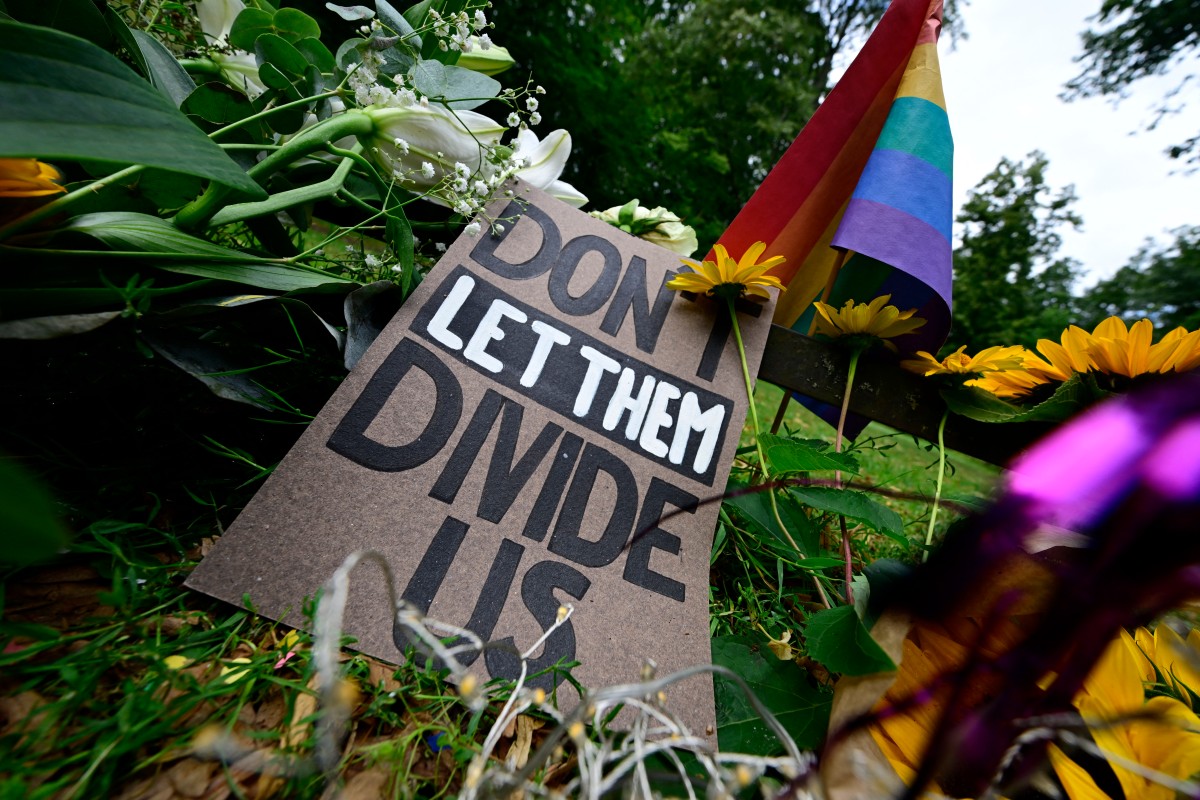
Flowers and a sign with the lettering ‘Don’t let them divide us’ placed in tribute to the victims at the Tiergarten park in Berlin on July 27, 2026. (Photo by John MACDOUGALL / AFP)
Leading justice urges deeper analysis first
Meanwhile, some voices have warned against fast action before investigations are concluded.
Anna Gallina, Chair of the Conference of Justice Ministers, reacted cautiously to immediate proposals for tightening the law. Speaking to Funke media group, she said that following the attack, the first priority needs to be an intensive reappraisal of the way cases like these are handled — before policy decisions are made.
“Fast demands may look striking, but they do not do justice to the situation without intensive prior analysis,” Gallina said.
Fuel for the far-right
Within Berlin’s LGBTQ+ community, many have shared concerns that Germany’s far-right leaders will try to politicise the attack and weaponise grief to fuel their anti-immigration and Islamophobic platform.
These concerns were made clear by some who attended a vigil on Sunday at Brandenburg Gate, which was held in solidarity with the victims.
Banners seen at the vigil said, “My queer grief won’t be instrumentalised for your Islamophobia,” and, “Rage, grief, no racist interpretations.”
READ ALSO: ‘The fight continues’ – How Berlin is reacting to the deadly Pride attack
In an X post, the AfD’s co-leader, Alice Weidel, accused Chancellor Friedrich Merz of insufficient action against “migrant violence.”
Merz himself said on Monday that it was “too early to say what political conclusions we will draw from this brutal attack, but it is clear that we will have to go beyond just announcements”.
The chancellor also said, “We must do everything we can to limit the freedom of movement of such potential criminals as much as possible,” and added that all possible consequences should be examined.
According to a report by Welt, he suggested this could include revoking German citizenship from dual nationals. Interior Minister Alexander Dobrindt was asked to prepare a statement about these potential consequences in the coming days.
With reporting by AFP.
Disclaimer : This story is auto aggregated by a computer programme and has not been created or edited by DOWNTHENEWS. Publisher: thelocal.de