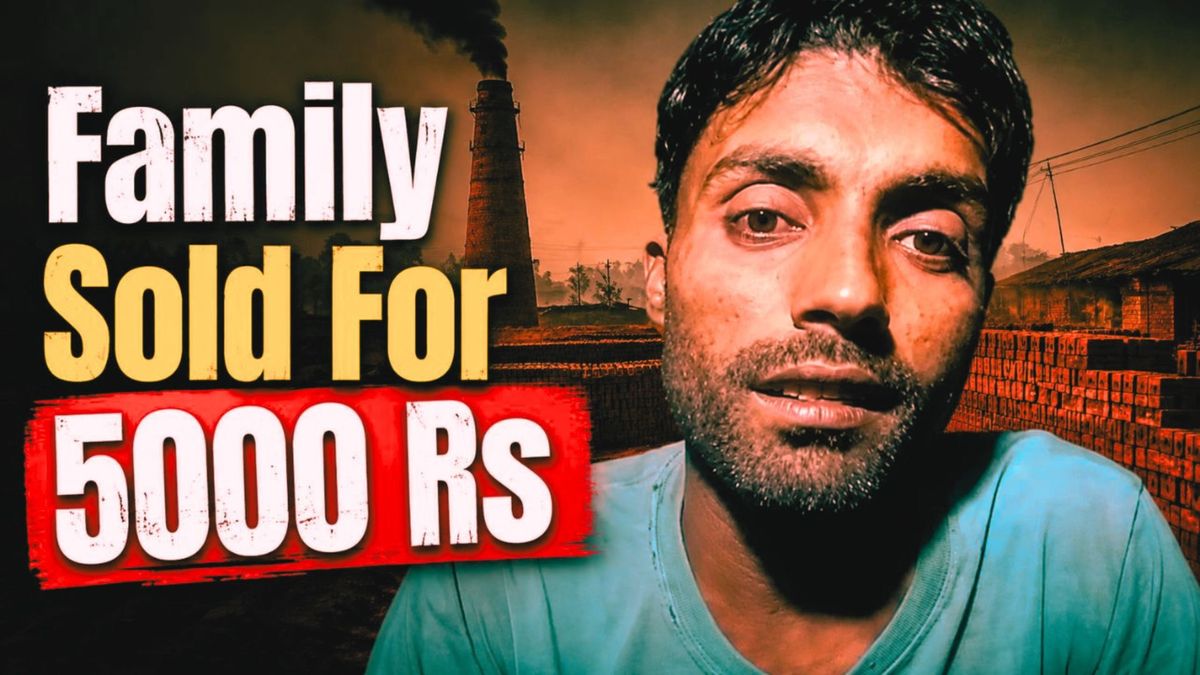
In a modest office at the Labour Commissioner’s headquarters in Ghaziabad, a piece of paper changed everything. Gulfam held his release certificate with trembling hands—proof that six months of bonded labour had finally ended. He had waited two hours in the queue before they called him inside. Two hours for a document that should never have been necessary. Two hours for what amounts to an admission: your family was trapped, exploited, and the system failed to protect you.
This is not the beginning of Gulfam’s story. The Probe first reported his case in April 2025, after he was rescued from Satyam Brick Kiln in Loni, Ghaziabad, working under conditions that defy description. Now, with the release certificate in hand, we return to document the aftermath—and the questions that remain unanswered.
Also Read: Saharanpur Bonded Labour Crisis: Children Expose Exploitation
The ₹5,000 Advance That Trapped a Family in Bonded Labour
It started simply enough. A man approached Gulfam with an offer: work at a brick kiln in Ghaziabad with a ₹5,000 advance to help with immediate needs. His wife was pregnant. Money was tight. The advance seemed reasonable.
“They first said they will give us 600 rupees per day for the labour,” Gulfam recalls, his voice steady but weighted with memory. “I told them that I can’t relocate and work like that as I am already in debt of 5000 rupees. So they said we will give you 5000 and clear your debt. So they gave me 5000 rupees in advance. Then they told me that after 10 days we will give you 50,000 rupees.”
He worked with hope. Days passed. Then weeks. Then months. No wages came.
“It was almost like they had purchased my entire family for 5000 rupees,” Gulfam says, and the phrase hangs in the air—a bonded labour arrangement so complete, so total, that it felt like human trafficking disguised as employment. “And we couldn’t escape. We were like prisoners there.”
The brick kiln was owned by a man known as Pappu Pehelwan. The contract was never written. The promises were never kept. The ₹5,000 advance—meant to help a family in crisis—became the chains that bound them to Satyam Brick Kiln for half a year. This is how bonded labour works in Ghaziabad’s informal economy—and across much of India: not through explicit agreements, but through the slow suffocation of debt, surveillance, and the complete erasure of choice.
Child Labour, Forced Work, and No Wages: Inside Satyam Brick Kiln in Ghaziabad
Gulfam’s wife was pregnant at the time they were at the brick kiln. He says, the kiln owners did not care.
“My wife was very weak. Even during pregnancy, they made her work,” Gulfam notes. “If she needed medicine, they would just give her a ₹2 tablet. They never allowed us to go out and get treatment for my wife. They would not enable medical treatment either.”
But the cruelty extended beyond his wife, he states. Their children—five years old and three years old—were forced to work. Even his newborn daughter, only five days old, was present in those conditions.
“They would ask my children to lift bricks and help with labour work,” Gulfam says, and the words carry the weight of a parent who could not protect his own children. “My newborn daughter was only five days old. Even during my wife’s pregnancy and after childbirth, she was made to continue working.”
In the final month of pregnancy, Gulfam’s wife went into labour. It was after 9 PM. They had just finished work. The kiln owners called an ambulance and rushed her to the hospital—a moment of mercy that dissolved instantly.
“I told them I wanted to accompany my wife, but they said: ‘What will you do there?’ They took her alone,” Gulfam says. His wife gave birth without her husband.
When Gulfam asked for wages, he alleges he was beaten. “If I asked them for wages, they would beat me up. Even when I had a fever, I was forced to work.” He tried negotiating for medicine for his mother, who fell critically ill. “I didn’t even ask for the full wages they owed me. I just asked them for money to buy medicines. But they refused to give me any money.”
Also Read: Ludhiana Brick Kiln Horror: Bonded Labourers Sold and Assaulted
Escape Attempts and Surveillance: The Reality of Bonded Labour in Modern India
After three months at the Ghaziabad brick kiln, Gulfam began asking for wage slips and records of his work. According to Gulfam, whenever he asked for wage records, kiln operators told him they would provide them later.
“That’s when I realised they had trapped me,” he says.
By then, escape had become his obsession. He tried multiple times. “One night around midnight, I tried to leave with my wife and children. But there was constant surveillance. Whenever I tried to leave, someone was awake and watching. They had guards monitoring workers. They had heavy security deployment and they wouldn’t let us escape.”
This is not historical slavery. This is not a story from the 1800s. Gulfam’s case at the Ghaziabad brick kiln is not isolated. Across India, bonded labour survivors have described being trapped through debt, surveillance, withheld wages, and restrictions on movement.
Gulfam’s rescue came through determination and a single phone number. Somehow, he obtained the contact of Nirmal Gorana, a labour rights activist. He called. He explained everything. Gorana responded immediately.
“Because of him, I was rescued and taken home,” Gulfam says. “A lady from The Probe spoke to the government officials when I was not getting the release certificate after my rescue.”
The rescue marked an end to the physical bondage. But the legal battle was far from over.
Release Certificate Received — But Justice Remains Incomplete
Gulfam has finally received his release certificate from the Labour Commissioner’s office in Ghaziabad. He waited two hours. He stood in line. He received a piece of paper acknowledging that he had been bonded, that he had been a victim, that he had been freed.
“I went to the Labour Commissioner’s office many times but then I couldn’t get the certificate. Finally, The Probe spoke to the officials. The officials asked me to meet them after 8 days. When I reached there, I waited for two hours. Then they called me inside and handed me the release certificate,” he says.
It should have been a moment of complete victory. Instead, it feels incomplete.
When asked about compensation—what the government had promised to make this right—Gulfam’s answer was stark: “No. I don’t know anything about compensation.”
Six months of forced labour. A wife forced to work during and after childbirth. Children forced to lift bricks. A newborn present in conditions no infant should endure. And no compensation plan, no pathway to recovery, no acknowledgment of the damage done.
The release certificate proves the bonded labour happened. The law says workers who experience bonded labour are entitled to rehabilitation and compensation. But in practice, in Ghaziabad as elsewhere in India, victims are left to navigate a bureaucracy that moves slowly, if at all.
When asked what he would tell the District Magistrate if given the chance, Gulfam’s response was not angry. It was not a demand for punishment or compensation. It was a plea for the most basic dignity:
“I would tell them only one thing: Workers should receive their wages on time. If labourers are working honestly, they should be paid fairly. That is all we want.”
Also Read: Hardoi Tragedy: Trafficked Teen Killed, Family Forced to Flee
The Larger Picture
Gulfam holds his release certificate—a piece of paper that, according to the National Human Rights Commission’s May 2021 advisory, must be issued within 24 hours of rescue and serves as the key to unlocking immediate financial assistance and rehabilitation. But when we asked him about compensation, he had no answer: “No. I don’t know anything about compensation.” No government official explained what the certificate meant. No one briefed him on his entitlements, the timeline for payments, or the rehabilitation process. His wife, who was forced to work during pregnancy, has received no trauma counseling or medical rehabilitation. His children, aged five and three when they were made to work at the kiln, have had no psychological assessment, no counseling to process the trauma, no educational support. The release certificate is real. The roadmap for what comes after it is not. The Probe had to intervene—alongside labour activist Nirmal Gorana—to get the certificate issued at all. Without media attention, without civil society pushing, Gulfam’s case would have languished.
The brick kiln owners and staff who inflicted this horror—locking the family in surveillance, beating Gulfam for asking wages, forcing his children to work—have not been arrested. They have not been prosecuted. They remain free. This is not an exception in Ghaziabad’s brick kiln industry; it is the rule.
Across The Probe’s previous reporting on bonded labour cases, we have documented the same pattern: criminal proceedings are rarely initiated against bonders. When an FIR is registered, brick kiln owners face minimal penalties and continue operating. In Gulfam’s case, there has been no detailed investigation into how many other families were trapped by the same owner, how many other children were forced to work, or how to prevent future exploitation at the same kiln. The investigation has been narrow, reactive, and incomplete.
What happened to Gulfam represents a larger failure: bonded labour law in India works in a cosmetic way. The real questions are never asked. The brick kiln owner is never fully prosecuted. The conditions that created the bondage remain untouched. Gulfam has his freedom. His children still have nightmares. His wife still struggles with health complications. And somewhere in Ghaziabad, another family is walking into the same ₹5,000 trap.
Disclaimer : This story is auto aggregated by a computer programme and has not been created or edited by DOWNTHENEWS. Publisher: theprobe.in