Sam Dean
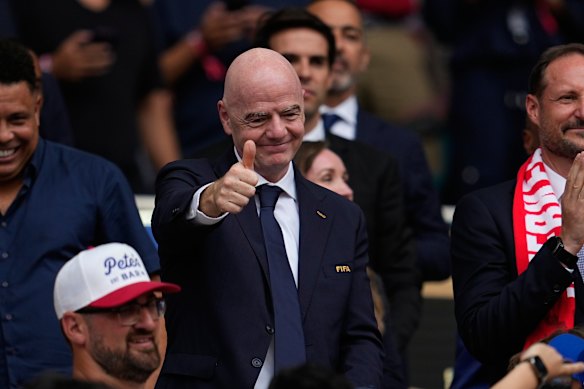
The rebellion against Gianni Infantino’s plan to sell stakes in the World Cup has led to influential figures in football scrambling to oppose the FIFA president’s scheme.
Infantino is an increasingly prominent figure on the world stage, thanks in no small part to his close relationship with Donald Trump, but that does not mean he is all-powerful.
Here are the ways in which Infantino’s plot to sell the “soul” of football, as European governing body UEFA described it, could potentially be blocked.
Kill the competition with a boycott
What would the World Cup be without European nations? It is a question that FIFA will have to consider should UEFA’s threat of a boycott materialise. Lobbying is already taking place to determine whether a European boycott could be agreed.
The absence of European nations from the men’s and women’s World Cups would be a devastating blow to the competition. Five of the last six men’s World Cups have been won by European nations, and three of this year’s four World Cup semi-finalists were European. After all, both the men’s and women’s world champions are Spain.
The World Cup is regarded as the pinnacle of the game and much of its commercial appeal hinges on the presence of leading players. A boycott of European teams (and subsequent absence of many of the world’s top players) would undermine the competition at every level.
The threat of a boycott has been used before. In 2021, UEFA president Aleksander Ceferin warned of a boycott by European and South American countries if FIFA pursued plans to stage the World Cup every two years. A few months later, Infantino backed away from the project, claiming it had never been proposed.
All 55 UEFA members would need to agree to a boycott, so it remains to be seen whether such drastic action is feasible. The early indications are that it might be difficult to convince all members to stand together on this issue. On Wednesday, the president of the Czech Republic’s football association said that he “can see the positive impact of FIFA’s intentions”.
However, individual nations could take their own stand and refuse to play in FIFA competitions.
Defeat Infantino in an election
The next FIFA presidential election will take place in Rabat, Morocco, on March 18, 2027. Infantino confirmed in April that he will be standing for re-election, saying: “The last 10 years has been a pleasure and I am proud to have brought FIFA back to football and football back to FIFA. The journey goes on!”
At the time of writing, Infantino is the only declared candidate. He also stood unopposed in 2019 and 2023. It had seemed improbable that anyone would stand against him next year, but the furious reaction to his latest scheme could yet change the situation. The deadline for other candidates to come forward is November 18, so there is enough time for rivals to organise themselves in response to these latest developments.
The problem faced by any potential rival to Infantino’s position is that he has seemingly already secured the votes required to win the election. Earlier this year, the South American, African and Asian confederations said they would back Infantino. Those three associations represent 111 countries, with Infantino needing the support of 106 of 211 member countries to win the vote. As of the spring, therefore, Infantino had effectively already won.
Furthermore, Infantino has received support for re-election by other leading nations, including England. The Telegraph (London) revealed this month that England’s Football Association intended to back Infantino with a letter of endorsement after requests from FIFA to back his candidacy. The England FA refused to confirm whether that letter was sent, following the Folarin Balogun controversy at the World Cup.
However, these associations could yet withdraw their support. The Asian Football Confederation said on Wednesday that it was “disappointed” that it was not consulted on Infantino’s proposal before it became public knowledge. The Asian body represents 47 votes, so a potential withdrawal of their support would open the door to another candidate.
Who could stand against Infantino? Nasser Al-Khelaifi, the president of Paris St. Germain, has been touted as one potential option. Al-Khelaifi is deeply enmeshed in the world of football governance, as the chairman of European Football Clubs (EFC, previously known as the European Club Association) and an executive committee member of UEFA. He is the first Asian to hold a UEFA position, which could help him to win support from two continents.
On Wednesday, Al-Khelaifi’s EFC issued a statement to express its “serious concern” over FIFA’s actions over its private investment plans, and called for “calm and thorough consultation … with more rigorous and transparent governance processes put in place to protect the game for the long term”.
‘I am proud to have brought FIFA back to football and football back to FIFA.’
Gianni Infantino making a case for re-election as FIFA president
It has also been reported that Dariusz Mioduski, the Polish owner and president of Legia Warsaw, may be a potential rival to Infantino. Mioduski is also an EFC vice-president.
Victor Montagliani, the president of CONCACAF and vice-president of FIFA, has not ruled out a future run for the presidency, although he is expected to seek re-election with CONCACAF next year.
Infantino and FIFA did find some support in Africa. The Confederation of African Football did not criticise the plans and instead asked its members to participate in consultation. It will hold a committee next week to “assess and evaluate the proposed FIFA Forward Enterprise.”
Dial up the political pressure
Even before this latest move, Infantino had been dealing with increasingly intense scrutiny as a consequence of his close relationship with the Trump administration. Earlier this week, for example, a leading Democratic lawyer wrote to Infantino to request he appear before the House judiciary committee.
Representative Jamie Raskin, the senior member on the committee, has requested FIFA to provide all of its records on its contacts with Trump, his administration and The Trump Organisation, the family business.
Raskin put Infantino and FIFA on notice not to destroy or delete any correspondence with Trump and his associates and requested he produce “a list of anything of value (including transfer of money, gifts, prizes, awards, or public appearances) given to President Trump, members of his administration, or their family members, or any entity associated with them, such as The Trump Organisation”.
The Democrats are the minority in the House, meaning Raskin is unlikely to have the power to force Infantino to appear. But that could change should the Democrats retake control in the next midterms, which would potentially give him the power to subpoena the FIFA president to answer questions.
Infantino’s attempts to cosy up to Trump have long been clear to the watching world, but the apparent partnership between the two men triggered criticism during the World Cup, as a result of the Balogun scandal.
Trump said he asked FIFA to review the US forward’s one-match ban, which was subsequently suspended. As a consequence, 72 members of the European Parliament called for an investigation into Infantino’s role in the Balogun decision.
The spotlight on Infantino’s relationship with the Trump administration will now become more intense. The proposed investor group will be led by Thrive Capital, which is run by Joshua Kushner, the younger brother of Trump’s son-in-law, Jared Kushner.
Sources have played down suggestions of involvement by the Trump administration in the plans, but these family links will not ease the political pressure facing Infantino. Andy Burnham, the new UK prime minister, has criticised the latest proposals, while other politicians and activists have also raised their voices in opposition to the new plot.
Glenn Micallef, the European commissioner for intergenerational fairness, youth, culture and sport, made clear his objections on Wednesday. “The relentless commercialisation of football has become corrosive,” he said. “It’s threatening the things that made football the world’s most popular sport.”
Infantino’s opponents will hope that the rising tide of political anger will help to convince member associations to turn their backs on Infantino.
The Telegraph, London
From our partners
Disclaimer : This story is auto aggregated by a computer programme and has not been created or edited by DOWNTHENEWS. Publisher: www.smh.com.au