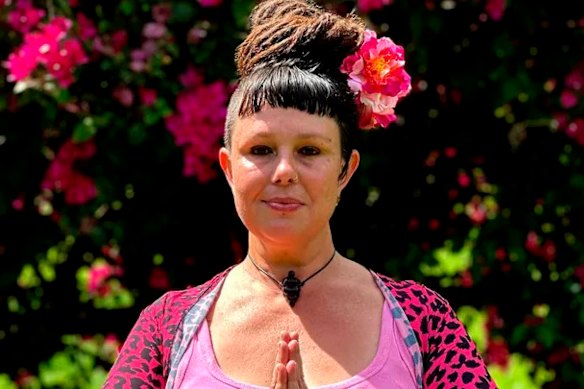

A self-described “birth keeper” advised an expectant mother to “go home and rest” after two doctors told her to urgently present to the emergency department, the NSW Coroner’s Court has heard.
Sita Kali – also known as Mumma Sita – was involved in the care of two of the four babies who died following a “free-birth” or homebirth in the NSW Northern Rivers region between 2022 and 2024.
These four deaths are being examined at an inquest which started at Lismore Local Court on Monday. The families of the four babies who died declined to be involved in the inquest.
The small but growing number of free-births fall entirely outside the medical system. As opposed to a planned midwife-led homebirth, a free birth mother may be alone, with a partner or unaccredited support person such as a doula or birth keeper.
Kali described her role as a “a birth keeper [who] provides advice which allows women to make informed decisions as to the best way to birth their children”, the court heard. She does not carry any medical equipment that could assist women in a medical emergency.
The court heard about a woman who had a “very strong desire” to homebirth but was out of area for her local hospital’s homebirth program. The woman instead planned to free birth with Kali and a doula.
While midwives had estimated the woman’s due date was July 28, 2022, based on the scientifically proven method of calculating a due date based on her last period, Kali estimated a due date weeks later, on August 14 or 15, based on the likely date of conception.
The woman did not give birth until 43 weeks and one day gestation, and the court heard Kali “played a critical and crucial role into altering [the mother’s] understanding as to when her baby was due”.
On August 18, the mother was “getting a little worried about being late on the hospital calculation,” however given she was “only one week after the date that Sita calculated … I felt OK,” the court heard.
She attended an ultrasound on August 19, which found the baby had a very compromised heart rate, prompting the radiologist to urgently call her GP, who contacted the mother to express his concern.
Both doctors explained to the mother that her pregnancy had become a medical emergency which required a heartbeat monitor and birth within four hours.
The mother said she was afraid of being “forced into a caesarean” if she attended hospital, and called Kali for advice.
“I advised [the mother] to go home and rest, calm herself down and consider what she wanted to do,” Kali said in her police statement. “My advice was that I wasn’t medically trained.”
The baby was delivered on August 20 at just after 8am, with the father, Kali and the doula present.
The baby’s skin was white, had the umbilical cord wrapped twice around his neck, was not breathing and had faeces on his face. There was difficulty establishing breathing for a few minutes, but breathing returned following massage.
The mother had a preference for a lotus birth, which involves allowing an umbilical cord to dry and detach naturally, usually three to ten days after birth. The umbilical cord was still attached when paramedics arrived 12 hours later.
Kali recorded that the baby displayed signs of laboured breathing, but told the mother that holding him close to her chest would help.
The pair discussed going to hospital, but decided it was not needed.
Kali left before the baby had latched to feed, and the court heard that the baby never latched.
In the evening, the baby developed hiccups and stopped breathing about five minutes later. Paramedics arrived just before 11pm, where they found a limp and hypoxic baby with a heart rate of over 100.
A number of attempts were made to intubate but the baby was pronounced dead just after midnight.
The baby’s father told police that in the brief time he was with them, he gave them love, and that he does not know or care about the baby’s cause of death.
Kali has launched an online fundraising campaign to assist with her legal fees, and had raised $4500 of her $15,000 goal on Monday.
“My journey began with my own first birth, on the side of a mountain more than 26 years ago,” Kali’s fundraising site read.
“That experience profoundly shaped my understanding of birth as a natural, physiological, emotional and spiritual process, and awakened a lifelong calling to support wombyn [sic] in reclaiming trust in their bodies, their instincts and their right to make informed choices.”
The inquest is expected to run for two weeks, and will examine whether there should be greater regulation around care provided by unregistered support workers.
The Morning Edition newsletter is our guide to the day’s most important and interesting stories, analysis and insights. Sign up here.
From our partners
Disclaimer : This story is auto aggregated by a computer programme and has not been created or edited by DOWNTHENEWS. Publisher: www.smh.com.au