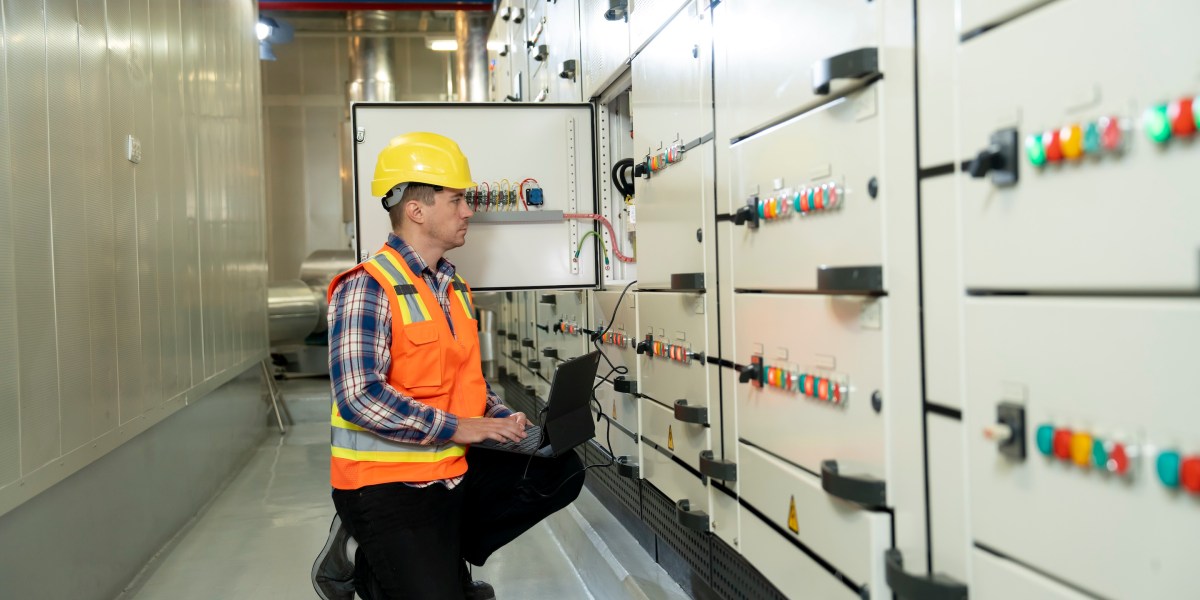
The most expensive technology buildout in history is running headfirst into a problem Silicon Valley can’t code its way out of: there aren’t enough electricians, linemen, and tradespeople to build the physical world that AI needs to exist in.
Ford CEO Jim Farley has been blunt about it. The data center boom, he told Fortune, is already mutating into an energy crisis—and the energy crisis is really a labor crisis. “Even if the data centers get built, there’s still a huge question mark about how the energy sector will support them. And there’s obviously going to be large shortages.” The U.S., in his telling, is in “the second or third inning” of taking this seriously.
In a new investment perspectives paper, Goldman Sachs Alternatives, which manages more than $625 billion in alternative assets, argues that the companies capturing roughly 90% of AI’s profit pools today—chip designers, memory manufacturers, and semiconductor fabs—represent none of the physical bottlenecks that will determine whether artificial intelligence can actually scale. Power generation, grid infrastructure, high-voltage components, advanced cooling, and mission-critical services collectively account for about 10% of AI-related earnings, Goldman says, but 100% of the chokepoints.
“Many investors are still looking to replicate past successes in data centers,” argued the co-authors Leonard Seevers, Jason Tofsky, and Sydney McConathy, “missing the critical chokepoints that will define the next phase of growth.”
The crisis coming for agentic AI
The catalyst is the emergence of so-called agentic AI: autonomous, always-on systems capable of running continuously across workflows, rather than responding episodically to user prompts. Goldman estimates these systems will be 60x to 130x more energy-intensive than the AI tools most people use today.
The math compounds fast. Studies suggest agents use roughly 4x more computing tokens than standard chat interactions, and multi-agent systems — where AI models coordinate with each other — use about 15x more. Multiply that by the expectation that agents will run persistently, not just when a user opens an app, and the aggregate demand on infrastructure becomes exponentially larger than what today’s data centers were built to handle.
“The infrastructure foundation on which AI has been constructed will not sustain the AI of tomorrow,” Goldman wrote.
Power, people, and parts
The specific constraints Goldman identifies are unglamorous by Silicon Valley standards — but increasingly hard to dismiss.
The U.S. faces a projected 45 gigawatt power shortfall for data centers by 2028, with 72 gigawatts of new capacity needed through 2030 — the equivalent of 72 large nuclear power plants. Meanwhile, more than 3,400 data centers have been announced or are already under construction across the country, with the grid nowhere near ready to power them all.
Ford CEO Farley also continued to predict a shortage of workers in what he calls “the essential economy” of blue-collar trades, to power this ongoing energy revolution.
Goldman likewise concluded that the human capital problem may prove harder to solve than the hardware one. Goldman estimates approximately 760,000 additional power and grid workers will be needed by 2030, including 207,000 specialized transmission and distribution roles that require three to four years of training to fill. That pipeline doesn’t exist — and can’t be built quickly. Supply chains compound the problem further, with wait times for substations, high-voltage cables, and steel already stretched well beyond historical norms.
The grid workforce gap also sits inside a much larger demographic squeeze. A recent JLL report, citing U.S. Department of Education estimates, warned that as many as 2.1 million skilled trades jobs in the U.S. could go unfilled by 2030, with potential economic losses reaching $1 trillion annually. JLL calls these workers — electricians, HVAC technicians, plumbers, pipe fitters, maintenance crews — a “silent army” that is aging out faster than the country can replace them. More than one in five U.S. construction workers is already older than 55, roughly 39% of electricians are 45 or older, and skilled trades broadly are losing five workers to retirement for every two new ones entering the field.
The supply-demand gap is already visible in the postings: nearly 600,000 jobs were advertised across major skilled trades last year, while only about 150,000 new workers entered the labor pool through apprenticeships. In other words, before AI’s agentic era adds a single gigawatt of new demand, the workforce expected to wire and cool it is already shrinking.
Farley said this remains a “full-blown” crisis, and the U.S. is only in “the second or third inning” of grappling with it seriously. “So many of the real problems are in small companies and small businesses that don’t have the funding. Trade school is often offered as an option, but it’s extremely expensive. Not everyone can afford it.”
Where the opportunity shifts
For investors, Goldman’s bottleneck argument points toward what it calls “pick and shovel” companies that most AI-focused portfolios have underweighted: grid-connected power generation, advanced cooling systems, specialized fiber splicing, end-to-end design engineering, and providers of high-voltage components sold directly to hyperscalers.
The firm also draws a distinction within the data center market itself, favoring grid-powered facilities in established urban locations — where demand is resilient and less susceptible to speculative oversupply — over speculative builds racing to capture near-term hyperscaler contracts.
The valuation gap Goldman is flagging is stark. The combined EBIT of chips, servers, manufacturing, and memory is currently nearly 9x that of power, components, and data center services companies — a gap Goldman characterizes not as a reflection of value, but of mispricing.
The bigger picture
With AI-related capex expected to surpass $750 billion in 2026, concerns about a repeat of prior tech buildout cycles have grown louder. Goldman’s counterargument is that the transition to agentic AI alone is expected to drive over 90% of future demand for digital infrastructure, making current spending not a speculative bubble but a structural race to address physical constraints that are already binding.
The AI era was supposed to be defined by algorithms and accelerators. Goldman’s argument is that it may ultimately be decided by substations, switchgear, and the availability of licensed electricians. Whether the investment thesis plays out or not, the underlying physical reckoning is no longer hypothetical — it’s already here.
Farley pointed out to Fortune that Ford’s ongoing restructuring involves launching an energy business and converting several factories in that direction, with workers now needing to learn arcane expertise such as lithium iron phosphate chemistry. He echoed what Goldman described: “We are ourselves finding skilled trade shortages as we convert our automotive battery plants to energy storage battery plants in Kentucky and Michigan,” he said. “I think our story is just very similar to what’s going to be happening across the country with linemen, electricians, plumbers,” Farley said, “It won’t be just for data centers, it’ll be for transmission lines, off-grid energy sources. It’s going to get a bigger debate, not a smaller debate.”
Disclaimer : This story is auto aggregated by a computer programme and has not been created or edited by DOWNTHENEWS. Publisher: fortune.com