There is something about a song that refuses to disappear. Long after the singer is gone, the instrument retired, the stage dismantled — a melody hangs around. It travels in the throats of grandchildren. It hides in the corners of old homes. It waits.
This week, we went looking for the people who are listening.
A pair of sisters carrying music into Mumbai’s bastis on a bus. A family in Delhi keeping a tabla legend’s rhythm alive in the very house he built. A village in Kerala whose songs are older than most countries. And a festival in Bengaluru that decided beats and biodiversity belong on the same stage.
Four stories. One simple idea — that the future has a soundtrack, and we get to choose what’s on it.
The bus that pulls up with a music class inside
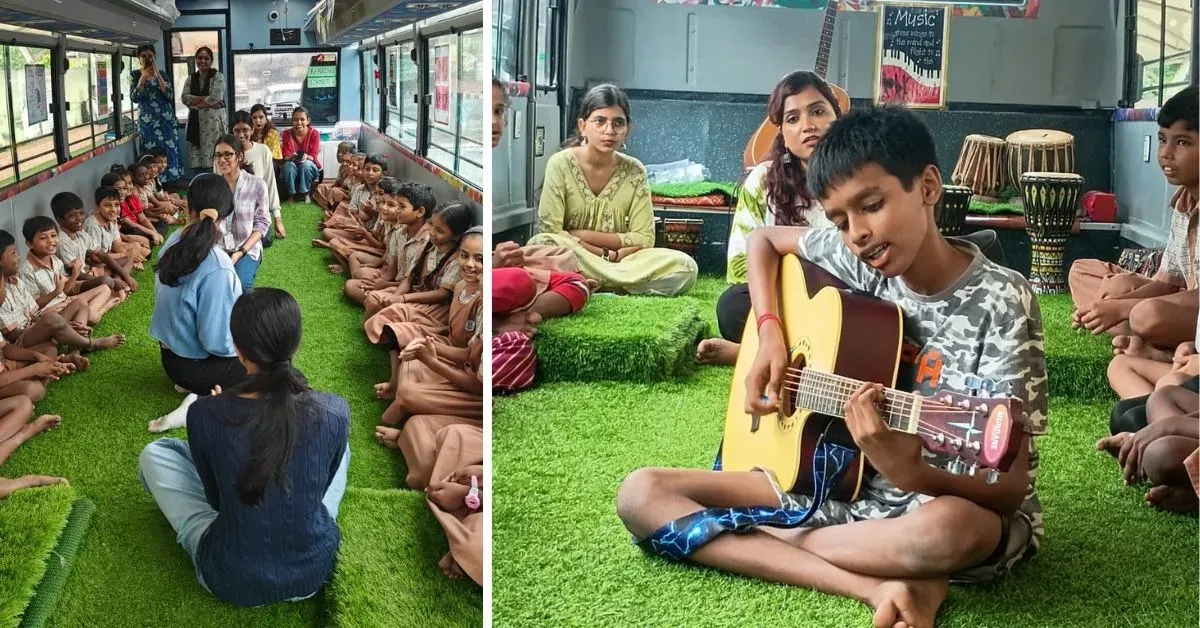
Twelve-year-old Naresh doesn’t always feel like going to school. But on the days he does, there’s a 45-minute reason waiting for him: music class. In Mumbai, sisters Kamakshi and Vishala Khurana have turned a bus into a roving classroom that parks in seven bastis across the week, bringing songs, rhythm and emotional vocabulary to over 500 children who might otherwise never sit in a music room.
There are no recitals, no exam pressure. Just the radical idea that a child humming on a Tuesday afternoon is also, somehow, a child being seen. Step inside the bus where music does the teaching.
The tabla wizard, the bandaged hand, and the house that remembers
In 1958, Pandit Chatur Lal played the tabla until his knuckles bled and the sun came up — because, as the story goes, the guests had no transport home. He was 39 when he died, but in those few years he carried Indian classical percussion to the Museum of Modern Art, the Rockefeller Centre, and into a never-before jugalbandi with American jazz great Papa Jo Jones.
On his 100th birth anniversary, his family has turned his New Delhi home into Taa Dhaa — possibly India’s first museum dedicated to a percussionist — where his soap from Paris, his rudraksha mala, and a tape that exists in only two places on Earth all live on. Meet the family keeping a 100-year-old beat alive.
The Kerala village where every house is a music school
/filters:format(webp)/english-betterindia/media/media_files/2026/04/25/young-girls-singing-songs_11zon-2026-01-16-17-40-25-2026-04-25-10-22-29.webp)
Valmutty has 54 houses and roughly 2,200 years of music in its bloodstream. Long before notation books and YouTube tutorials, the Paanars of this Palakkad village were the news anchors, historians and bards of ancient Tamil society — singing their way across kingdoms. Today, 75-year-old Deivanai still sings the same wake-up songs to the gods that she learnt as a 10-year-old, eavesdropping from a corner of the room.
Her granddaughters’ generation now wants to teach. And earlier this year, Kerala officially declared Valmutty its first Pattu Gramam — Music Village — a title that finally puts on paper what these families have been doing all along. Listen to the village that has been singing for 2,200 years.
The festival where the stage is built from scrap, and the audience knows it
Most music festivals leave behind a small landfill. Echoes of Earth, in Bengaluru, leaves behind a sustainability handbook. Founded by Roshan Netalkar in 2016, India’s first green music festival has been plastic-free since day one, drinks come in steel tumblers you carry home, and the spectacular stages — last year, a one-horned rhino, this year, mycelium networks and whale song — are sculpted from junkyard salvage by more than 100 artists over six months.
In 2024, 26,000 people partied across 170 acres and sent zero waste to landfill. The music, as it turns out, sounds even better when nothing is being thrown away. See how a music festival became a climate movement.
Some traditions live on big stages. Others on buses, in bastis, around temple courtyards, and in steel tumblers raised under recycled lights. Either way, India is still singing. And this week, that’s reason enough.
Disclaimer : This story is auto aggregated by a computer programme and has not been created or edited by DOWNTHENEWS. Publisher: thebetterindia.com