
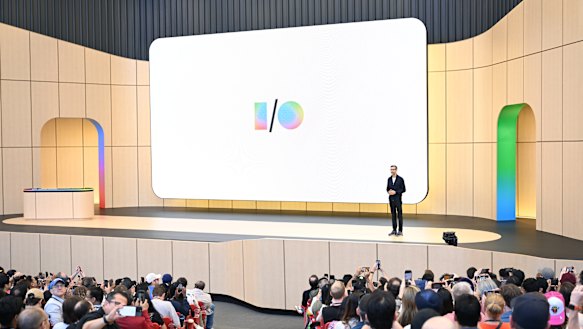

In the race to create AI products that people will find genuinely useful, things have been moving extremely fast. And though Google was once seen as the slow encumbent which had to drag its legacy advertising and search business into the new era, lately it’s accelerated into what looks like a decisive lead.
The company has leveraged its Android business, its close relationship with Apple, its massive user base and its access to sensitive personal info via existing apps and services to push its Gemini AI into all aspects of digital life. In its last quarter, it showed that its advertising revenue was actually climbing as a result of AI. And at its developer conference Google I/O on Wednesday morning, it said Gemini users had doubled in a year to sit at around 900 million. Here are some of the ways it proposed to keep expanding.
New models
The most wide-reaching new announcement at I/O was Gemini 3.5, Google’s new family of frontier AI models which the web giant promised would increase speed and efficiency while empowering more autonomous use for AI agents beyond text chat and image generation.
The first model from the new family, 3.5 Flash, is out now and already powering the Gemini app and AI Mode in Search. Google showed benchmarks indicating that the model is four times faster than other frontier models, yet more powerful in coding than heavy models like Gemini 3.1 Pro, which was released in February.
Some research has indicated that average spend on enterprise AI has grown many times faster than expected, with some companies blowing their annual token budget in less than half a year. Google chief executive Sundar Pichai said the lower cost of 3.5 Flash, which was powerful enough for almost all tasks, would appeal to these companies.
“Top companies are processing about 1 trillion tokens a day. If they shifted 80 per cent of their workloads from other frontier models to 3.5 Flash, they would save more than $US1 billion ($1.4 billion) annually,” he said.
Also unveiled at I/O was Gemini Omni, a new family of models designed to accept any combination of input modes (for example text, voice, code, images, video) and output in any mode. For now, Omni Flash will only output video, with a Google demonstration showing a user asking for a clip that used the camera style of one clip and the visual style of others, together with a character built off an uploaded photo. The model will only be available in the Gemini app for paying subscribers, but it will be free in an update to YouTube Shorts this week.
AI Search
Google claims it has made the biggest change to its web search box in 25 years, as it’s now formatted to take advantage of 3.5 Flash’s speed. The box now expands as you type to encourage you to ask long and detailed questions, and makes suggestions as you go. You can add images, files or videos to reference, or point to an open tab in Chrome. The company said you’ll still get a list of links as web results, below the AI chat and output, but it will be more relevant because of the context. This change is live now.
Later this year, the search box will also be able to code its own visualisations, tables and graphics, in order to explain concepts with interactivity. Paying subscribers will also be able to build mini-apps directly in Search that they can return to, which Google said is designed to remove repeat searching. For example, you could build a mini-app that always shows what movies are showing in a particular cinema, or one that creates a custom workout routine considering your local weather.
Users can now also choose to connect AI Mode in Search to Personal Intelligence, Google’s platform that lets its AI sift through your data in Gmail, Google Photos and more.
Content credentials
To counter the implications of ever-more-powerful image and video generation models, Google introduced some new tools for transparency. It said its SynthID watermark — which is an invisible piece of data that can be read by machines to determine if something was made by AI — has been embedded in more than 100 billion images and videos, plus 60,000 years of audio assets. It has worked to encourage other companies to embed SynthID in assets its tools create, and at I/O it announced OpenAI had agreed to use it as well.
The next step is something Google called Content Credentials verification. It and many other companies use the C2PA credentials standard when creating media, so for example when you look at a photo in Google Photos it will be able to show you the brand and model of the camera that took it. Google said it is rolling out a feature to Gemini, Search and Chrome that would enable users to ask about the providence of any media they saw, and receive information about how it was captured or created, and whether it had been edited by AI. Google said it was advocating for global standards that would mean images captured by a phone or camera — without being edited by AI — would be easy to verify no matter where they were posted.
Smarter glasses
Last year Google announced Android XR, a new platform developed with Samsung and Qualcomm that would put Google AI on your face via smart glasses. This year the company showed off a bit more of what that would actually look like.
The first wave of glasses, launching in the coming months, will be released by fashion brands Warby Parker and Gentle Monster. They resemble Meta’s original Ray-Ban smart glasses, in that they have speakers, microphones and cameras, but no screens. Users will be able to tap the frames to summon Gemini, and ask questions about anything they can see. The glasses will also give Google Maps directions, take photos and video, play music and podcasts, take calls, transcribe messages and notifications and conduct live translations.
Later this year, Google plans to release Project Aura, a product it’s developed with Xreal. These extended reality glasses have screens built in to layer up to five apps at a time over your view of the real world. Like Apple’s Vision Pro, they’re tethered by a cable to a processor box around the size of a phone, which you can put in your pocket or hang around your neck on a lanyard. But unlike Vision Pro, they look like sunglasses. Project Aura even lets you connect external devices to use the glasses as a monitor, so you can mirror any phone, laptop or even a game console like the Steam Deck onto the displays.
Your own agent
Though Google promised a future where everyone would have an army of AI agents at their beck and call, accomplishing digital tasks on the internet in the background, its most evocative real-world version of that will initially only be available in the US, and only to users on the most expensive Google subscription.
Gemini Spark is an AI agent that runs online, on dedicated servers, 24 hours a day. You talk to it through the Gemini app, but it can continue working when you lock your phone or turn off your laptop. It can connect to Google apps like Gmail and Drive, and in the future it will be able to navigate the web and connect to other apps you use. Google showed examples including the agent periodically sifting through emails to deliver a daily digest of important dates from an overabundance of messages from a primary school, or crunching credit card statements as they came through to flag any irregularities.
The company said Spark is designed to ask you for permission before performing “high stakes” actions on your behalf. It showed off an upcoming Android feature that would gives your agent a home at the top of your phone, so you can see what it’s up to and if it needs anything. Though Spark is rolling out for US Ultra subscribers only, it is eventually planned to release more widely.
Google also showed off agents in Search, which will launch for subscribers later this year. You program your agents by describing the kinds of searches you’re looking to make — for example houses that come onto the market in a certain area at a certain price range, or new sneakers from a certain brand — and the agent stays across the topic in the background, notifying you of any developments.
Vibe docs
AI is already deeply embedded in Google Workspace, which boasts an astonishing 4 billion users. But at I/O the company showed off some ways it’s trying to fundamentally reimagine how its users create on the platform. The most impressive demonstration was Docs Live, a new way to draft whole documents by verbally brain-dumping to Gemini. The draft changes as you keep talking, whether you have new ideas of want to correct something the AI has done, and can pull information from the web and your personal data if you’ve given permission. There’s a similar Live feature coming for Gmail and Google Keep, pulling relevant information from your inbox or turning your shower thoughts into lists and reminders respectively.
Less clearly useful was Pics, a new app that lets you create and edit images using AI. It was positioned as an easy way to change visual assets for use in apps like Slides and Drive, removing elements or editing text. Like other workspace tools it also lets teams collaborate on projects together.
AI Shopping
Finally, Google laid the foundations for how online shopping might work on an internet that we browse by talking to agents rather than clicking on links. Universal Cart is a tool that can show up across apps including Search, Gemini, Gmail and YouTube, letting you add any product you see to your list. The cart finds purchasing options, and can let you know about restocks or discounts. Google’s demo even showed the cart notifying users if an item was at its lowers price in 60 days, or that the PC parts that had been added were not compatible with each other.
For checking out, users can stay in Google’s cart and let an agent take care of the purchases, or you can transfer the items to your selected retailers’ website. The Universal Cart is launching in the US later this year.
Get news and reviews on technology, gadgets and gaming in our Technology newsletter every Friday. Sign up here.

From our partners
Disclaimer : This story is auto aggregated by a computer programme and has not been created or edited by DOWNTHENEWS. Publisher: www.smh.com.au


