
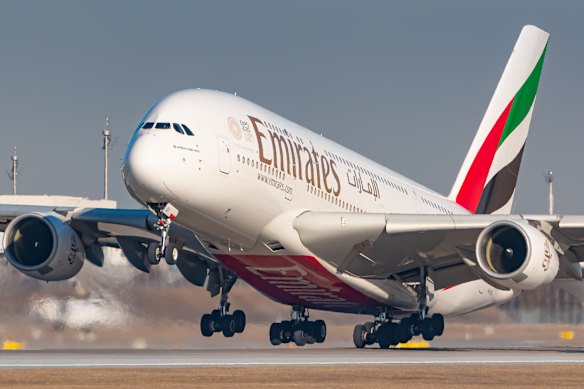
Peace has returned, for now, to the states bordering the Persian Gulf, and that’s welcome news for anyone planning to travel through the region to Europe or elsewhere.
The latest update from Smartraveller for the United Arab Emirates and Qatar, dated June 18, is “Reconsider your need to travel”, a downgrade from the previous “Do not travel” advice. Travellers passing through the region now need not fear (as much) that they are putting themselves in harm’s way, or travelling uninsured. It’s also a good outcome for travellers who put their plans on ice when the war on Iran erupted at the end of February.
When Emirates, Etihad and Qatar Airways cancelled flights en masse they offered refunds or credits, but quite a few Aussie flyers with bookings for journeys later in the year chose to keep their original booking intact. Then they went looking for backup flights with other carriers including Qantas, Singapore Airlines, Cathay Pacific, Turkish Airlines and the China-based airlines.
Many of those travellers are now asking: “What should I do with my backup flight bookings?” And according to Mark Trim, founder of Adelaide-based Complex Travel Group, “the good news is that many of those backup fares are easier to cancel than travellers realise.”
When the war began, Trim says, availability of alternate airfares out of Australia was limited. Often it was only top-tier fares that were available, at top-dollar cost. “Top-tier inventory is naturally refundable, typically with a minor or nil penalty. This means the backup fares that travellers paid a premium for during the disruption are, in many cases, the easiest fares to walk away from.”
Sign up for the Traveller newsletter
The latest travel news, tips and inspiration delivered to your inbox. Sign up now.
So, is now the time to cancel those backup tickets and ask for a refund? Maybe not. Given the stop-start nature of the Middle-East conflict, there is no guarantee that hostilities with Iran will not resume. If that happens, air travel could be affected once again, and that backup flight could be the difference between a European jaunt and the couch.
What’s happening with airfares aboard the big three Gulf State airlines?
Travellers with a credit voucher aboard a Gulf airline for a flight they were unable to take during the conflict might be wondering if that credit is going to get them to their original destination without additional cost.
Now that they’re back on schedule you might expect Emirates, Etihad and Qatar Airways would be juggling fares with some upward movement as confidence returns, but that’s not happening. Throughout the Persian Gulf conflict their fares remained fairly stable. That’s despite some travellers reporting low passenger numbers, and even empty rows aboard Emirates and Qatar Airways flights.
Spot bargains appeared, especially in premium classes. Emirates’ president Sir Tim Clark said some first-class cabins were about half full during the conflict, but there was no panic selling. In the main those airlines cut capacity, downscaling flights to match demand and holding fares at about pre-conflict levels.
As hostilities taper, Gulf carriers continue to price competitively. According to Skyscanner, a return economy flight to Europe in August with Etihad can be had for about $1600, on par with Malaysia Airlines and significantly less than Qantas, Cathay Pacific, ANA, Thai and Turkish Airlines. The same flight with Qatar Airways is sitting at about $2000, and $2400 with Emirates. In the following month, Skyscanner has return economy class flights to Europe priced at about $2400 aboard the Gulf triumvirate, roughly the same as Cathay Pacific, JAL and Qantas, with China Southern and China Eastern drifting slightly higher.
Virgin Australia COVID flight credits are set to expire
The issue of domestic flight credits is again under the spotlight as Virgin Australia’s COVID credits approach their expiry date. The credit applies to tickets issued on or before July 31, 2022 for bookings made between April 21, 2020 and July 31, 2022. Customers holding credits must book by June 30. Originally customers also had to fly before June 30 as well, but after a backlash, the deadline to travel has been extended to May 27 next year. According to Virgin, more than 90 per cent of pandemic credits have been used, but credits worth around $93 million are still in customers’ hands.
There are some good reasons why customers might not be using their credits, despite what the airline says are extensive efforts and regular reminders to customers. An airline credit is usually for a specific dollar value. The credit is worth the dollar value of the original ticket, or whatever value the airline specifies. If you apply it to a future booking and the replacement fare is more expensive than the value of the credit, you pay the difference.
But is it right that Virgin walks away with $93 million in windfall profits? Plenty of the airline’s customers don’t think so, nor does Senator Bridget McKenzie who said the money belongs to Australians and it was unacceptable for the company to keep it. Qantas faced a firestorm of criticism when it set an expiry date on COVID airfare credits, initially linking their validity to 12 months from the original booking date. That date was later extended to December 31, 2023, and later still the airline scrapped the expiry date on all COVID-19 travel credits, making them valid indefinitely.
That’s not the same as a refund, but a credit with no expiry date beats Virgin’s response. Whose interest does a flight credit really serve? And why should they be used as a reason for airlines to avoid paying a refund?
 Michael Gebicki is a Sydney-based travel writer, best known for his Tripologist column published for more than 15 years in Traveller. With four decades of experience, his specialty is practical advice, destination insights and problem-solving for travellers. He also designs and leads slow, immersive tours to some of his favourite places. Connect via Instagram @michael_gebickiConnect via email.
From our partners
Disclaimer : This story is auto aggregated by a computer programme and has not been created or edited by DOWNTHENEWS. Publisher: www.smh.com.au


