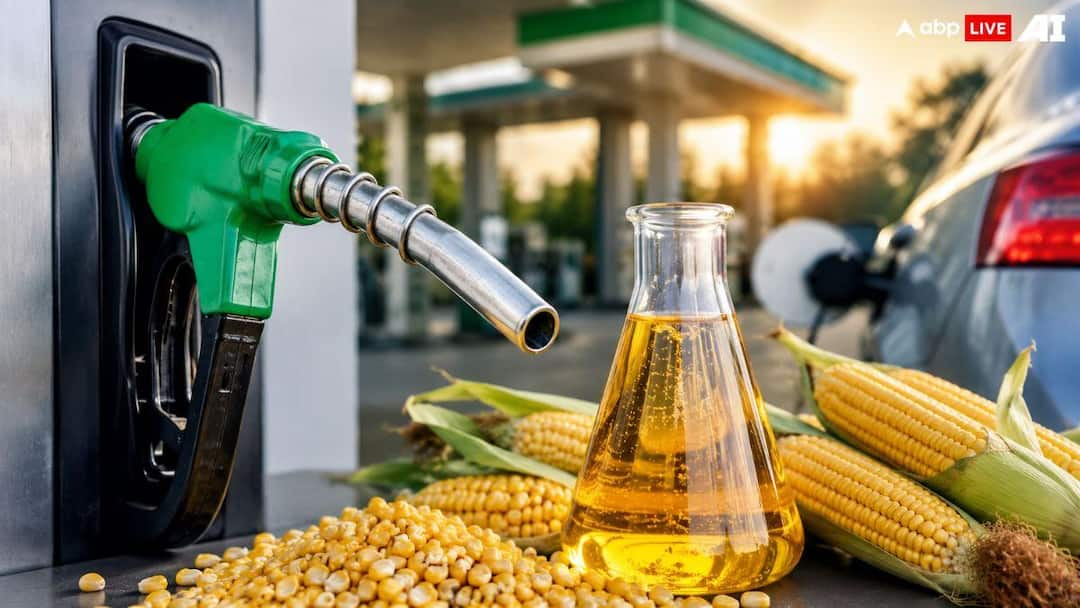
- Government notified amendments permitting E100 ethanol-blend vehicles.
- Only specially designed, certified flex-fuel vehicles can use E100.
- Rules also raised light vehicle weight limit to 3,500kg.
The government has notified amendments to the Central Motor Vehicles Rules, paving the way for vehicles designed to run on ethanol-petrol blends containing up to 100% ethanol, or E100.
The Ministry of Road Transport and Highways (MoRTH) issued the changes on Monday, October 26. However, the expanded fuel options will apply only to vehicles specifically designed and certified for higher ethanol blends, a senior ministry official said.
Vehicles approved for E20 petrol or conventional fuel cannot use E85 or E100, as they are not designed for such high ethanol concentrations.
E100 Fuel: Which Vehicles Can Use It?
The revised rules provide for flex-fuel vehicles capable of operating on ethanol blends ranging from E20 to E100. While E20 petrol contains 20% ethanol and 80% petrol, E85 consists of 85% ethanol and 15% petrol. E100 is nearly pure ethanol.
The ministry official clarified that fuels with ethanol content above E20 and up to E100 are intended exclusively for vehicles designed and certified to use them. The changes do not mean that existing petrol vehicles can switch to these fuels without the necessary compatibility.
MoRTH has also revised certain vehicle classification thresholds, fuel specifications and technical references used in emission-related tables and testing provisions.
Also Read : Britannia Told To Drop “100% Whole Wheat Bread” Claim: CCPA Says Atta Is Only 62% Of Loaf
Vehicle Weight Threshold Raised To 3,500 Kg
Alongside the provisions for higher ethanol blends, the government has increased the vehicle weight threshold for light petrol and diesel vehicles.
The limit has been raised to 3,500 kg from 3,000 kg, for vehicles covered by the changes.
The amendments form part of changes to vehicle regulations covering fuel specifications and emission-related requirements.
Maruti Suzuki Launched Wagon R Flex Fuel In June
India’s push towards flex-fuel vehicles has already seen a development from Maruti Suzuki India. In June this year, the automaker launched the Wagon R Flex Fuel, described as India’s first flex-fuel passenger vehicle.
The model is capable of running on ethanol-petrol blends ranging from E20 to E100.
Toyota Motor Corporation, Tata Motors and Hyundai Motor Company are also developing flex-fuel vehicles for the Indian market as policymakers encourage alternatives to conventional petrol and diesel.
India’s Ethanol Bet, But Consumers Remain Worried
The government has been encouraging ethanol blending to reduce India’s dependence on imported crude oil, which is a major contributor to the country’s current account deficit.
India has already introduced E20 petrol, containing 20% ethanol. Flex-fuel vehicles extend the range of blends that compatible engines can use, including E85 and E100.
The importance of alternative fuels has also come into focus amid the West Asia conflict, which has left India and other countries exposed to disruptions in energy supplies.
Not everyone is convinced. Customers and automakers have flagged a drop in mileage with ethanol blends, while carmakers have also spoken recently about the newer fuels’ effect on some car parts and how long vehicles last.
Earlier Draft Covered E85, E100 And Other Alternative Fuels
Before notifying the amendments, MoRTH had proposed changes to vehicle emission rules to expand the scope for higher ethanol blends and alternative fuels across vehicle categories.
The draft amendments to the Central Motor Vehicles Rules, 1989, included provisions for E85 and E100, as well as B100 biodiesel and hydrogen-CNG combinations.
The notified changes now provide a regulatory framework for vehicles designed to use higher ethanol blends, while retaining the requirement that vehicles must be specifically engineered and certified for the fuel they use.
Also Read : Digital Gold Vs Gold Coins Vs Jewellery: Which Is Smarter To Buy This Dhanteras?
Input By : PTI
Disclaimer : This story is auto aggregated by a computer programme and has not been created or edited by DOWNTHENEWS. Publisher: abplive.com