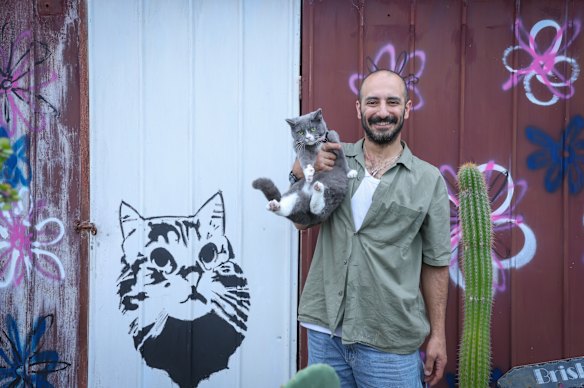

Growing up in Iran, Ashkan Teymouri was surrounded by cats, but never had one of his own until migrating to Australia over a decade ago.
First there was Mamoosh, a beautiful Persian who offered companionship and familiarity in his early, often lonely, years in Melbourne.
During the pandemic, he adopted three British Shorthair kittens – Mini, Circe and Jay Jay. The trio has, in no uncertain terms, changed his life and emotional world, teaching him patience and responsibility.
“They don’t like to be approached very harshly. You have to be so slow with them and take your time to get their trust. But it’s rewarding,” says Teymouri, 36.
So devoted is the tradesman to his cats that his last relationship ended in part because of them. Jay Jay escaped – and eventually died – last year. His partner at the time, who never liked his cats, showed a lack of sympathy to Jay Jay’s loss, which Teymouri considered the final straw for their relationship.
“When I lost him, I went through an absolute mental crash. I can’t tell you. I couldn’t go to work because I was crying, and she [his ex] said, ‘Just be strong’.”
While some cat lovers like Teymouri are born that way, others, like Greg Beazley, are made.
When Beazley’s wife Haejin Yoo first told him she was adopting a kitten, he wasn’t enthused.
“I grew up with a dog, so I always assumed I was a dog person,” he says.
But it didn’t take long for said kitten – Pom Pom – to win his heart.
“Very quickly, I was like, ‘Oh man, cats are just amazing’. There are so many pros to a cat as opposed to a dog – they’re toilet trained, they show the right amount of affection and not overly so, like they’re not always in your face, they don’t have to get washed, and they can fend for themselves,” says Beazley, 42.
“I really treat them as little babies – I always say goodnight and good morning and that sort of thing.”
In the past year, Yoo and Beazley’s family has quickly expanded to include rescues Bewty (named by their five-year-old daughter) and Skipper, the latter of whom started as a foster cat but has engendered particularly strong emotions in his dad.
“He was covered in ringworm, and we treated him very carefully over the coming months. But what really sold me on him was that he came in very skittish and shy, and as soon as we showed him some love, it was like he never felt that before,” says Beazley.
“The way he looked up at me was with gratefulness.”
‘Cat dads are now hot’
From Zsa Zsa Gabor to Sade, Emily Brontë to Taylor Swift, pop culture is full of cat ladies (often with adjectives like “crazy” or “single” tacked on).
Such women have long attracted a certain stigma – of loneliness, introversion, witchiness. As have their male counterparts – historically seen as weak, effeminate or antisocial.
According to a 2020 study, heterosexual American women found men pictured holding cats to be less dateable than those without. Its authors hypothesised this due to ingrained cultural perceptions linking male feminity and homosexuality.
But while the feline has long been associated with the feminine, “cat dads” like Teymouri and Beazely are moving into the limelight as outdated gender stereotypes fall to the wayside.
Mark Ruffalo, Dave Franco and Macklemore (alongside the late Sam Neill and Hollywood veteran Anthony Hopkins) are among a number of Hollywood men declaring their love for their feline companions.
Last year, Franco was crowned People Magazine’s inaugural “sexiest cat dad”, while a growing number of pet food brands and rescue shelters – like Sydney’s Cat Protection Society – are rolling out dedicated marketing campaigns for Father’s Day.
Meanwhile, the subreddit r/cuteguyswithcats, as the name suggests, abounds with photos of men (sometimes topless) with their feline companions. On TikTok, heterosexual women post videos of boyfriends and husbands with cats, declaring them “green flags”.
“Cat dads are now considered hot. Every time you see a video of a cat dad, there are always comments like ‘protect this man at all costs’,” affirms Yoo.
While dogs remain Australians’ favourite pet, cats are a close second with 33.6 per cent of households owning at least one, according to Animal Medicines’ latest report.
A 2015 Roy Morgan survey found 1.3 million Australian women owned cats, compared to 1 million men, while more recent research from the UK and US suggests a similar parity.
According to dating app Hinge, 31.8 per cent of men with pets on their profile have cat listed compared to 41.5 per cent of women.
Tanya Koens, a clinical therapist and sexologist, connects the zeitgeist’s affection for cat dads to a growing uneasiness among heterosexual women about dating men.
She points to recent, high-profile cases at home and abroad of domestic violence and sexual assault.
“I think a lot of women don’t feel safe and don’t know what to expect from men, and they’re having a bad time on dating sites,” she says.
“Anything that could indicate a guy having a modicum of being decent or safe or attuned to emotions is a good sign.”
It should go without saying that there is no inherent association between cat ownership and moral character.
But there seems to be something about cats – their nature and the kind of care they require – that infers a rejection of our culture’s “toxic” masculinity.
As Dr Jodie Stewart, a cat historian and author of The Cats of Australia, puts it:
“Cats are seen as being aloof and independent, and you have to work on boundaries – to sit down and ‘talk’ about consent between one another. But some more traditional, conservative men who are tethered to this idea of subservience and obedience find that difficult to navigate and can prefer dogs.”
Some small studies have indeed found an association between political preference and pets, with more left-leaning individuals owning cats.
Still, Koens is wary of the double standard: “When guys are into cats, suddenly they’re heroes. But when girls are, they’re crazy cat women.”
Men and cats in history
The association between femininity and cats can be traced as far back as Ancient Greece, but became “supercharged” in the medieval period during the witch trials, explains Stewart.
Into the 18th and 19th centuries, alongside changing ideas around women and family, cats were seen as the pets of women and children.
But history is full of cat dads if you know where to look.
Stewart’s research unearths men and cats outside the domestic sphere, often in the workplace or in places of hardship: like young soldiers in war zones cuddling with cats or caring for feline shipmates (at sea, cats were seen as “workers”, kept to catch vermin).
“These really deep affectionate bonds were formed between men and cats in spaces where love, affection and care weren’t a common thing,” she says.
Perhaps the most famous example of this is Matthew Flinders and his ship cat Trim, who accompanied him on his circumnavigation of Australia.
Flinders’ biographical tribute to Trim – “the most affectionate of friends, faithful of servants, and best of creatures” – provides a rare glimpse into the figure’s inner world.
“You have this British naval officer, doing the ‘manly’ work – sailing around, circumnavigating the country – but there’s this other side of him; this very emotional world. And that’s the thing cats do, right? They engender very strong emotions,” Stewart says.
‘How am I so lucky?’
Public servant Eddie Kok, 33, from Melbourne is a “proud cat dad” to rescues Cloud and Jasper.
But while this fate may have seemed inevitable, given his partner Joyce Lau is a passionate volunteer with the RSPCA, Kok wasn’t sold when they first fostered (then adopted) Cloud in 2021.
“Growing up, I never really saw cats as much of a pet option… I thought they’d be menaces, tearing things apart and pawing everything,” he says.
But it was Cloud’s nature – tough on the outside, but a softie at heart – that won him over.
“It’s just like, ‘Oh wow. How am I so lucky to deserve your love and attention?’. It feels extra rewarding compared to dogs or other animals.”
Their second, Jasper, was a stray rescued by Kok. The pair have a close bond, with Jasper more likely to approach for cuddles. (“He has a soft spot for me compared to Cloud,” Kok says).
Cats can “bring out a different side of people in terms of respect and boundaries”, says Kok, and have brought greater responsibility into he and Lau’s life while they contemplate having kids.
“They’ll easily tell you if they don’t like something, or want alone time and space. That has given me a lot more perspective in terms of how I am with animals and people – to be a lot more mindful.”
Make the most of your health, relationships, fitness and nutrition with our Live Well newsletter. Get it in your inbox every Monday.
From our partners
Disclaimer : This story is auto aggregated by a computer programme and has not been created or edited by DOWNTHENEWS. Publisher: www.smh.com.au