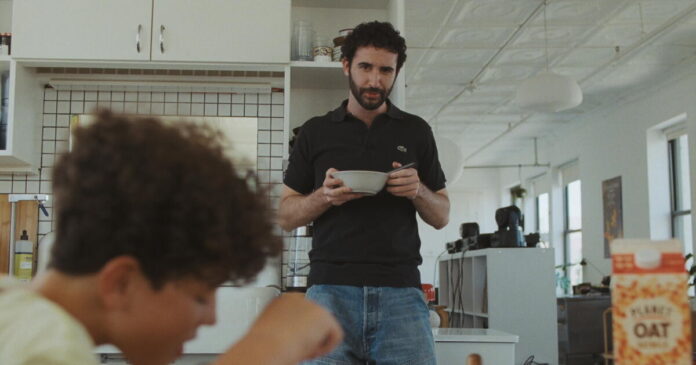
Little Rock, Ark., 2002. Minnie (Katherine Mallen Kupferer) and Callie (Chloe Coleman) drive to their last day of junior year, Callie behind the wheel, windows down, scream-singing to “All You Wanted” by Michelle Branch: “If you want to, I can save you. I can take you away from here.”
It’s a familiar teenage moment that arrives early in “Mouse,” the third collaboration from filmmaking partners Kelly O’Sullivan and Alex Thompson. The song is a nostalgia hit for the elder millennials in the room, and it crystallizes this moment in time in the early 2000s, girls on the cusp of adulthood. But the song becomes a touchstone that shifts meaning throughout “Mouse.” In this scene, the song represents liberation, friendship, joy. Then it becomes a reminder of loss, then a warning sign. For better or for worse, it’s forever tied to Callie and her free, self-possessed spirit.
Writer O’Sullivan mines her own teenage past for “Mouse,” and the film is too perfectly specific to that time period to be made by anyone who didn’t live it. Co-directors and life partners O’Sullivan and Thompson conjure 2002 with key needle drops (see also: Nelly’s “Hot in Herre” and Shaggy’s “Angel,” deployed with laser-like accuracy) and a warm, grainy aesthetic, every frame like an old disposable camera snap.
But what they convey with “Mouse” is far more profound than mere throwback Y2K style. The story here is about the strange relationships that form in the wake of devastating loss, and an examination of the unpredictable, messy and confusing connections often found between people experiencing grief.
Coleman’s Callie is a superstar of the high school stage, though she is not long for this picture. Her absence leaves a crater in her community, but especially in the lives of her bestie, Minnie, and her mother, Helen (Sophie Okonedo), who find themselves adrift and alone. Shy, retreating Minnie was happy to bask in Callie’s light, while Helen’s existence was almost entirely dedicated to her only daughter.
At a loss, Helen and Minnie somehow end up attaching to each other, falling into a strange but comfortable rhythm, play-acting the roles they yearn for, filling a Callie-shaped hole. Helen, a pianist, offers to give Minnie voice lessons, as she did her own daughter; Minnie gets to pretend to be Callie’s beautiful and popular best friend. Helen’s elegant house is a respite, a place where Minnie escapes her lower-class home life: a single mom, Barbara (Tara Mallen, Kupferer’s real mother), baby brother, too many dogs, TV dinners most nights.
Minnie creeps out of her shell, signing up to sing in the talent show and developing a crush on a video store clerk (Iman Vellani). But her fumbling coming-of-age is fraught with guilt, mostly about Callie and her shattered mother. Acting as her friend’s stand-in grants Minnie the confidence she never had but leaves Barbara out in the cold.
It’s apt that theater was Callie’s art form of choice. In “Mouse,” we watch as the players attempt to act their way through their grief. The superficial high school mean girls claim they were closer with Callie for the attention, but even more devastatingly, we witness Helen going through the motions of mothering another child and Minnie enjoying the space her friend occupied. It’s a way to get through the day, but it’s not sustainable, and everyone is on a collision course with reality.
Theater provided the medium for catharsis in O’Sullivan and Thompson’s second feature, 2024’s “Ghostlight,” in which Keith Kupferer (father of Katherine and partner of Tara, who respectively played his daughter and wife in the film), portrays a grieving construction worker finding himself in a community theater production of “Romeo and Juliet.” The theater arts in “Mouse” aren’t as sophisticated, with a memorial talent show shepherded by melancholy Mr. Murdaugh (David Hyde Pierce), featuring cringey contemporary dance, close-up magic and Gilbert and Sullivan tunes. But the function is the same: The stage provides a channel for the repressed emotions of these characters.
Mallen Kupferer, the daughter of two theater artists and an actor since early childhood, is a wonder to watch, her performance as authentic and awkward as any teenager. Her feisty turn in “Ghostlight” is a far cry from mousy Minnie, who tamps down her disappointments and desires for the sake of others. With Helen, whom Okonedo imbues with a curious, charming sensitivity, there’s a freedom for Minnie to step outside of her prescribed zone. Mallen’s Barbara is the third corner of this triangle, and when she and Okonedo square off in a motherly showdown, sparks fly and harsh truths pour out.
O’Sullivan and Thompson consistently bring honesty and humanity to the characters in their work (which includes their first feature, 2020’s “Saint Frances”). In “Mouse,” that extends to the creation of the setting and era, the filmmakers weaving a richly textured quilt of 2002 to surround these characters.
But the emotions themselves are timeless. Teenagers will always feel jealous, obsessed, insecure, confused about who they are and what the future holds. Every parent will have to navigate those feelings in big and small ways. “Mouse” examines the extremes of this unusual and intimate intergenerational dynamic with tender thoughtfulness. Like Branch sings in her 2002 hit, “All you wanted was somebody who cared.” Thankfully, care is what this filmmaking duo supplies, consistently.
‘Mouse’
Rated: R, for language, some sexual references and teen drinking
Running time: 2 hours
Playing: Opens Friday, Nov. 6 at Laemmle Royal
More to Read
Disclaimer : This story is auto aggregated by a computer programme and has not been created or edited by DOWNTHENEWS. Publisher: latimes.com