
I, like so many, have been profoundly affected by the horrific attack on Helen Haines (“Tragic turn for Haines’ family”, October 22). We hear that all politicians are the same. They’re not. Helen Haines cares deeply for her constituents and exudes decency and a respect for all. The media is asking who Helen Haines is, which informs a broken part of our political dialogue. We should already know who she is – intelligent insightful, energetic, compassionate. Quietly improving the lives of others. Unfortunately, this dignified approach gets lost to the noise and fury by shallow politicians who we already know too much about. Always spoiling for a fight, a cheap shot or a nasty, thoughtless remark. If the media had focused more on MPs like Haines, maybe those ripples of kindness she has shown would have spread across this vast land, rather than hate and division, which offers nothing but further suffering. We have just witnessed the terrible result of people being constantly bombarded with confected outrage by many who should know much better. My heart goes out to Helen Haines and her family and to all those she has helped along the way. Sean McClory, Manly
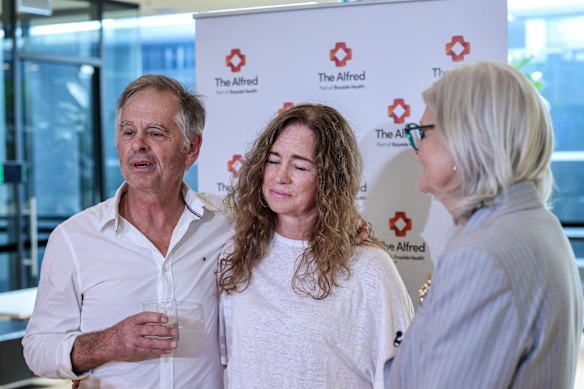
Your front page photo summed up so much about the shocking, brutal attack on independent MP Helen Haines, and its aftermath. The stoic, articulate and loving husband, Phil Haines, comforting us with his words, “The two most important parts of Helen for us as a family are her heart and mind. We are grateful and thankful that at this stage, both her heart and her mind are in good shape.” Next to him, the bereft image of the cousin Jules Muir, and beside her, our always wise and measured Governor-General Sam Mostyn. She provided the absolutely right official independent support, representing the country for the victim and family. As a nation, irrespective of politics, we are lucky to have both women in their very different jobs. As is often said, we thank them for their service. Jennifer Fergus, Croydon
What would Helen say? I want that T-shirt.Vivienne Mackenzie, Port Hacking
Discard the divisiveness
When Tony Abbott was PM, I spotted his wife, Margie, shopping in the same fruit shop as me. I thought, how good is Australia that she can go about her day normally (“Keeping MPs safe harder than ever”, October 22). Sadly, no more. Unless we all reject the megaphones of divisiveness. Don Easter, Redfern
We Australians who are obviously concerned about the safety of the 226 federal and621 state and territory politicians in our midst, are living in la-la land if we think that 24-hour security can be provided for them (“Simply listening to voters is putting politicians at risk”, October 22). While there is no publicly available figure for the total cost of 24-hour security for all the federal MPs, in 2024-25 alone, the Australian Federal Police spent $523 million on protection for politicians and government buildings. Eric Palm, Gympie (Qld)
Words are weapons
The many and varied comments on the increase in violent language and actions in our lives following the recent attack on Helen Haines are not surprising. Calling a spade a shovel is a well-worn cliché applicable to most politicians for generations, and we pretty much expect it. Every politician knows that to get noticed in the press you only have to make an inflammatory comment about someone and you are immediately front-page news, and we the public encourage this behaviour by feeding on the consequences. But when the remark implies violence on a person, it goes way too far. Right now, politicians who should know better are running for cover or backtracking on their previously intemperate language. Claiming the comment was in jest or was not meant to be taken literally is no excuse, and it sets a dangerous precedent. Tolerance of ugly language is normalising violence in our community, and we are seeing the consequences. Bruce Spence, Balmain
Ken Pares (Letters, October 22) posits that the violence against politicians started with “Ditch the witch” in 2011 (no thanks to Tony Abbott, who made no attempt to challenge that behaviour) – but it was certainly assisted by Alan Jones’ comment the same year that then-prime minister Julia Gillard should be stuffed in a chaff bag and thrown out to sea. Worse, still, Jones thought “it was a joke”! David Gordon, Cranebrook
Everyone should send a letter of gratitude to a member of parliament. Justin Fleming, North Sydney
Put big tech on leash
Combating all this hate and misinformation on social media is simple. Make the big tech companies behave like all our other companies, institutions and banks. To join or participate, you have to supply several ID checks – driver’s licence, Medicare card etc. And to participate in most standard groups, you need a National Police Check (NPC: $55.80 via Service NSW online). The big tech companies must stop anonymous profiles of users. Big tech must verify all profiles of users with a verified photo and name and address. Social media should never allow anonymous profiles. You don’t get published in the Herald without having your name and address verified. Alan Nicholas, Sandringham
When will the governments of the day bite the bullet and legislate that all online platforms must always display the actual source of the content they send out. It is time for these platforms to comply with the same regulations that our citizens and businesses do every day. One cannot open a bank account without fully identifying oneself. One cannot obtain a driver’s licence, a tax ID or get a MyGov account anonymously. Why should Facebook, Instagram, etc be anonymous. Make the cowards who send anonymous posts reveal themselves and be accountable for the threats they make. These platforms make billions of dollars in profits every year and should use a small percentage of these dollars to screen and identify their users. Pamela Wood, McMahons Point
Was the menacingly threatening meme reported to the police (“The sinister meme that appeared just hours before the attack on Helen Haines”, October 21)? Gail Grogan, Toongabbie
The mental illness factor
While there is certainly a need for public officials to tone down their rhetoric, a critical issue is being overlooked: untreated mental illness (“Deleted posts show Nugent had mental health spiral”, October 22). It has been nearly three years since the Bondi Junction Westfield tragedy. What has actually changed since? While we see increased security, we have yet to see a meaningful commitment to ensuring that those suffering from severe mental illness receive the urgent treatment and support they need. Chris Wiecek, Kiama Downs
The other side of the attack on Helen Haines is that the perpetrator apparently has serious mental health issues and has possibly been let down by health and welfare systems. Surely, his personal privacy needs to be protected and respected. I’m appalled at the blatant disclosure of his house and photos showing where and how he lives. Jacqui Keats, Black Head
Time for truth laws
With the advent of AI and elections approaching at both state and federal levels, Australia should enact truth-in-political-advertising laws (“Republican ad riling the US is a warning for Australia”, October 22). The Electoral Commission would have the power to determine whether political parties are using AI to deceive or misinform voters through their campaign advertising and to take appropriate action. Ray Armstrong, Tweed Heads South
Better use for barracks
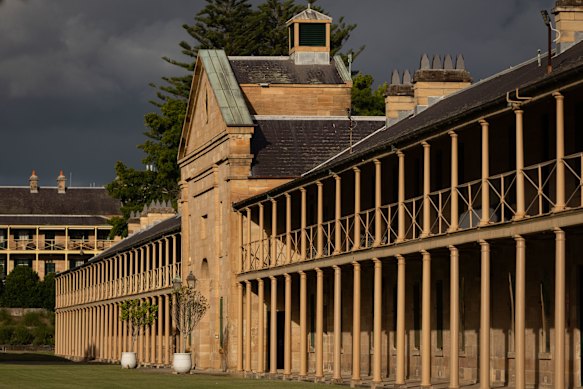
In Victoria Barracks, our government has a golden opportunity to provide much-needed accommodation for nurses, interns and other medical staff from the nearby teaching hospital, St Vincent’s (“Barracks eviction sparks fears for families”, October 22). Some of those staff must travel long distances at all hours to fill their shifts. With apologies to the army, that is a more productive use of the valuable land. Army staff should be located at country bases, which is more appropriate to their role. Anthony Healy, Centennial Park
The attendance at the Save Victoria Barracks rally this Sunday should demonstrate the importance of historic Australian institutions to our government. I believe this rally will be well attended, and if the government chooses to ignore this message, it does so at its own peril. I thank Labor MP Marjorie O’Neill for her campaign against the sale of the barracks. I hope many Herald readers and others join me at the rally. Paul Reid, Campsie
Political mine move
Michael McGowan has written a balanced account about the connection between state Labor and the MACH mine expansion (“The green light that followed Minns’ boardroom lunch”, October 22). He draws in the need for stable energy supply in NSW. This mine, however, is not only the source of coal for local energy, it is also a money spinner for the mining company. Importantly, the premier said the need to retain jobs in the Hunter region was his principal reason for planning to legislate around a High Court decision. What has been forgotten is that the same government announced that it would build new trains in the same region. The state project will provide, according to its statement, 780 jobs during construction and 550 continuing jobs. Given that the mine is continuing to expand, despite a ruling from the country’s highest court, one can still wonder whether the threat from One Nation was the real reason for a short-term local popularity grab. Jennifer Blackman, Wentworthville
We, the people, say no
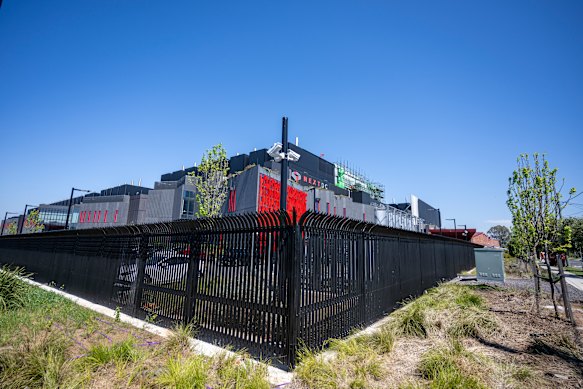
As a result of community activism in the Melbourne suburb of West Footscray, NextDC will “slash” its expected profits and construction spending on this particular data centre (“‘Worse and worse’: Backlash over data centre threatens billions in building boom”, October 22). Earlier in the week, Microsoft and NextDC warned the NSW government that plans for the nation’s largest data centres might be abandoned if the developers could not secure favourable power supply and planning agreements. In the US, the backlash against data centres is playing havoc with traditional red/blue divisions. About 70 per cent of people now object to a data centre being built in their neighbourhood. Apart from serious concerns over power and water supply, air and noise pollution, unsightly infrastructure and general disruption to amenity and people’s wellbeing, job losses attributable to AI are proceeding at pace. Our governments appear reluctant to pass up the opportunity to play host to data centres, and may cave to the threatening behaviour of their developers, but we, the people, have other ideas. Fiona Colin, Malvern East (Vic)
Is there a “backlash” against data centres? Or is it sensible people fighting against poor planning and location of data centres? Mark Anderson, Coogee
PCs and servers replaced massive mainframes in sterile computer rooms. A satellite’s computer power in 2000 now fits in a smartphone. Perhaps data centres have a lesson to learn. In the 2040s, a desktop box using quantum computing might replace a data centre. Perhaps they should be designed so the servers and cooling can be ripped out and converted into Amazon warehouses or Bunnings outlets. Neville Turbit, Russell Lea
Stupid wars
Unemployment is rising, consumption growth is “tepid” and inflation is getting worse. Somehow, to the RBA this adds up to “monetary policy is working”! It isn’t, and clearly cannot address current circumstances (“Reserve faces ‘hard choices’ as it ponders new rate hike”, October 22). Higher mortgage rates only reduce consumption from the minority of families with mortgages that they can barely afford. Others are virtually unaffected and continue to spend. Our inflation is mostly caused by the stupid wars in Iran and Ukraine, plus to some degree government spending. There’s nothing much we can do about the wars, but the government can raise taxes on the wealthy – which will reduce their consumption – and reduce spending by cancelling the ridiculous AUKUS submarines, which we are paying for but will never see. Andrew Taubman, Queens Park
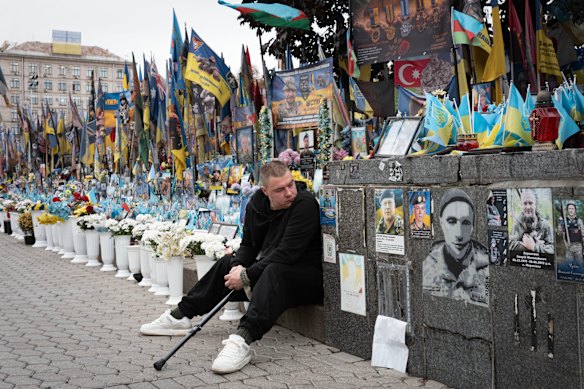
So the “Reserve faces hard choices”. The RBA has been raising interest rates for most of the year, inflicting severe financial pain on young families with mortgages. The rate increases have increased unemployment but had little impact on inflation. Interest rates affect total demand, but the major and obvious cause of Australia’s inflation comes from the supply side. You’d have to havebeen living under a rock if you hadn’t noticed the very significant impact of the wars in Ukraine and the Middle East on petrol, diesel and fertiliser prices. The large increases in the prices of these permeate most parts of our economy and interest rate rises do not stop this damage. James Tulloch, Westleigh
Chiko Roll nation
It is interesting that most of the names of the finalists for Good Food’s chef of the year and service excellence – such as Boonyalit Boonprakong, Justin Shin and Gianluca Esposto – are from non-English backgrounds. How tragically boring will it be if voters continue to support Pauline Hanson and we are all condemned to a diet of fish and chips, potato scallops and Chiko Rolls (“Meet the finalists up for the three biggest Good Food Guide awards”, October 22). Peter Nash, Fairlight
Phew, it’s moths
So glad to hear it’s bogongs that are stuffing up the weather forecasts. I thought AI had taken over the BOM (“Moth swarms confuse weather radar”, October 22). Helen Bersten, Lindfield
Things long gone
The Herald reports that a human composting bill has been passed by NSW parliament’s upper house (“Human composting bill passed by MPs”, October 22). Looks like funeral homes will join video shops, wheelwrights, X-ray machines for feet in shoe shops, dunny carts and Saturday arvo flicks as things that used to be? Joe Weller, Mittagong
It’s a good idea, but I’ll need a bigger compost bin. Michael Deeth, Como West
- To submit a letter to the Sydney Morning Herald, email letters@smh.com.au. Click here for tips on how to submit letters.
- The Opinion newsletter is a weekly wrap of views that will challenge, champion and inform. Sign up here.
Disclaimer : This story is auto aggregated by a computer programme and has not been created or edited by DOWNTHENEWS. Publisher: www.smh.com.au