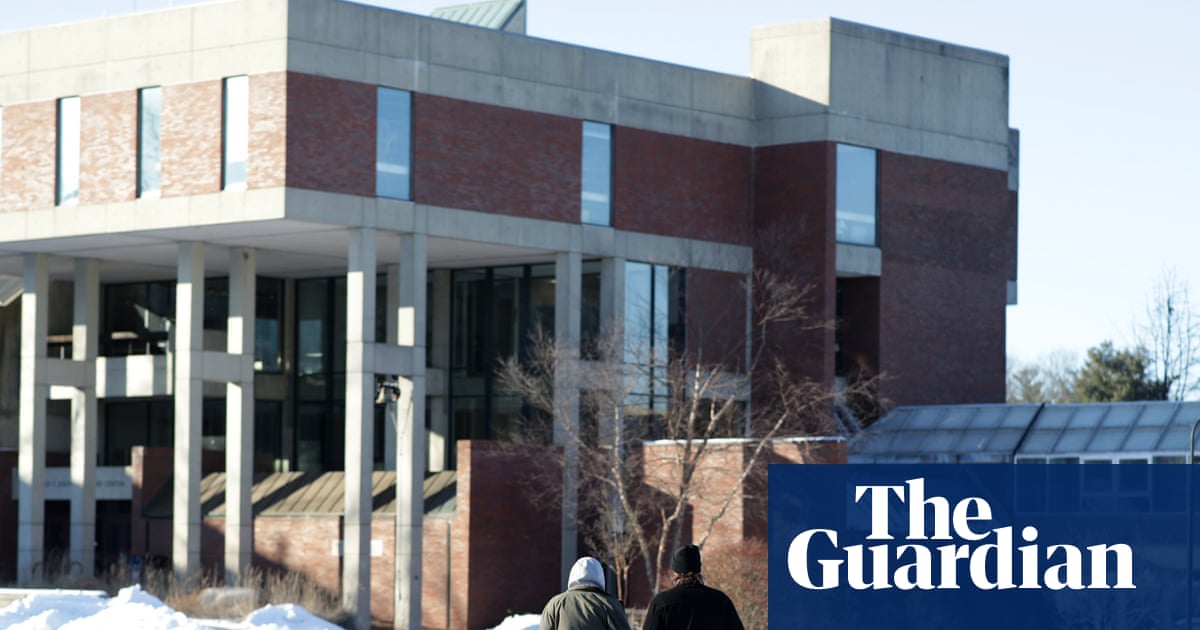
When Hampshire College enrolled its first class of students in 1970, it offered a new breed of liberal arts education, one meeting each student’s interests and motivations, emphasizing learning across disciplines and close relationships with teachers.
For the next 56 years, Hampshire provided just that, becoming a beloved alma mater to scores of unconventional learners who sought, and found, a college experience “unlike anywhere else – and unlike anyone else’s”, as the school’s site still promises to deliver.
“It was the first time in my life where I truly learned in school,” said Alec MacLeod, an artist and educator who enrolled with the second class of Hampshire students alongside film-maker Ken Burns. For his senior project, MacLeod invented a fictional country, designing its history and geography, even its cuisine and folklore, under the guidance of an anthropologist, a philosopher and an artist.
“I can’t imagine I could have done that anywhere else,” he said of Hampshire. “It’s a special place where special things can happen.”
But future students searching for the imaginative, quirky and occasionally unstructured undergraduate experience Hampshire became known for will have to look elsewhere. This week, the college’s president and board announced that the upcoming fall semester will be Hampshire’s last and that the school will shutter permanently due to low enrollment and years-long financial problems. In 2025, the school had set a goal to enroll 300 students – it got about half that number.
In a statement, the president and board wrote that they had left “no stone unturned” trying to save the college after it almost closed six years ago.
“Despite this herculean effort, the financial pressures on the college’s operations have become increasingly complex, compounded by shifting external factors,” they wrote. “We remain unwavering in our belief that the experience a Hampshire College education provides is exactly what the world needs.”
Hampshire is hardly the first institution to fall to collapsing enrollment amid worsening career prospects for college graduates, a decades-long crisis affecting particularly the humanities and liberal arts and the rise of AI – among deeper societal fractures. Nearly 300 colleges and universities have closed between 2008 and 2023, according to the Hechinger Report, which tracks the closures. Dozens of faculty have been laid off and departments cut or consolidated at universities large and small, private and public. Even the country’s most storied institutions have not been immune. The Trump administration, which has declared US colleges and universities “the enemy”, has waged an unprecedented campaign against them that has only exacerbated the crisis.
Hampshire administrators said they decided to close now to use the school’s last resources to help students transition out of it. Those who are close to finishing their degrees will be able to stay through the fall, while others may transfer to a number of partner institutions in Massachusetts and other states.
It’s less clear what will happen to the school’s roughly 250 faculty members, who were advised to apply for unemployment benefits. RL Goldberg, who teaches trans and queer studies there, said faculty were aware of the financial woes but were blind-sided by the announcement.
“A lot of us felt like there was still significant time to course correct,” they told the Guardian.
The announcement was also met with shock and disbelief from alumni, many of whom described the news as “gut wrenching” and “devastating”. As the tributes flocked in, former students spoke of Hampshire as a “magical place” and their time there as deeply transformative. “I wouldn’t be who I am without Hampshire” was a common refrain. “What a loss for future generations who need it” was another.
The product of a 1958 committee established to “re-examine the assumptions and practices of liberal arts education”, Hampshire offered an experimental pedagogical approach, attracting what the school’s president called “bold, iconoclastic thinkers”, and encouraging them to design their own curriculum and self-evaluate in place of traditional grades.
“To know is not enough,” the school’s motto advises, and the Hampshire experience extended far beyond the classroom. The college was unabashedly progressive, fostering a socially conscious, advocacy-oriented education, and becoming one of the first in the country to require all students to complete community service. When conservative legislators in Florida overhauled the state’s only public liberal arts school, New College of Florida, promising to transform it into a “bastion of conservatism”, Hampshire offered its fleeing students admission.
Hampshire is exactly the kind of inclusive, critical-thinking-focused, left-leaning learning institution that the right has long accused of so-called “wokeism”. Already, conservative commentators have seized on the closure announcement to argue that colleges are responsible for their own demise.
“Schools like Hampshire College wrote off half of the country and offered indoctrination over education,” one such commentator wrote. “Students were offered little more than woke credentials with few marketable skills or demonstrated abilities with their degrees. By removing the ‘anxiety’ of grades and rigorous academic standards, the college became a comfort zone rather than a learning zone.”
Goldberg, the Hampshire professor, argued the right’s antagonism against higher education was largely manufactured, but masked deeper questions about the future of universities.
“The truth is, there is [an enrollment] cliff of students who are applying for colleges right now, there are huge questions about what a college education is for. People wonder: Why invest so much money, go into so much debt?” they said. (Hampshire’s tuition runs about $60,000 a year, excluding housing, though the school says 99% of students receive financial aid.) “We’re mired in this conversation about wokeism, which I don’t think is particularly useful to any of us when our schools are closing, our students have no clear pathways, they’re in debt, our teachers are living paycheck to paycheck and our workers don’t have any sense of stability.”
Burns, who had in recent years spearheaded fundraising efforts to save the school, told the New York Times that Hampshire’s closure came at a time “when higher education has been hijacked by the transactional”.
“A college education is, to some, like a Louis Vuitton handbag,” he added. “And that’s not Hampshire.”
Disclaimer : This story is auto aggregated by a computer programme and has not been created or edited by DOWNTHENEWS. Publisher: theguardian.com