
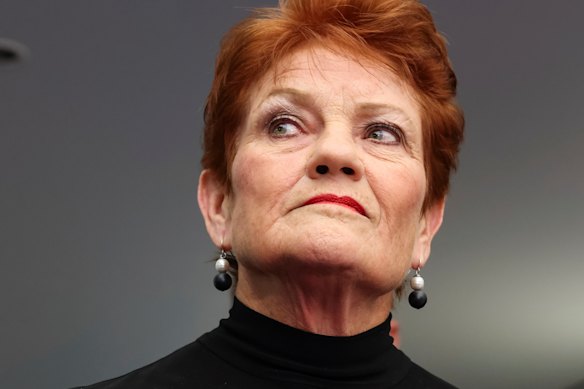
Pauline Hanson says One Nation is rising because the main parties have “lied” to voters. RedBridge polling, published in the Australian Financial Review, demonstrates that younger Australians – Millennials and Gen Zs, now the largest voting cohort in the country – increasingly agree. This is because neither main party is offering the economic reform required, or is honest enough to tell young voters that it is about to get worse. Neither is prepared to admit that the past 15 years were the warning shot, not the wound. Until one of them does, votes will keep bleeding to One Nation – and the two main parties will have earned it.
Younger Australians know that the economy is failing them – and that reality is no longer being contested. The Productivity Commission documented a “lost decade” of income growth: between 2008 and 2018, real wages for 25- to 34-year-olds went backwards while those over 35 kept growing. Per Capita estimates that this cohort was collectively denied more than $60 billion a year in wages over the decade to 2022. COVID hit the same cohort hardest, stalling their careers when they should have been building wealth.
That pressure has been compounded by debt. This cohort will carry the bill from the past two decades twice over: federal debt will pass $1.05 trillion next year, and NSW and Victoria – which bore most of the pandemic’s lockdown burden – will between them hold close to $440 billion in state debt. The GST compounds it: NSW’s share has just fallen to 82 cents in the dollar, its lowest since the tax began. They will service all of this debt while paying some of the highest housing costs, income tax rates and – after the budget – capital gains tax in the world.
The budget papers made this economic reality explicit. Treasury kept its productivity growth assumption at 1.2 per cent – effectively conceding that the position of younger Australians will not improve this parliamentary term, or next. And waiting in the wings of that is artificial intelligence – the technology most likely to transform the very white-collar industries in which this cohort is concentrated. The budget had little to say about how Australia capitalises on the AI transition or protects workers through it. This generation is being left to face that alone.
Labor insists that it is the party on the side of young people. But the ALP’s instinct, confronted with a generation whose real wages have stagnated for a decade, is to offer $250 – not to ask why $250 is the most that the system can deliver. The government treats younger Australians increasingly as recipients of token assistance rather than participants in a dynamic economy.
The Coalition’s problem is different. Federal Opposition Leader Angus Taylor’s proposal to index the bottom two tax brackets is one of the few honest economic ideas offered in recent years. But much of the Coalition policy platform is like a slingshot to the past, as though this cohort could be won back by re-litigating the culture wars of the past decade. They cannot.
The uncomfortable reality for the two main parties is that One Nation is now competitive. The RedBridge polling projects One Nation winning 53 seats and becoming the formal opposition, with the Coalition reduced to 12. The Greens are projected to lose their last lower house seat. Even the teals – whose success has prompted talk of a new party – could face headwinds. No part of the existing political map is immune.
This is not because voters have moved to the right. It is because young voters have concluded that the main parties’ economic offer is so thin that a minor party with no answer on productivity, housing, AI or tax reform now looks like a reasonable protest vote. One Nation has no answer to why a generation cannot afford a house. It simply does not pretend otherwise.
What this generation wants is not radical. It was promised a society in which work was rewarded, housing was attainable and the ordinary milestones of adult life were within reach. It wants housing supply addressed at scale, tax reform that does not place the burden on working-age incomes, and an economy capable of generating sustained wage growth. Instead, Labor is offering managerialism without mobility. The Coalition is offering frustration without modernity.
The main parties need to speak honestly about debt, productivity, technological disruption and the reforms required to restore upward mobility. A party willing to do that would not just win an election, it would deserve to. If neither does, the result is visible in the polling. Pauline Hanson is not the cause of this. She is the reckoning. And the next election could be very different to the last.
Jane Buncle is a barrister and former member of the administrative committee of the NSW Liberal Party. She is a member of the Liberal Reform Commission led by Senator James McGrath.
 Jane Buncle is a barrister and officeholder of the Liberal Party
From our partners
Disclaimer : This story is auto aggregated by a computer programme and has not been created or edited by DOWNTHENEWS. Publisher: www.smh.com.au


