in Madrid
Back to the virus-hit cruise, Fernando Clavijo, the regional president of the Canaries, has said he persuaded the central government not to allow the MV Hondius to dock in Tenerife.
Clavijo had objected over the boat’s arrival, saying it could threaten public health in the archipelago, and had demanded a meeting with the prime minister, Pedro Sánchez.
He eventually got a meeting today with Spain’s health minister, Mónica García, who told him the boat would remain at anchor.
Here’s what he’s just posted on X:
“Collaboration can only happen with information, accuracy, and respect for the Canary Islands. Today I reiterated to the State our opposition to the cruise ship docking in the Canary Islands. We have succeeded in getting the national government to accept the proposal put forward by the islands that the ship not dock under any circumstances and remain anchored until the passengers have disembarked, ensuring all safety guarantees for the people of the Canary Islands and for those traveling on board.”
The Irish government will do everything possible to make sure Irish citizens on a hantavirus-hit cruise ship get home safely, Ireland’s premier said.
Tour operator Oceanwide Expeditions said two Irish nationals are on board the MV Hondius, which is at the centre of an outbreak of the disease.
Speaking to reporters on Thursday, taoiseach Micheal Martin said health authorities are “working actively” to bring the Irish citizens home.
Asked if they will have to quarantine he said: “Health Service Executive and public health protocols will apply. Obviously, quarantine and isolation will be part of that.”
Spain’s head of civil protection, Virginia Barcones, provided details at a press conference in Madrid about what those on board the cruise ship can expect after arriving in the Canary Islands at around midday on Sunday.
She said: “From the moment when we see that asymptomatic people are ready to be evacuated from our country, there will be a quick process,” she says.
“They will not leave the boat until the plane is there to take them to their countries. Once they leave the boat, they will be taken by road, it’s about a 10-minute drive.”
Barcones added: “Mechanisms are being put together, but they will be completely isolated from the public.
“They will be taken to an isolated fenced off place, they will be in isolated vehicles, they will reach an area of the airport that will be completely isolated.
“There is no possibility of contact.”
That’s all from me, Jakub Krupa, for today, but I am leaving you with Nadeem Badshah who will keep you up to date with the latest news from around Europe.
in Madrid
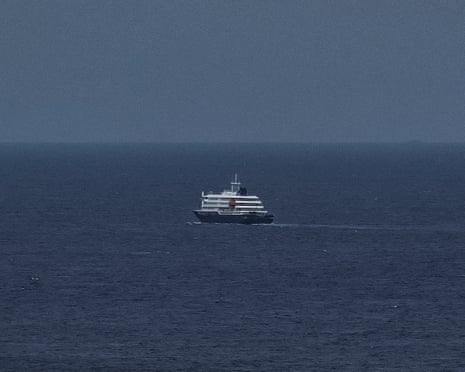
The ship is due to anchor off the port of Granadilla in Tenerife on Sunday.
EU nations are expected to begin evacuating their citizens the following day.
As the Spanish health minister explained, “passengers will be evaluated on board the ship and will only disembark for transfer or repatriation with protective equipment, a specific health worker, and without contact with the population.”
As explained earlier, the current plan – that Clavijo fought for – is for the virus-hit cruise ship to go to Canary Islands, but not dock there, and merely remain at anchor.
The passengers will be allowed to leave it by boat only when their onwards transfers – to isolation or abroad – are ready so there is no risk to the local population (15:17, 15:48).
in Madrid
Back to the virus-hit cruise, Fernando Clavijo, the regional president of the Canaries, has said he persuaded the central government not to allow the MV Hondius to dock in Tenerife.
Clavijo had objected over the boat’s arrival, saying it could threaten public health in the archipelago, and had demanded a meeting with the prime minister, Pedro Sánchez.
He eventually got a meeting today with Spain’s health minister, Mónica García, who told him the boat would remain at anchor.
Here’s what he’s just posted on X:
“Collaboration can only happen with information, accuracy, and respect for the Canary Islands. Today I reiterated to the State our opposition to the cruise ship docking in the Canary Islands. We have succeeded in getting the national government to accept the proposal put forward by the islands that the ship not dock under any circumstances and remain anchored until the passengers have disembarked, ensuring all safety guarantees for the people of the Canary Islands and for those traveling on board.”
We also have a bit of an update from Hungary’s incoming prime minister Péter Magyar’s after he met with Italy’s Giorgia Meloni.
Their meeting also had the potential to be a bit awkward given Meloni’s vocal support for the outgoing prime minister, Viktor Orbán, but it looks like they got along just fine.
Magyar, who is becoming a bit of a social media sensation, walked into Palazzo Chigi with a cheery “Buongiorno a tutti” (“Good morning all”) as we can tell from a short video of his visit.
(I know this is not the most important thing here, but note the classic Italian hit his team chose to illustrate the visit with, which also – somewhat randomly – happens to also be a personal favourite of the Czech prime minister, Andrej Babiš.)
In their respective statements after their talks, Magyar said it was a “constructive” meeting which showed that “Italy and Hungary are closely aligned on many issues – from determined action against illegal migration, to the EU accession of the Western Balkans, and the strengthening of member states’ competitiveness.”
He also made an oddly specific reference to a Hungarian logistics hub in the Italian port city of Trieste, which he said he hoped to see completed as early as possible.
For her part, Meloni issued a courteous statement saying they “exchanged views” on key issues – competitiveness, migration and international crises – and that the bilateral relations between Italy and Hungary continue to be “strong.”
Sadly, her version of the video doesn’t include the same catchy Italian song (boo).
Magyar will be inaugurated in Budapest this Saturday, ending 16-year rule of Orbán, with a celebratory public event planned to usher the new era – and an EU flag expected to return to the country’s (stunning) parliament building.
Meanwhile, we have a bit more on the meeting between Pope Leo and US secretary of state Marco Rubio earlier today, with the Vatican saying the pair “renewed the shared commitment” for good relations between the US and the Vatican.
The US embassy to the Holy See said on X that Leo and Rubio had discussed “topics of mutual interest in the western Hemisphere” and “their shared commitment to promoting peace and human dignity.”
It was very notable that the WHO was keen to strike a reassuring tone in this press conference: yes, the outbreak on the ship is a serious public health situation and needs to be cautiously managed given its characteristics, but it remains mostly contained and the overall risk to the general public remains low as its transmission works very differently to Covid.
It was clear that the main point we were meant to take from this briefing is that, in the WHO’s view, the situation is nothing like the beginning of the Covid pandemic in 2020.
Well, let’s hope they’re right.
As the press conference wraps up, here is a summary of the key points:
-
World Health Organization experts stressed the hantavirus cruise outbreak was “not the start of Covid pandemic” (14:38, 15:44) as they pointed several differences between the two viruses and insisted the public health risk remained low (15:24, 16:17).
-
There are currently eight cases, with three people dead (15:20), but the situation is believed to be largely contained to the cruise ship with expansive public health operation under way to minimise risk of further transmission.
-
“We do not anticipate large epidemic,” the WHO’s senior expert said (15:40).
-
The new virus needs “close and prolonged” contact for transmission, such as among household members, intimate partners, and people providing medical care (15:20).
-
The incubation period of virus is expected to be “up to six weeks,” with WHO noting that more cases are “possible” (15:23)
-
The first confirmed case is believed to be linked to a birdwatching trip in Argentina, Chile and Uruguay (15:28).
WHO’s Maria Van Kerkhove is very clear though on the scale, as she repeats – time and time again – that the overall risk remains low.
“I do want to reiterate contextually what we’re talking about. The risk to the general public is low.”
WHO’s Anaïs Legand says in previous outbreaks a “high” mortality rate associated with the hantavirus was observed, as she talks up the importance of early supportive and intensive care to address the issue as early as possible.
“It is very important that any patient can be admitted to a safe and adequately equipped [space] with trained staff to ensure that patients can receive the level of care that is needed, in case they present severe presentation and deteriorate,” she says.
Disclaimer : This story is auto aggregated by a computer programme and has not been created or edited by DOWNTHENEWS. Publisher: theguardian.com