When looking at how a budget is going in its immediate aftermath, don’t look at the answers given by the politicians trying to sell it – look at the questions they are asked.
On the morning after last week’s budget, broken promises was the common theme. Which sounds like a negative, but in fact it was the closest thing to an endorsement Labor was likely to receive from interviewers, in the enormous, glaring absence it pointed to: criticism of the actual policies.
ILLO TO COME FROM BENKE
On the occasions the policies themselves were questioned, it was often to ask why Labor had not gone further. By late Wednesday morning, the government would have felt safe declaring victory, at least in this first crucial phase.
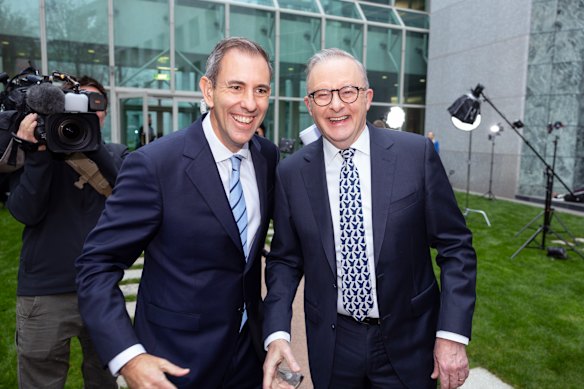
If the general acceptance of the need for change was part of this, there was another element, too – more important still. Both Treasurer Jim Chalmers and Prime Minister Anthony Albanese looked suddenly larger. There was a calm assuredness to Chalmers, who had seemed to change overnight: there are moments in political life that can do that.
Both seemed sufficiently comfortable in what they had done to move easily through different registers: humour when useful, ferocity when necessary. Albanese, challenged on having used such tax advantages himself, declared that when young he had drilled into him the importance of owning a home – like all “working-class people who want the next generation to be better off than they are. And that is precisely what we are doing here … And I’m proud that I wasn’t born to rule. I’m proud that I worked hard. I’m proud of what I’ve achieved … And that is why, in last night’s budget, we made sure that we do not want to leave a generation behind.”
It was the best use of his personal history we have heard: a matching of identity, purpose and policy.
This is often the way of things in politics. It is so easy to become immersed in the daily demands of political life – to find yourself doing only what is in front of you. Then – sometimes from choice and sometimes not – a politician finds themselves in a fight. In that moment, they must explain why they are doing what they are doing. In justifying their actions, they reveal to us – and sometimes to themselves – their underlying drive.
What is that drive, for this Labor government, then?
Albanese and Chalmers mounted a consistent case that people working for an income had been hard done by relative to those earning income from assets. This is a clear articulation of one of the structural problems with both our economy and our society – and it draws a distinction between those who have benefited and those who have suffered.
This budget was significant because it began to confront the implications of that distinction. Yes, more needs to be done. But that is a truism, not a criticism: it does not undercut the significance of Labor’s actions. This is a massive intervention in the housing market – a reshaping of the architecture of that market, left in place for decades, and with it the assumptions made by millions of Australians about how they should spend their money.
And underneath that, there is something with the potential to be far more significant still – the fact the government is admitting there is a fundamental problem in our society.
In doing so, the Albanese government has shifted its position. This was reflected in a second element of the story the government began to tell: about the “status quo”. The status quo in tax and housing, said Chalmers, was “busted”. The Coalition, by vowing to repeal Labor’s changes, was defending the “status quo” – it was, said Albanese, “in denial about the challenges facing Australians”.
Now remember that not long ago, Labor opposed these changes, too. By its own logic, then, it was Labor very recently defending the “status quo” – Labor that was “in denial about the challenges facing Australians”. And this accords with the overriding impression of this government until now: its tendency to make small alterations in the hope of leaving things largely as they were. For Labor to have shifted its stance here may be a seismic shift in politics as we have experienced it since 2022.
By taking this action and arguing forcefully for it, Labor has made one more shift. It has acknowledged what is possible.
Forty years ago, Paul Keating said Australia risked becoming a “banana republic”. In a piece written to mark that anniversary, Keating last week confessed that “in the saying of it, the truth of it lifted a weight off me”.
Keating had done three things with that truth-telling. First, he had created a shared sense of reality: these were the circumstances Australia was facing. Second, he had made it possible to take the actions he was soon to take. And third, he had gone further than that still: he had made it necessary to take those actions. He had made it impossible for himself and his colleagues to back out.
Albanese and Chalmers have now set themselves against the status quo. Yes, they mean the status quo specifically on housing and taxation. But the symbolism of what Labor has done is larger. They have underlined the great inequality that exists in this country. They have signalled that it cannot be allowed to grow larger. And they have made clear that taking on that fight is both possible and within their capabilities.
In one sense, that creates an extra burden: like Bob Hawke and Keating, they cannot now relinquish the responsibility they have taken on. But the truth is they already carried that responsibility, whether they admitted it or not. Now it has been declared, publicly and irrevocably. The immediate impact, last week, was much the same as it was for Keating: a weight seemed to lift off them.
Sean Kelly is an author and a regular columnist.
 Sean Kelly is author of The Game: A Portrait of Scott Morrison, a regular columnist and a former adviser to Julia Gillard and Kevin Rudd.Connect via X.
From our partners
Disclaimer : This story is auto aggregated by a computer programme and has not been created or edited by DOWNTHENEWS. Publisher: www.smh.com.au