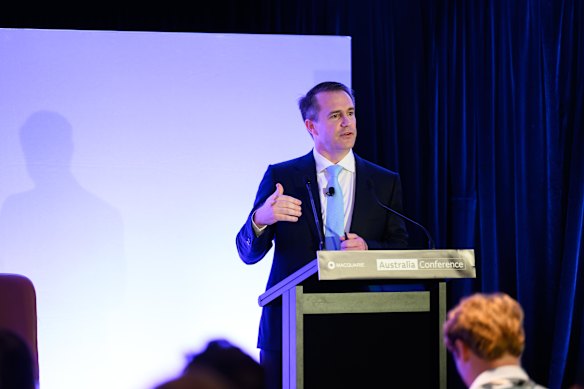

Sharon AI’s controversial boss James Manning had a brutal response to a damning report that has raised questions about his business conduct, as well as the deals that have created the billion-dollar company he founded just two years ago: “Have you seen the share price today!?”
Since the report by New York-based short seller Bleeker Street Research was released this week, Nasdaq-listed Sharon AI shares have jumped around 20 per cent to a record high of $US54.
Manning said the company’s bona fides were backed up by world-class partners like Nvidia, Cisco and now financial giant Oaktree Capital Management, which recently led a $US350 million ($483 million) convertible notes raising for Sharon AI.
“I don’t want to dig into the short report overly … there’s a lot of allegations there, but I think you’ve got to look at our ecosystem. You’ve got to look at our partners,” he told attendees of the Macquarie Australia Conference in Sydney on Thursday.
For completeness’ sake, they would also have to look at previous Sharon AI claims. In its recent annual report, it mentioned AI chip giant Nvidia was a “strategic shareholder”. This was later clarified, with the startup admitting this was not the case and the statement had been made “in error.”
Still, that lapse will be of little solace to the author of the short report, which rather than sending the stock tanking ushered in the latest share price jump.
Bleeker Street Research did not reveal how many Sharon AI shares its related funds have sold short – a scheme that’s betting on falling share prices to make money – but it faces significant losses if the stock continues its ascent.
In its report, the New York hedge fund questioned Sharon’s transformational five-year, $US1.25 billion contract with little-known Indian group ESDS Software Solutions Limited unveiled last month. It also alleged there were questionable related-party transactions by senior executives, including Manning.
It also shed light on Manning’s acrimonious exit from bitcoin miner Mawson Infrastructure Group, which ended its legal battle with him in 2023 with a $2 million payout.
Separately, an old report from this masthead surfaced, highlighting the AI executive’s involvement in an alleged scam that almost cost Crown casino $32 million from a winning streak by Manning, who denies any wrongdoing.
The media reporting on these issues may have helped to ensure that Manning spoke to a packed audience of fund managers at the Macquarie conference, eager to hear details about his start-up’s planned ASX float.
If successful, Sharon AI’s dual-listing in the US and Australia will give local investors direct exposure to the AI investing frenzy that has sent Wall Street to record highs while other bourses around the world, such as the ASX, have faltered in face of the ongoing Iranian crisis.
“I think my big message is that AI demand is exploding, and I don’t need to tell you that because I think you’ve seen it everywhere,” Manning told the conference.
“The adoption of AI is real, and I think that, fundamentally, is driving demand. And we’re in an environment where demand (exceeds supply).”
His forecast of a boom in AI use was backed by Coles chief executive Leah Weckert, who said at the same conference that the grocery giant is using AI throughout its business, including to help decide what to stock in each store.
“We are on the cusp of something quite different in retail,” she said, painting a scenario where up to 30 per cent of Coles’ online grocery sales will be handled by AI agents by 2030.
Her comments helped explain Sharon AI’s rapid ascent, which Manning likened to another Aussie start-up that has listed overseas – former crypto miner Iren, whose stock soared more than 1000 per cent in value last year. Iren’s pivot from Bitcoin mining to high-performance computing is now underpinned by a long-term contract with Microsoft.
“Those guys have done a phenomenal [job],” Manning said.
He was also keen to point to what sets Sharon AI apart from other tech stocks as a so-called neo cloud provider. Neo cloud providers outsource part of their computing infrastructure to others, and focus on the core computing – setting up and running AI specialised hardware such as Nvidia chips in data centres – for customers like graphic design platform Canva.
“We’re not trying to build out the data centres. I think that’s what differentiates us so much. We are not trying to build out the underlying infrastructure, and we partner with leading data centres to do this,” keeping a lid on the investments needed to scale up its business, Manning said.
The Market Recap newsletter is a wrap of the day’s trading. Get it each weekday afternoon.
 Colin Kruger is a senior business reporter for the Sydney Morning Herald and The Age.Connect via email.
From our partners
Disclaimer : This story is auto aggregated by a computer programme and has not been created or edited by DOWNTHENEWS. Publisher: www.smh.com.au