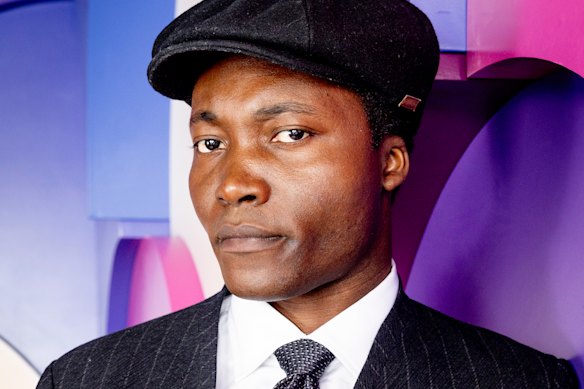
Benjamin Clementine defied his family to forge his own musical destiny. The journey that followed has been far from easy.
Benjamin Clementine was five when an uncharacteristic act of resistance sealed his fate. Growing up in a household where instruments were forbidden, he became so entranced with the toy piano a classmate had brought to primary school that when she refused to let him play it, he took it – hoping to spend at least one evening at home with it – but was ordered to return it before he had the chance. How, he wondered, had this single-octave keyboard produced such an astonishing combination of sounds?
“I was looking at this girl with that thing – I remember it like it was yesterday – and I asked her if I could play,” he says. “She said no. She just wouldn’t give it to me. I was so fascinated by this thing but sad that I couldn’t have it. When I looked at it, I got this good feeling I’d never felt before, outside of laughter with my siblings. It’s like how some kids feel when they find football or basketball or tennis.”
Born and raised in London to a family of Ghanaian descent, the 37-year-old musician, composer and actor had almost no exposure to popular culture in his formative years. It was a strict, religious household. Non-Christian music was forbidden, as were instruments of any kind. His father, who had been a professor of mathematics in Liberia, was determined his son would study law.
Somehow, despite his parents’ best attempts to shield him from the corrupting influence of secular music, Clementine, who will tour Australia for the first time this month, has become one of the most acclaimed voices in contemporary music. Unbound by genre, his compositions draw from a range of styles including classical, experimental and avant-garde. Poetry, literature and the writings of pioneering psychoanalyst Donald Winnicott also inform his work.
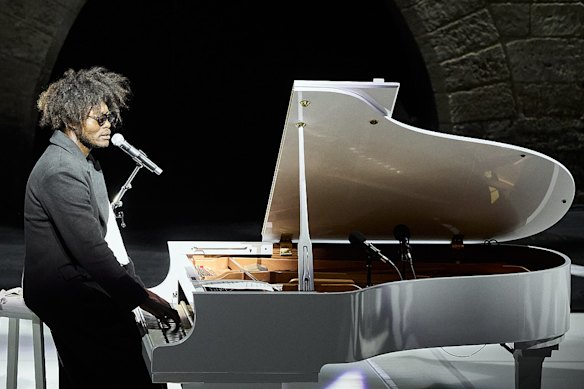
Speaking via Zoom from his home in California, his 193-centimetre frame curled into an armchair, Clementine says that when he brings his Back To Basics tour to Australia, it’ll just be him and his piano, which he usually plays barefoot. (He has likened this to the thrill of driving without shoes.)
“Because I’ve never toured Australia, I want to show them my bare self, and it’s up to them to take me for who I am,” he says. “To be honest, I get tired of touring with so many people [in a back-up band].
“There’s always this offer of the Sydney Opera House. I would love to play there, but first I want to come in with a humble kind of approach. I don’t want to play in front of 5000 people right now in Australia; I want to play in front of 500 to 1000 people. My aim is to be intimate with people who are seeing me for the first time, so that we genuinely get to hear each other and smell each other. That’s what I’ve always done.”
This pared-back approach is also a chance to reconnect with his musical roots, having taught himself to sing, compose and play a number of instruments.
“Before all the tricks of production and frequencies and equalisation and compression, there’s just the song,” he says. “My greatest ability, from what I’ve been told, is to simply tell a story without noise. Over the years, I went from that to almost showing off through production – and sometimes you get lost in those things. I’m just tired of it. This is about going back to the fundamentals.”
It’s not hard to see why critics frequently compare Clementine, with his powerful voice that shifts between delicate vulnerability and raw intensity, to Nina Simone. Many of their songs are self-contained stories, often containing social critiques. As one reviewer observed, each sings “as if all the world depended on it”. And they share a striking physicality that underscores a powerful stage presence. Clementine, who has modelled for Abercrombie & Fitch, has high, sharp cheekbones and an angular jawline. As The Guardian memorably put it, he “resembles an art deco illustration of himself”.
Throughout his career, Clementine has amassed high-profile fans including Damon Albarn, Bjork and Paul McCartney. He met the latter after he was invited to perform on the TV music program Later… with Jools Holland.
“Normally, I’m not fazed by anything when I’m performing but I could see Paul watching while I was playing and it was all a blur,” Clementine says. “Afterwards, I went to go to the loo and someone tapped me on the shoulder. It was Paul McCartney and I can’t remember exactly what he said but it was something like, ‘Oh, that was a great song’.”
Having already recorded an EP, Cornerstone, he got to work on his first studio album, At Least For Now, released to wide acclaim in 2015. His subsequent albums, I Tell a Fly and And I Have Been received similar praise – including from the father who had been so reluctant to let him play music.
“He never said he was proud of me, but he showed me in his own way,” Clementine says. “Before he died, he said, ‘I like some of your songs’. It broke me down a little bit and I was in tears. For me, it was a huge compliment.”
Now, as a father of three, Clementine understands his parents’ motivation in pushing him towards a career in law. Having fled political turmoil and material deprivation to build a stable life in London, they spent a fortune on his education, including boarding school. To them, it was incumbent upon their children to forge respectable careers. But fate intervened when his family moved to a house where an upright piano had been left behind.
“They didn’t want me to play it because they knew it would pull my interest from my study,” he says. “And they were right: I was going to be a lawyer but then I decided not to do that.
“After suffering themselves, and working hard to be accepted into society, you wouldn’t want your children [to experience similar hardships] … so there was resentment and anger,” he says. “They’re conservative; they do things the ‘correct’ way so it’s just embarrassing to have a child who has abandoned everything but doesn’t really know what he wants to do, other than going for whatever is ‘out there’. It’s a really hard thing for an immigrant parent to process that.”
Naturally, music lessons were not an option, so Clementine taught himself to play piano by ear, and tried any instrument he could get his hands on. He spent hours in his local library, studying poetry, art and literature. (Sylvia Plath and William Blake are major influences, as is Nick Cave: “His music transports you to different places, and transcends different feelings and moments in time.”) He bought books with accompanying CDs to acquire the basics of French, Mandarin, German and Italian, among other languages.
“I’ve always had a thing for languages and literature,” he says, paraphrasing a quote commonly attributed to Cicero. “‘Language without literature is like a body without a head’. I believe that literature is music in itself. It has melody and harmony, it’s atonal and tonal, it has rhythm. Now, I find myself writing and then applying it to common sounds. I change the accents on words and the intonation is determined by how I feel. I think that’s my personal secret in how I express what I want to say.”
Among his most popular songs are Cornerstone, which he performed on the Jools Holland show; I Won’t Complain, from his Mercury Prize-winning debut album At Least For Now; and Nemesis, used in the opening credits of Apple TV’s Morning Wars. He has also had supporting roles in the 2021 film Dune; Steve McQueen’s 2024 World War II drama Blitz; and Guy Ritchie’s Netflix series The Gentlemen.
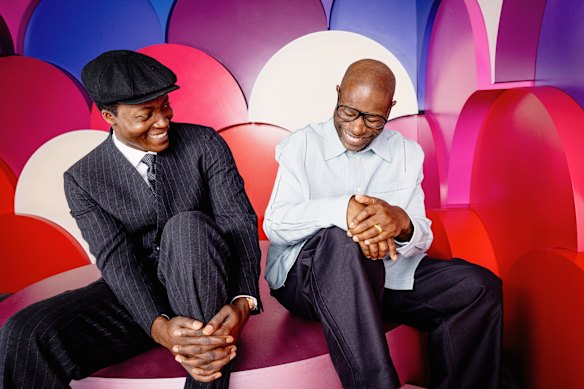
Does he believe the absence of formal music training allowed him the freedom to cultivate his unique sound?
“If you’d asked me that question 10 years ago, I would have been arrogant,” Clementine admits. “I’d have said something like, ‘There’s no such thing as theory; we should all just receive music from our ears’. But as a 37-year-old man, I think theory is necessary.
“Look, I’m happy with how I turned out. And I can read music now because I spent five years studying it myself, so I compose differently.”
When Clementine was 16, his parents divorced: a huge shock in light of their devout Christianity. He lived with his father briefly, then his mother, before bouncing around Camden and crashing with mates. Not long after, he quit school.
At 19, he moved to Paris, primarily because it was close and contained a significant proportion of English-speaking residents. Much has been made of his time in the city, from periods of homelessness and stints in hostels to busking in the subway. But he’s reluctant to portray this as the first chapter of a rags-to-riches tale.
He did, however, learn a lot about life while performing at train stations.
“It was like Darwin’s survival of the fittest,” he says. “If I asked for money, I would only eat for a day but if I befriended somebody, I would eat for a week. I learned to be a better human. In England, I was still a boy.”
Fellow buskers introduced him to popular music from the ’40s, ’50s and ’60s, including Nina Simone, Bob Dylan, Leonard Cohen and The Beatles.
“In that period, musicians had something they wanted to say and they had a melody to go with it,” he says. “But over the past 30 years, popular music has all been driven by the catchy phrase and the chorus. In the West, we’re obsessed with melody because it sells music. But melody has also plagued our music in the sense that people get away with saying nothing.”
In France, Clementine became successful enough that he could afford to eat and pay his bills. Still, he refused regular requests from police to obtain a mandatory busking permit. “I didn’t want to succumb to the idea that I’m only worth a cent in the subway,” he says. “I never went to Paris to busk or make music. I knew that I was going somewhere.”
Benjamin Clementine performs at Melbourne’s Forum on October 20; Sydney’s Enmore Theatre on October 21 and Perth’s Fremantle Arts Centre on October 24.
Want more music?
Disclaimer : This story is auto aggregated by a computer programme and has not been created or edited by DOWNTHENEWS. Publisher: www.smh.com.au