When Nathaniel Spencer, who now is 41, was a high-school golfer at the chock-full-o-athletes IMG Academy in Bradenton, Fla., he talked his way into playing center-back in a scrimmage with the school’s supremely talented soccer team. Among the standouts on the field was Freddy Adu, an attacking midfielder who, at 14, had become the youngest athlete ever to sign a professional contract in the United States when he came to terms with the Major League Soccer team, D.C. United.
Spencer, who had played competetive soccer growing up but only at the local level, said he didn’t know who Adu was; he also didn’t care to know. He wanted only to shut Adu down, and shut him down he did, Spencer said. So suffocating was Spencer’s defense, he said, that the coaches inquired about his interest in joining the team.
“That was a turning point in my life,” Spencer told me the other day. “Do I choose soccer? Do I choose golf? Obviously, I chose golf.”
But it’s not quite that simple, because over the next two-plus decades, Spencer also chased many other pursuits, including but not limited to professional rock climbing, pro disc golf, motorcycle riding (he’s owned five of them), high-level table tennis, all-night Texas Hold ’Em, intensive gym training, the Air Force and making history as a contestant on the hit show, “American Ninja Warrior.” Oh, and did we mention Spencer also quit golf — for 15 years?
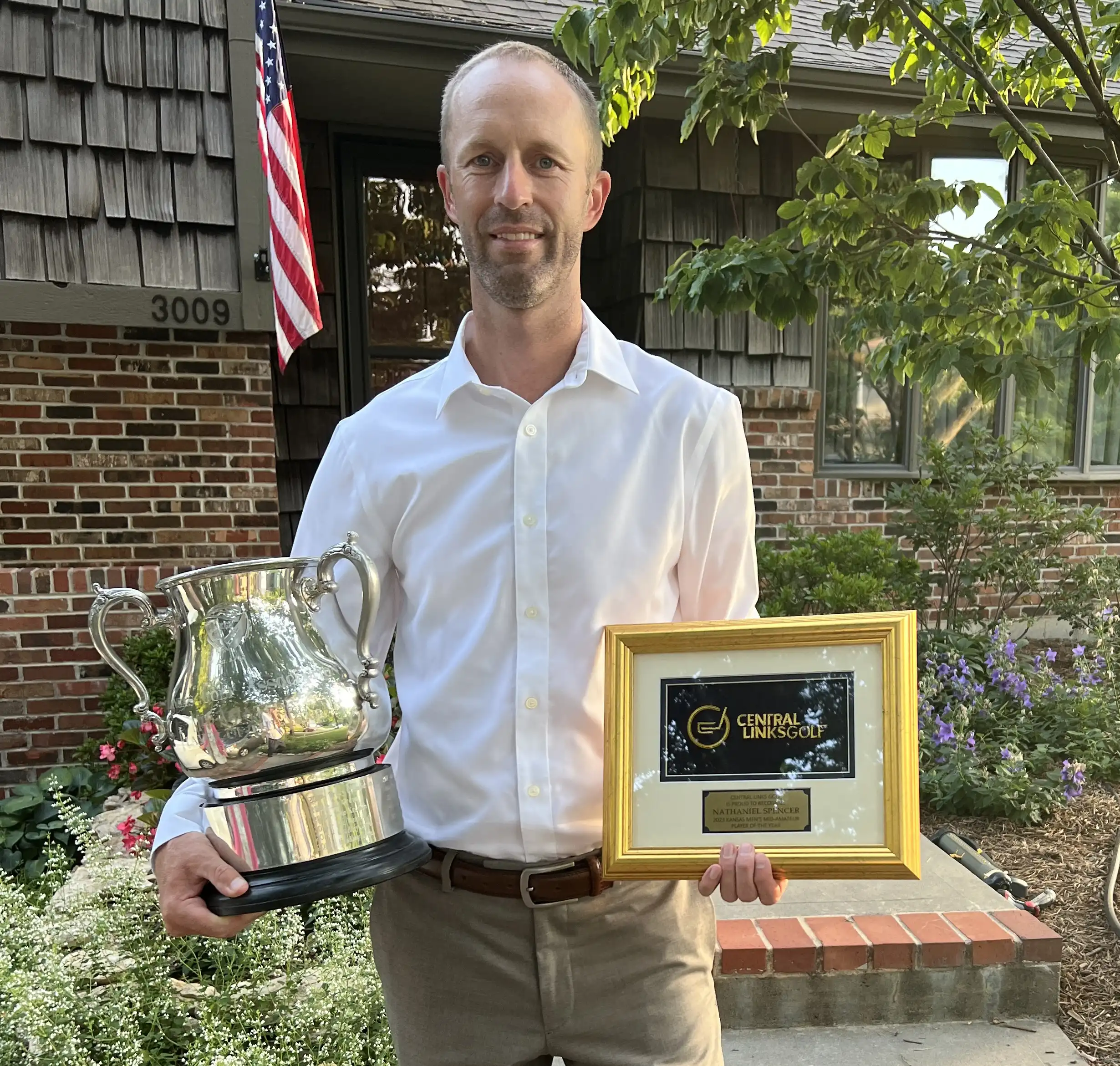
Today, Spencer has returned to the game, and in a big way. In 2023, he was named the Kansas Mid-Amateur Player of the Year, and this weekend he will make his first appearance in a United States Golf Association championship: the U.S. Mid-Amateur, which kicks off Saturday at Sand Valley, a sprawling golf resort in central Wisconsin about a nine-hour drive north of Spencer’s Lawrence, Kansas, home.
It’s not unusual for U.S. Mid-Am competitors to take long and winding roads to their first Mid-Am start; in fact, that’s one of the charms of the event. But you’d need to go deep down the tee sheet in this year’s field — or maybe any Mid-Am field — to find a player who took a more circuitous, adventurous or improbable route than Nathaniel Spencer, whose resume reads less middle-aged golfer than Marvel action hero.
Spencer has been lighting up the Kansas amateur golf circuit.
courtesy nathaniel spencer
***
SPENCER GREW UP IN the same town in which he now lives. As a toddler, he would follow his father, Daniel, then a University of Kansas professor, to a local park where Daniel hit golf balls. Soon enough, young Nathaniel was doing the same. That led to range visits, and at age 7, by which time his family had joined Lawrence Country Club, on-course rounds. Nathaniel mostly was self-taught but he improved quickly and soon began playing in local junior events. By his early teens — when he wasn’t blowing fastballs past batters as a standout pitcher — he was playing golf at the national level, in American Junior Golf Association tournaments, which raised his profile and led to his admission to IMG.
During his stint in Bradenton (he was there only for his junior year), Nathaniel was selected to play on a team of top U.S. juniors that included future PGA Tour winners Brian Harman and Patton Kizzire. Nathaniel also spent his time at IMG rebuilding his swing. He was a slender kid and had trained himself to sway through impact for power; his IMG coaches wanted him to put a more “modern” move on the ball, Spencer said, adding, “I probably didn’t come into my swing until maybe my senior year.”
As Spencer tells it, he wasn’t much interested in attending college. He’d seen some of his contemporaries go that route and believed he’d develop more quickly by testing his game in the pro ranks. For a short while, he had financial support from local boosters, but when that dried up, life got tough fast. He bounced among mini tours — the Dakotas Tour, the Gateway Pro Tour, the All Pro Tour — but was struggling to make ends meet. PGA Tour Q-school also was out of reach, because, he said, he couldn’t afford it.
“It was really frustrating for me, because here I was, I was a good player,” he said. “I wasn’t like winning every single time, but I was definitely good enough to be given that opportunity, and I just never was afforded the opportunity. It really upset me.”
Spencer was 23 and fed up with the game, or at least with the barriers that he perceived to be holding him back from progressing in the pro game.
He’d had enough. He was done with golf.
“And that kind of set me on a 15-year journey of just exploring life,” Spencer said.
***
DIVORCING HIMSELF FROM the game wasn’t easy for Spencer. “When you lose purpose in life — there’s a lot of people that, I guess, can relate to that, where they’re either good at something or, for whatever reason, they’re unable to do what they feel like their purpose is,” Spencer said. “For me, it was like, Well, what am I going to do now?”
Spencer needed work, and he found it, he said, by making contacts through pro-am appearances; one of those connections, he said, led to a job with an environmental consulting agency. Around this same time, Spencer said, he began feeding his competitiveness through fitness and weight training.
“Kind of became a gym bro for a little bit,” he said. “Just trying to gain some size since I was always skinny.” Size, speed, strength, agility. Spencer gained all of it. Through long hours at the gym, he said, “I ended up meeting some people that were in special operations, in special warfare and also three-letter agencies,” some of whom encouraged him to pursue that line of work.
Spencer considered it and even trained with his new military pals but ultimately decided the time wasn’t right for that kind of career move. Then one of those friends made another suggestion: Spencer should try out for the TV show “American Ninja Warrior,” which pits contestants against rigorous obstacle courses. As it turned out, the deadline for applying for Season 4 was the next day. Spencer mobilized quickly, shot a bio video and submitted it. The next morning at 4:45 he was awoken by a call from one of the show’s producers. Spencer was in.
A few weeks later, Spencer went to Texas for qualifying, one of about 4,000 hopefuls nationwide seeking one of the 100 finalist spots. He advanced though the first of two rounds and then in the second round announced himself as a legitimate contender when he became the first entrant to finish the course in the allotted time. He was moving on.
With a month between qualifying and the finals, Spencer settled in Houston to train with some of his fellow contestants. “Wiithin like a week of doing it, they were like, ‘Dude, you’re really strong. You just really need to get your finger strength for some of these obstacles that you’re going to go through. You should go head next door.”
Next door, as in the rock-climbing gym. Spencer had long wanted to try rock climbing, and he and his 140-pound frame took to it like a mountain goat to a cliff, progressing at a pace that, as he described it, no one at the facility had ever seen before. “I fell in love with it and I was like all in,” Spencer said. “I was like, okay, maybe this is my purpose.”
But first he had a TV show to try and win. In the first stage of the “American Ninja Warrior” Season 4 finals, which was held on a splashy outdoor set in Las Vegas, 25 of the 100 finalists attempted the course before Spencer — and all 25 failed. Then it was Spencer’s turn: 130 seconds to complete a series of daunting obstacles with names like the Step Slider, the Rolling Log and the Jumping Spider. Reality shows like to fit their contestants into archetypes (i.e., Marketing Specialist, Software Engineer, etc.); Spencer was “Former Pro Golfer.” As he made his way around the course, one of the announcers said, “He’s got great touch — just like a golfer.”
Spencer competing on “American Ninja Warrior.”
American Ninja Warrior
When Spencer hit the final obstacle, a rope wall, he had 16 seconds left to scale it, clamber onto a platform and cross the finish line. It was going to be tight, and it was. Spencer completed the course at the exact instant the clock hit 00:00:00, becoming the first contestant in “American Ninja Warrior” history to do so. Put another way, he had recorded the slowest-ever successful qualifying time in show history.
The producers, Spencer said, were elated that a contestant had finally completed the challenge. So, too, were Spencer’s fellow contestants, he said, “because they were like, ‘Finally, somebody made it. It is possible to make it.’ All the contestants were mobbing me, just congratulating me because they’re like,’Thank you for giving us hope.’”
Spencer didn’t have much time to celebrate. The second stage of qualifying was the next day, but it would not be Spencer’s night. When he was unable to complete the Salmon Ladder — by which competitors use a bar resting on parallel walls to pull themselves up a series of rungs — his “ANW” run was over.
Still, he had developed a new passion by way of his training: scaling walls. Spencer was so enthused by rock climbing that he moved to Texas to hone his skills at what he described as a “hole in the wall” climbing gym. Soon enough, he had a job there. Climbing became his life. Within 10 months, Spencer said, he had advanced to a V11 bouldering level, which is roughly the golf equivalent of a scratch handicap. “Most of the people that get to that level,” Spencer said, “it took them, like, five, six years, even 10 years.” (Spencer also was becoming a bit of a card shark. During this period, he said, he would frequent local casinos and play marathon sessions of Texas Hold ‘Em, once playing consecutively for nearly five days without sleeping.)
Spencer’s athleticism is the stuff of legend among his friends. Curt Wright, who is a 2 handicap and one of Spencer’s golf buddies from Lawrence Country Club, said Spencer is the best putter he’s ever seen — but that his talents extend far beyond taming slippery greens. In 2008, Wright and Spencer spent time together in Cedar Rapids, Iowa, helping to clear out homes after devastating flooding there. On that trip, Wright witnessed Spencer, motivated by a $20 bet, broad jump from the ground into the flatbed of a Ford F-250; that’s about a 40-inch leap. On that same trip, Wright watched in awe as Spencer dangled off stairwells and pulled himself up with one arm. “He was like the Six Million Dollar Man from back in the day,” Wright said. “He’s kind of freaky like that.”
In his Texas days, as Spencer gained confidence in his bouldering ability, he transitioned to outdoor climbing, though without proper training. On a solo expedition to Hueco Tanks State Park in El Paso, he found himself reaching for an unstable handhold. “I just didn’t understand risk, because I always push risk,” he said. The gamble proved costly. Spencer plummeted 35 feet and broke both of his heels. Surgery followed but Spencer bounced back and by the next year was competing internationally in professional climbing events. He also made acer run at qualifying for another season of “American Ninja Warrior” but that quest ended badly when he re-broke one of his heels. The injury resulted in more surgery, two titanium screws in his heel and the end of his “ANW” dreams.
Spencer on the wall.
courtesy nathaniel spencer
***
SPENCER WAS 27 by this point and coming to the same realization about rock-climbing that he had had about golf: It was a hard way to make a living. Through climbing he had made yet more military contacts who convinced him that his physical skills were well suited for a special warfare post. This time around, the timing felt right for Spencer. He entered Air Force training. “I was progressing pretty well,” he said. “I was selected to go to a certain base for top performers.”
But then came another injury, Spencer said, and a physical that turned up a heart issue. Spencer’s supervisors required him to take a break from training, and it soon became clear to him that a special-ops post was out of reach.
Still, Spencer served in the Air Force for four years. The experience, he said, wasn’t what he expected it to be, but he did, on occasion, find golf to be beneficial, because when word got out that he had played professionally, high-ranking officers wanted to play with him. The game provided him entrée. Ultimately, though, Spencer decided a military life wasn’t for him, and in 2020, he said, he was honorably discharged. (The military does not comment on individual discharge cases.)
Spencer was 31 and with more winding roadway still ahead of him.
Spencer wasn’t an Air Force pilot but he did hitch a ride now and again.
courtesy nathaniel spencer
***
AT YET ANOTHER crossroads, Spencer returned home to Lawrence to live with his parents. He was still fighting health issues, he said, including debilitating fatigue.
“I would just go for a run, like one mile, or I’d walking up a hill, and my body was not able to recover,” Spencer said. “It would take me anywhere from two to three or four days to recover. It was a little bit scary.” Spencer thought he might have Lyme disease or Rocky Mountain spotted fever or a food allergy, but a diagnosis eluded doctors. “They did a bunch of tests, and they’re like, ‘We don’t know what this is,’” Spencer said. Eventually, he learned it was a severe acute respiratory syndrome called the Coronavirus. Spencer believes he caught it in the Air Force well before Covid-19 became a household term in the U.S.
“It took two and half years for me to get over it,” he said. “I was not bedridden, but I was almost house-ridden. I wasn’t able to do very much, and I was just constantly tired.”
Finally, mercifully, he began to feel better. He wasn’t ready to get back into the gym but he was craving low-impact physical activity. One sport, in particular, offered exactly what Spencer was seeking: golf. Spencer returned to the game that he had abandoned. Just as valuable as the exercise that the game provided was time outdoors to clear his head. Shot by shot, he started to rediscover his love — and aptitude — for the game.
He regained his amateur status and quickly shot up the Kansas amateur ranks. By the end of the 2023 season, he was named the state’s Mid-Amateur Player of the Year.
Spencer’s competitiveness had returned and, with it, a belief that he could make another run at the pro game.
“It got me focused on a goal, and to kind of get out of what I was going through,” he said.
He found a sponsor and returned to the All Pro Tour, where most events pay out about $20,000 to the winners but require hefty entry fees. Then, Spencer said, his backer bailed on him, just as had happened in his early pro days. He also began experiencing what he described as uncontrollable physical changes, which included putting on 20 pounds “out of nowhere.” He said he lost feel in his game, in his swing. He missed 14 consecutive cuts on the APT.
He was bleeding money.
He was reeling.
Again.
***
SPENCER WAS FACING that familiar question: What do I do now?
He still wanted to play golf. He still wanted to compete. But he couldn’t afford to lay out two or three grand a week to chase his dream. He consulted with the USGA about regaining his amateur status — yes, again. This is the part of Spencer’s story that might draw eye rolls. Spencer gets that. But he also contends that there are professional golfers, and then there are whatever he was.
“If you look at my career in professional golf, I maybe played six or seven events each year,” he said. “Do you know how big of a joke that is? Like, if you were to consider yourself a pro golfer and you’re only playing six or seven events a year. And you’re not even getting a chance to do Monday qualifiers, you never get a chance to do a Q school. I think my total earnings that I’ve ever had was probably somewhere around 20 grand — accumulative for everything.”
The USGA granted Spencer’s request. Earlier this year, he regained his amateur status and didn’t waste time announcing his return. On Aug. 6, Spencer played in the U.S. Mid-Amateur qualifier at Wichita Country Club. Of the 93 players in the field, only three would earn a tee time at Sand Valley.
Spencer made a front-nine eagle and birdie to turn in three under, which left him well positioned to nab one of the qualifying spots. But when he bogeyed the 10th, he figured he’d need to play the last eight holes in at least one under to secure a place.
On 16, a par-5, he lipped out for birdie from seven feet. On 17, a par-3, he hit what he thought was a perfect 5-iron but the ball rolled just past the pin and over the green; another par. On 18, a par-4, he hit a horrid drive that left him by the 16th green. From there, he hit a blind shot over trees that left him short of the green and with a 40-foot chip. “As I’m walking up to my ball, I just kept telling myself, ‘I need to make this,’” Spencer recalled. “I’m gonna chip this in, and I can see that I can chip this in. I know I can do this.”
You know what happened next: Spencer’s visualization became a reality. That moment, he said, felt like a microcosm of his life’s journey. “I’ve done a lot of wild stuff, just truly unimaginable stuff,” he said. “And I’ve always found that I’ve had the ability to scramble to make things happen.”
Spencer’s pals at Lawrence Country Club can attest. So adept is Spencer at hitting a clutch shots and crushing souls in money games that his playing partners have dubbed him “One Upper.” When his friend Curt Wright, who is 65, recently shot his all-time low round of 66, Spencer congratulated his pal before informing him that earlier that day he’d posted a 64.
Spencer, who never has been to Sand Valley, has no expectations for the Mid-Amateur. “The world works in weird ways,” he said. “You can be really confident and it cannot work out for you. Or you can come in and be struggling, and then you tee it up and somehow you end up starting to play the most amazing golf of your life.”
Still, he can’t help but visualize how the week, in a dream scenario, could unfold.
“How crazy of a storyline would it be if I ended up winning?” he said. “And then I get to go to the Masters, and then the possibilities — if I was the first amateur to win the Masters, how crazy of a storyline would that be? That’s, I guess, the inspiration that I have: How crazy of a story can I make this?”
Disclaimer : This story is auto aggregated by a computer programme and has not been created or edited by DOWNTHENEWS. Publisher: golf.com