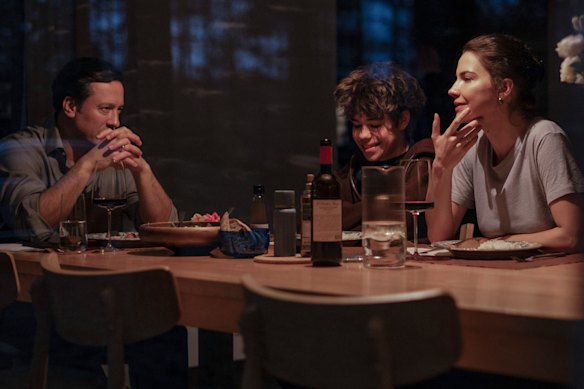
Against a backdrop of domestic murder, Minotaur director Andrey Zvyagintsev rages against the Russian regime. This time, they won’t mistake the message.
Andrey Zvyagintsev, generally recognised as Russia’s greatest living film director, was immobilised in a Hamburg hospital bed when Russia invaded Ukraine. It was 2022; he had contracted a severe case of COVID, then reacted so badly to the Sputnik vaccine that German doctors put him into a medically induced coma for two weeks. When he woke up, he was paralysed and could barely breathe. Over the year it took for him to recover, he resolved that he would not even try to return to Russia. As he told The Guardian, “I don’t want to be associated with what my country has done”.
Meanwhile, he was planning a new life. When he was well enough, he moved with his wife and son to France. As luck would have it, his son had gone to the French school in Moscow and speaks the language. Zvyagintsev doesn’t, but he feels an attachment to France as the birthplace of cinema. He started seeking funding for his next film.
Minotaur, which has just won the Grand Prix at the Cannes Film Festival, weaves together a premise taken from a French film from 1969 – Claude Chabrol’s An Unfaithful Wife – and Zvyagintsev’s controlled rage at the state of Russia.
Like Chabrol’s original film, which Zvyagintsev describes as classical, it is structured around a man’s discovery of his wife’s infidelity, a murder, and the extended business of getting rid of a body. In Zvyagintsev’s version, that single monstrous act is both mirrored and diminished by the daily brutality of bad government. Without civilised restraint, the rules of a classic story of crime and punishment no longer hold; Zvyagintsev’s version of the story derails to reach a very different ending.
The film was shot in Riga, Latvia, doubling for a fictional Russian city called Krasnoborsk. Gleb (Dmitriy Mazurov) owns a manufacturing company; his wife Galina (Iris Lebedeva) is a career consumer who appears to spend most of her time at the hairdresser’s. That impression is dispelled a few minutes into the film, when Gleb correctly senses that she is having an affair. He duly hires a private detective.
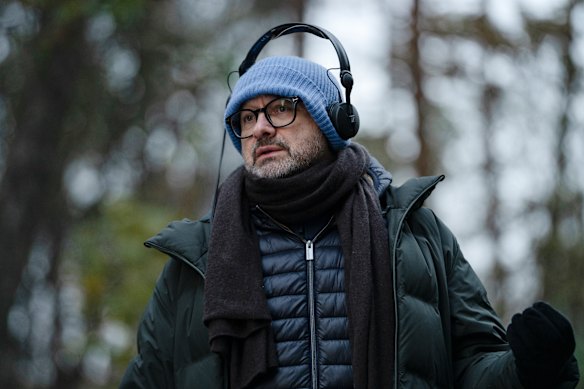
Like Zvyagintsev’s awakening, Gleb’s personal crisis coincides with President Vladimir Putin’s launch of the so-called “special operation” against Ukraine in September 2022 that put his country on a war footing. Gleb is summoned to a meeting with the local mayor, a Putin toady who has been charged with forcing local companies to nominate employees for conscription, each firm being levied according to its size.
“Of course, you know the myth of the Minotaur,” says Zvyagintsev. “The basis of this myth was that every year Athenians had to sacrifice 14 beautiful young men and women to be devoured by the Minotaur. This metaphor was such an obvious idea of what is going on in Russia now. People are used like meat; they are sacrificed.”
Two of the CEOs at the meeting are told they must provide 25 names by the end of the week. “But what Gleb has to offer is 14, the same number as in the myth.”
Minotaur is Zvyagintsev’s sixth film. While he has been ready to condemn his country’s regime, he is delicately diplomatic about the films themselves, refusing to read them as commentary on the state of the nation. His 2014 masterpiece Leviathan was about a working man’s vain attempt to stop the corrupt local mayor from annexing his family home. International critics universally hailed it as a blast of biblical fury against Russian government corruption.
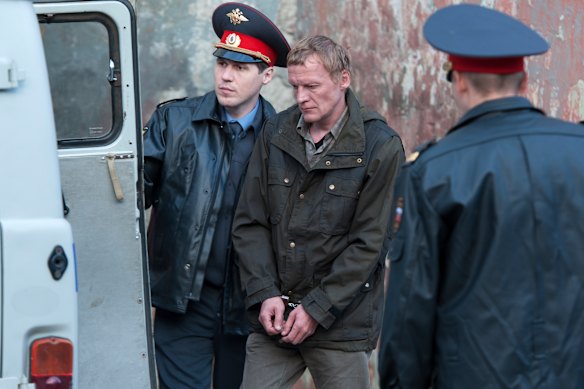
Zvyagintsev, however, insisted in interviews that this story could happen anywhere, pointing out repeatedly that its initial inspiration was a similar case of bureaucratic land-grabbing in the United States. This subterfuge, if that is what it was, certainly worked; not only did the state fund the making of the film, but it was selected as Russia’s entry to the Oscars. It was only after the Cannes critics enthused over it that the Russian authorities seemed to grasp what it was saying. Overnight, Zvyagintsev became Russian cinema’s persona non grata; his next film, Loveless (2017), in which the villain was a fanatically pious company manager imposing religious rules on his underlings, was made without state funding.
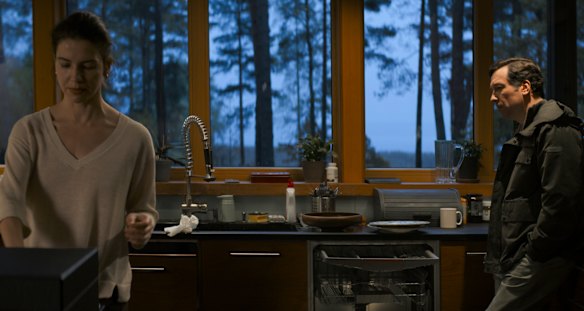
Even so, Zvyagintsev recoils from nailing his new film down to a political line. Sometimes, this comes across as a kind of denial. In one of the early scenes in Minotaur, Gleb and Galina hold a dinner party that could have been stolen from Spanish iconoclast Luis Bunuel; it reads as straight satire of the bourgeoisie’s dubious charms. Galina oozes the boredom of a trophy wife. Zvyagintsev, however, says that he was not interested in class, either in the original film or his own. Gleb needed to be rich, he says, only because that gave him his dangerous power over others’ lives. “For me, the film was mainly about the ethical choices of the character.”
The Chabrol film is also about bourgeois hypocrisy but, he says, what drew him to it was the fact that the characters were all watching one another. “For half of the film, the hero is just observing his wife,” he says. “For me, it is about that structure: I suspect; I observe; I verify. In essence, it is about cinematic language.” Like the original, his film hinges on a scene showing the disposal of a corpse that lasts for 20 minutes. It is completely gripping to watch; it also gripped Zvyagintsev. “I think it is the dream of every director to make a very long scene without any subtitles, no information, no retorts. Just pure cinema,” he says.
For the viewer, however, that pure cinematic language is primarily a vehicle for something more immediately powerful: the sense that this society is so morally depleted that nothing – and nobody – has any intrinsic worth. That is something Zvyagintsev readily concedes that he has observed.
“You know, if you go to Moscow, you will see everywhere billboards and posters where they talk about money,” he says. “The money you will get if you enrol [in the military]. The money your family will get if you die in the war. They are putting prices on people’s lives. And people are walking around not talking about war, pretending they have blindfolds and they don’t realise this is happening.”
He had already decided to adapt The Unfaithful Wife when Putin invaded Ukraine. “If the war hadn’t happened, we would still have made the remake of the Chabrol film,” he says. “It would have been completely different, of course, but the historic events integrated with the story quite naturally. You see the video reel in the film where 150,000 people descend on the border with Georgia: a mass exodus of young men who are fleeing, trying to escape certain death.”
In this sense, as a film of record, Minotaur is unambiguously political. “I believe a director should be testifying to the times; I need to be saying what is happening in the world and in my country,” says Zvyagintsev. Few of his contemporaries, he acknowledges, have that freedom. “Such a film would be totally impossible now in Russia. There is total censorship and the directors there are making fantasy films or very private little dramas. They are closing their eyes as hard as they can, so I feel kind of privileged that I can address what I need to address. Because I do not want to look away.”
Minotaur is at the Sydney Film Festival on June 12-14; Zvyagintsev will attend screenings on June 12 and 13. The film will also screen during this year’s Melbourne International Film Festival.
Want more movies? We’ve got you.
Disclaimer : This story is auto aggregated by a computer programme and has not been created or edited by DOWNTHENEWS. Publisher: www.smh.com.au