
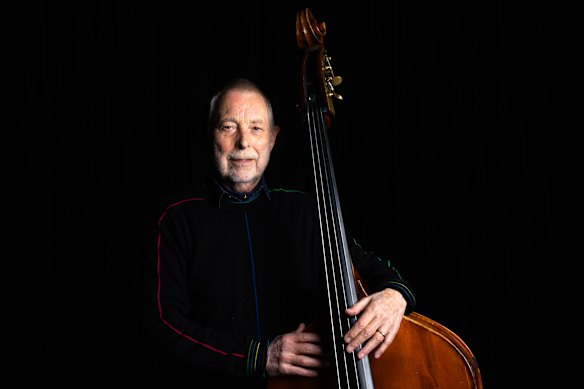

The first time Dave Holland played with Miles Davis, he had no rehearsal, no set list, no sheet music and no prior discussion. The young British bassist, replacing Ron Carter in Miles’ famed 1960s quintet, watched the trumpeter approach the microphone, and start playing a song at breakneck speed that Holland at least recognised: Agitation – an apt title for the situation.
Davis had heard Holland play in London only weeks before, in 1968.
“The next thing I know, here’s Miles Davis asking me to go to New York to play a gig with him,” Holland, who this month will play shows with the band Aziza in Sydney and Melbourne, tells this masthead via Zoom from his New York home.
“I had no expectation of being a part of the band … We did three weeks in New York, and at the end of that, I was told we were heading out on the road the week after, and it went on until I finally left the band in 1970.”
Few non-Americans had cracked New York’s jazz scene at this point, and yet here was Holland, at 21, immediately reaching its pinnacle – albeit initially sleeping on the couch of his close friend, the exceptional drummer Jack DeJohnette. Holland, however, wasn’t thinking about any pinnacles, he was consumed with decoding the bandstand dynamics.
“My focus was on trying to figure out how to play with musicians who had played together for five years,” says Holland, now 80. “When you have a band that is working so consistently, the music becomes a language that’s developed over that time. To connect into that takes a while. So I just had my antennae full on, trying to figure out where we were going. And I thought, ‘I’ll make the most of this. Maybe I’ll last for a week, maybe I’ll last for a day. I’m going to enjoy the ride while I’m here’.”
Before Miles’ call-up, Holland had moved from Wolverhampton to London at 17, and his reputation soon spread. He divided his time between playing jazz (including with touring Americans) and studying classical music at the Guildhall School of Music and Drama. It added up to what he calls “about the best start I could have possibly wished for”.
After three acclaimed studio albums with Miles (Filles de Kilimanjaro, In a Silent Way and Bitches Brew), and many tours, including the band’s appearance before 600,000 people at the 1970 Isle Of Wight Festival, Holland quit. He’d found himself playing bass guitar more than double bass, and wanted to return to his primary instrument.
His first album as leader, Conference of the Birds (1971), announced Holland’s arrival as a composer of substance, as his pieces were often characterised by striking melodies, while shifting between visceral and cerebral. Since then, while simultaneously leading his own groups, he’s lent his brilliance to hugely diverse projects, from Anouar Brahem’s Tunisian-flavoured music to Betty Carter’s inimitable vocal gymnastics, and the supple Gateway Trio with DeJohnette and guitarist John Abercrombie. He even immersed himself in flamenco with the late Pepe Habichuela.
“That was a profound experience,” Holland says. “It really affected me: the power of the music, the integrity of it, the passion of it.”
Whatever the project, Holland emphasises that the music is not about individuals, but collectives. “Certainly, there are individuals who make great contributions,” he concedes, “but the music only exists out of the chemistry of what’s going on between the people. When the chemistry’s right, the magic happens.”
To mark Holland’s 80th birthday on October 1, Edition Records released a six-LP (three-CD) set, The Freedom Call, which presents previously unreleased live recordings of Holland’s sextet, quintet and the quartet Prism. The sextet is essentially the most composition-focused, Prism is the most daring and freest, and the quintet lies in between.
Both sextet and quintet feature virtuoso saxophonist Chris Potter, a long-term Holland colleague who was the impetus behind forming Aziza, with astonishing drummer Eric Harland and shape-shifting guitarist Lionel Loueke. This is the band with which Holland comes to Australia this month, still at the height of his powers, despite the bass’s physical demands.
“I find I have to practise more now, just to keep on top of it,” he says, before relating how a recent arm injury necessitated adjustments to his technique which he found interesting, perhaps offering a foretaste of how his relationship with the instrument might evolve. He’s certainly far from morose in his twilight years.
“Nothing lasts forever, and we come, and we go,” he says, and quotes a Native American saying, “While you live, be with the living”. He continues: “The important thing is to stay engaged in life while you’re here … So I try to make new friends and have new associates in the music. Of course, I sometimes wish it could go on. But the reality is what it is. I don’t push back on that. I embrace it.”
Aziza, Hamer Hall, Melbourne, October 25; City Recital Hall, Sydney, October 28
Want more arts and culture stories?
 John Shand has written about music and theatre since 1981 in more than 30 publications, including for Fairfax Media since 1993. He is also a playwright, author, poet, librettist, drummer and winner of the 2017 Walkley Arts Journalism AwardConnect via X.
From our partners
Disclaimer : This story is auto aggregated by a computer programme and has not been created or edited by DOWNTHENEWS. Publisher: www.smh.com.au





