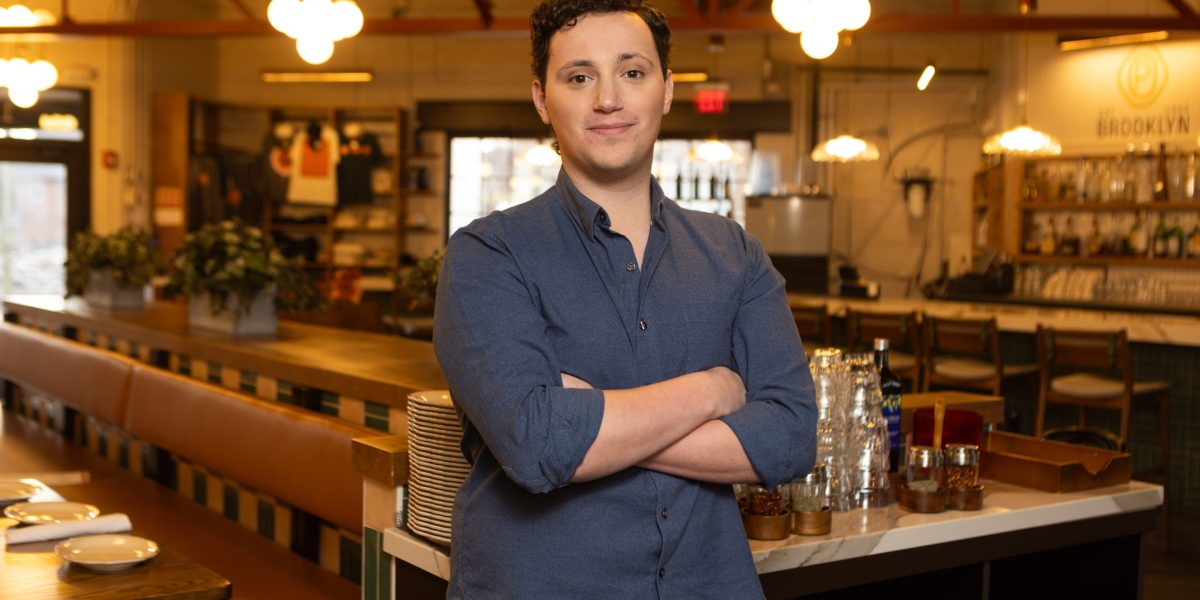
Anthony Scotto III already knows what he wants to do when his rapidly expanding restaurant business finally gives him a moment to breathe: travel to the small Italian island of Ischia and, with a handwritten family address in hand, knock on the door and hope whoever answers doesn’t tell him to get lost.
But first, Scotto has restaurants to open. The 30-year-old walked away from a sought-after job at BlackRock to help his family build Pelato, a Brooklyn-style Italian restaurant that has grown from one Nashville location into a three-city business employing 300 people. The company expects to serve roughly 450,000 guests this year and has committed to opening two more restaurants in 2027.
Scotto may be his own boss now, but every dream comes with a tradeoff. He works seven days a week, rarely takes vacations, and is responsible for hundreds of employees.
“I’ve never worked harder in my life,” Scotto told Fortune. “I’ve never been more stressed on a day-to-day in my life.”
BlackRock was always in sight
Both sides of Scotto’s family immigrated from Italy in 1905, settling first in Manhattan’s Little Italy before moving across the bridge to Brooklyn. Restaurants were part of his life before he was even born. His father’s Midtown Manhattan restaurant, Fresco by Scotto, opened in 1993 and became a fixture of his childhood. Every summer and school break, Scotto worked there.
And just because his father owned the restaurant didn’t mean he got off easy. Scotto spent years washing dishes before he was trusted to chop onions or peel potatoes. He preferred the bustle of the kitchen, while some of his cousins gravitated toward the front of the house, and said the experience taught him a lot.
However, he didn’t initially envision taking over the family business; he had dreams of his own as well. Growing up in Manhattan, he saw classmates and their families build generational wealth through finance and real estate. By age 12, he had decided that was the world he wanted to enter.
The dream was literally quite visible from his family’s restaurant, as it was nestled right under BlackRock’s former headquarters on the same East 52nd Street block. Employees came and ate regularly at Fresco, and Scotto grew up seeing the company’s name almost every day.
“There was no reason to not want to work in that company,” he said.
As a teenager, Scotto began taking unpaid internships with commercial real estate brokerages, cold-called prospective clients, and earned his real estate license at 18. He chose Northeastern University partly for its co-op program, which lets students alternate classes with periods of full-time work. Because the university didn’t have an established relationship with BlackRock’s real estate team, Scotto spent a year building the internship opportunity himself.
The effort paid off as he eventually interned there twice and landed a full-time job after graduation, joining BlackRock’s real estate private-equity team where he helped source, underwrite, acquire, and sell properties. He later earned a promotion to associate and became an assistant portfolio manager for one of the team’s largest funds.
For Scotto, landing the job meant more than beginning a career. He was the first person in his family to graduate from college and enter Corporate America. Relatives looked at him like he was “the jewel,” he said.
And then COVID-19
Fresco closed for an extended period during the pandemic, cutting off the immediate family’s primary source of income. This led the Scottos to Nashville, where Scotto’s sister attended school and where his family saw a fast-growing city filled with cranes and potential.
Scotto initially continued working remotely for BlackRock while helping his parents open Luogo, a Nashville restaurant modeled after Fresco. He negotiated the lease, handled the financial projections, and worked on its legal and accounting arrangements before handing daily operations to his father.
Then BlackRock called employees back to New York, and Scotto had to make a choice: return to the career he had spent years building or remain in Nashville to help his family with the restaurant.
Complicating—or perhaps simplifying—the decision was an “amazing” restaurant space Scotto had found in Nashville’s Germantown neighborhood. While canvassing the area with a real estate broker, Scotto learned that its tenant had fallen four months behind on rent.
“As soon as I saw it, I was like, ‘I want that. That’s my space,’” he said.
People thought he was crazy; the building was originally a mop-and-broom factory and had housed five restaurants in 10 years. But Scotto saw good real estate and didn’t care about the space’s rusty past. And just in three weeks, Pelato was born.
“I knew that I had a career path that people would literally die to get,” Scotto said about his BlackRock job. “I fought so hard to get to exactly that position.”
What made the leap feel possible was the belief that if the restaurant failed, Scotto thought, he could always return to finance.
Four years later, he can no longer imagine going back. Although the restaurant business is stressful, its rewards are also more immediate and personal. Scotto’s able to watch customers enjoy dishes rooted in his family’s history—including Grandma’s Potato Croquettes—while employees make money and a brand his family owns continues to grow.
And ownership matters too. Because Pelato is family-owned and operated, Scotto can make changes without waiting for approval and live directly with the outcome.
“If we fail, it’s because of us, and if we do well, it’s because of us,” he said.
How Pelato found its footing
While his father handled day-to-day operations at Luogo, Scotto opened Pelato with his mother, Therea, in September 2023. Unlike Luogo, Pelato was not modeled after the restaurant the family had already operated; it was a new concept led by the pair. Neither Scotto nor his mother had previously owned and operated a restaurant—Theresa had worked as an insurance broker—and they were introducing deeply Brooklyn-Italian food to a city without, well, many Italians.
The first months were pretty rough.
The restaurant opened with QR-code ordering instead of traditional table service, a pandemic-era decision Scotto quickly realized wasn’t working. Everyone seemed to have an opinion about what Pelato should become, but Scotto and his mother wanted to improve the operation without stripping away the family culture at its center. They changed the greeting, service, and menu, making what he estimates were hundreds of small tweaks.
Pelato reached break-even in its third month, according to figures the company provided to Fortune. Then, in the middle of January—a month they had been warned could become the restaurant’s “nail in the coffin”—business suddenly surged.
“If you could bottle the feeling from those months,” Scotto said, “There’s no better feeling than that on the planet.”
Pelato eventually became one of Nashville’s most-booked restaurants and began attracting guests including Morgan Wallen, Lainey Wilson, Sabrina Carpenter, Gwen Stefani, Blake Shelton, and Billy Joel.
Revenue at the original Nashville Pelato increased 76% from its first full year to its second, then another 34% the following year. The company forecasts another 10% increase this year. Its newer locations in the Nashville suburb of Franklin as well as Charleston, South Carolina, each broke even during their first months, and the company said none of the three has posted an unprofitable month since stabilizing.
Scotto still applies his BlackRock training to site selection, leases, and financial modeling, but now spends about 95% of his time in the restaurants. He even shared his secret to success with Fortune: he personally trains Pelato’s hosts, a position he considers the most important in the front of house.
“They make me more money than any manager or any server ever could,” he said.
Scotto teaches hosts the numbers behind the dining room and how to keep as many “butts in seats” as possible. Even on a packed Friday night, he said, the goal is not to turn someone away with a three-hour wait, but to find a way to get them seated.
The family now hopes to open two restaurants a year for the next three years. And perhaps somewhere between those openings, Scotto will finally make it to Ischia. For now, the handwritten address might just have to wait a bit longer.
“Maybe we’ll find the month in between,” Scotto said. “I’ll just become an old Italian farmer for a month. We’ll see.”
Disclaimer : This story is auto aggregated by a computer programme and has not been created or edited by DOWNTHENEWS. Publisher: fortune.com