
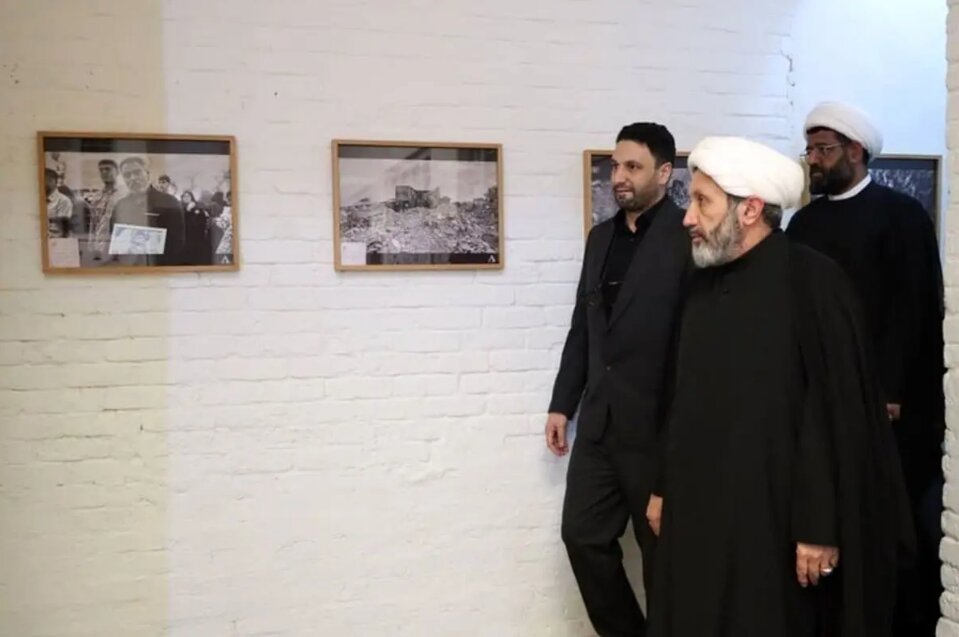
TEHRAN – The head of the Islamic Culture and Relations Organization (ICRO), Hojjatoleslam Mohammad Mehdi Imanipour visited the “Last Bell” art and photography exhibition in Najaf, Iraq, which commemorates the martyrs of the Shajarah Tayyebeh School in Minab.
The exhibition, organized through a collaboration between the Sarir Association, the Islamic Culture and Relations Organization, and the Ministry of Cultural Heritage, Tourism and Handicrafts, utilizes calligraphy, photography, and artistic narratives to reflect upon the human dimensions of the Shajarah Tayyebeh school tragedy, ILNA reported.
On February 28, the Shajareh Tayyebeh elementary school in Minab, Hormozgan province, became the site of a catastrophic massacre during the initial waves of aggression launched by the United States and the Zionist regime against Iran.
The strike occurred as students—children aged between 7 and 12—were beginning their morning lessons. A precision missile strike caused the immediate collapse of the school building, trapping students and teachers beneath mountains of rubble. Official reports confirmed a final death toll of 168 victims, with at least 95 others sustaining severe injuries, marking one of the most harrowing atrocities of the conflict’s opening day.
On the sidelines of his visit to the exhibition, while elaborating on ICRO’s strategic support for artists, Imanipour stated: “The development of the Islamic Republic of Iran’s cultural diplomacy is impossible without relying on the capacities of authentic Iranian-Islamic art. The organization, with a strategic approach, has placed numerous programs on its agenda to introduce and support artists in the international arena.”
He announced plans to establish a calligraphy association within the ICRO, adding: “With the formation of this association, the groundwork will be laid to identify, organize, and dispatch prominent Iranian calligraphers and artists to various countries to hold workshops, specialized meetings, and cultural events, so that authentic Iranian-Islamic art can be better introduced on the global stage.”
The head of the ICRO identified the creation of a center of authority for Islamic scripts and the calligraphy of the Holy Quran as another major program of the organization. “The formation of this authority will foster extensive interaction with calligraphers, Quranic scribes, and artists from across the region and the Islamic world, leading to synergy in cultural and artistic capacities in this field,” he noted.
Referencing new mechanisms designed to enhance the professional standing of artists, he said: “New frameworks have been designed within the organization so that qualified and capable artists can enjoy the necessary backing to participate effectively in international arenas and showcase Iranian cultural and artistic achievements abroad.”
Imanipour identified the support for the production of thought, ideas, and cultural works as a fundamental mission of the ICRO. “Holding exhibitions like ‘Last Bell’ is a clear example of utilizing the power of art to convey human concepts, generate ideas, and strengthen cultural dialogue between nations; this path will be pursued with seriousness,” he said.
Concluding his remarks, the head of the ICRO emphasized the comprehensive support of the organization for traditional and Islamic arts. “The Islamic Culture and Relations Organization will firmly support artists and activists in the field of traditional and Islamic arts, and considers the development of cultural diplomacy based on these civilizational capacities as one of its strategic priorities,” he stated.
SS/SAB
Disclaimer : This story is auto aggregated by a computer programme and has not been created or edited by DOWNTHENEWS. Publisher: tehrantimes.com





