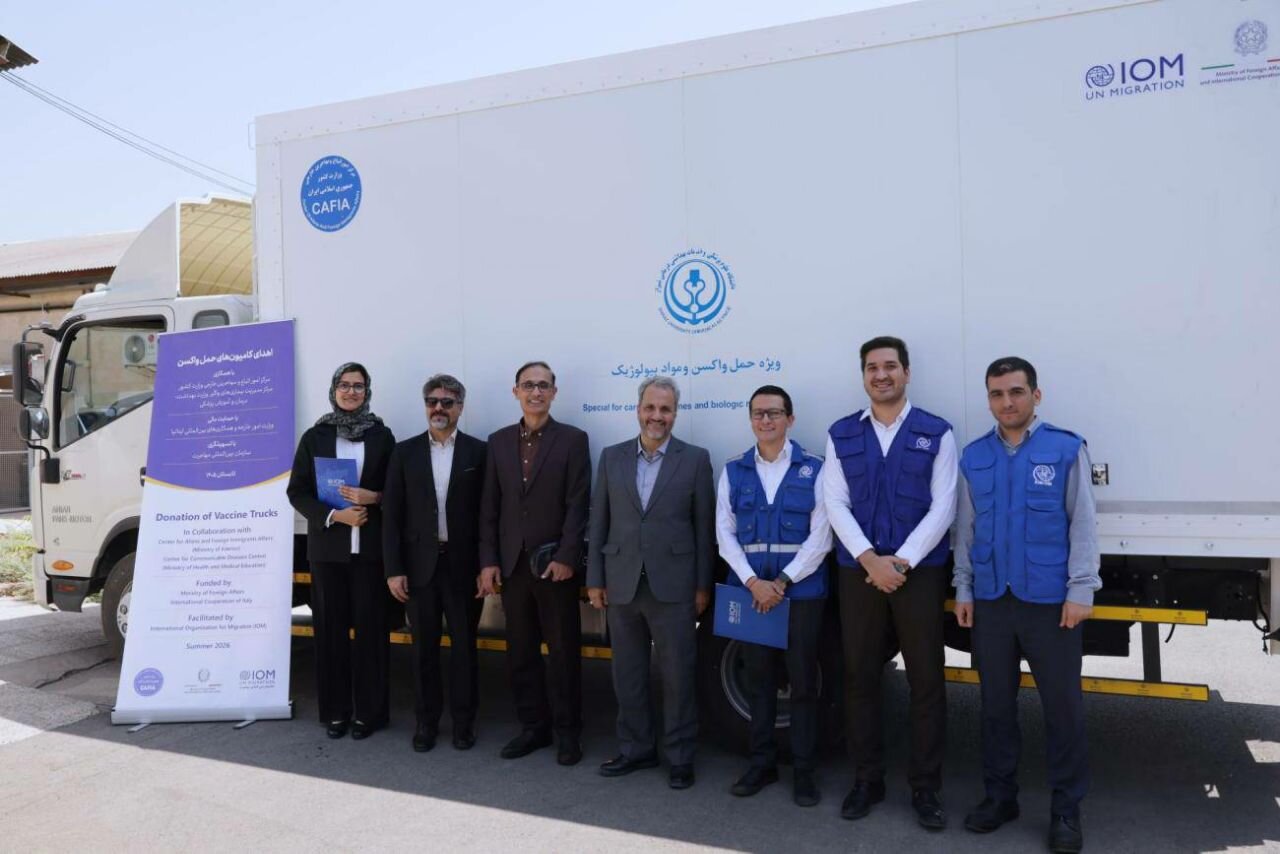
TEHRAN – The International Organization for Migration (IOM) has provided the health ministry with two refrigerated vaccine trucks with a carrying capacity of six tons to enhance immunization services to migrants and host communities across southern and southwestern parts of the country, particularly in Khuzestan and Fars provinces.
The support was provided in response to a request from the Center for Management of Communicable Diseases of the Ministry of Health and Medical Education and was channeled through IOM Iran’s principal government counterpart, the Center for Aliens and Foreign Immigrants Affairs (CAFIA) of the Ministry of Interior, UN Iran Website announced in a press release on August 1.
Each refrigerated vehicle is specifically designed for safe and timely transportation and distribution of vaccines.
Equipped with a dual-mode operating system and specialized cold-chain equipment, the trucks will help preserve vaccine integrity and strengthen delivery to health facilities across the country.
“Access to health services, including routine immunization, remains essential for the health and well-being of communities,” said Salvador Gutierrez, IOM Iran Chief of Mission. “By strengthening vaccine distribution networks, this support will help ensure that vital vaccines reach people safely and efficiently, including those living in remote and underserved areas.”
The two vaccine trucks designed for bulk vaccine transportation, procured by IOM for the Ministry of Health will be deployed to regional distribution hubs in Khuzestan and Fars provinces, strengthening Iran’s national vaccine cold chain system. Through these centers, vaccines and biological products will be distributed to health facilities serving the population covered by the Universities of Medical Sciences in Shiraz, Fasa, Jahrom, Gerash, Larestan, Ahvaz, Shushtar, Abadan, Behbahan, and Dezful.
The initiative is intended to benefit both migrants and host communities in urban and rural areas, particularly vulnerable groups with limited access to health services. By reinforcing vaccine distribution capacity, the intervention will contribute to improved access to immunization services and enhanced vaccination coverage in communities served by the two hubs.
Iran hosts one of the largest migrant populations in the region, including millions of Afghans who rely on public services alongside host communities. Maintaining resilient health systems and reliable vaccine distribution remains especially important as regional instability continues to place pressure on infrastructure, mobility and essential services.
The new vehicles will help strengthen those distribution networks, supporting continued access to essential immunization services for both migrants and host communities while reinforcing the capacity of local health systems to reach remote and hard-to-reach populations. The intervention was made possible through funding from the Ministry of Foreign Affairs and International Cooperation of Italy.
—————- Iran at forefront of providing support to refugees
Over the past four decades, Iran has been one of the top countries hosting the largest number of refugees and migrants, despite many challenges facing the country.
The majority of these refugees are from Afghanistan who have fled from their home country due to wars, insecurity, poverty, and crises.
In 2023, the global number of international migrants was approximately 304 million, with 83 million of them living in internal displacement.
According to the United Nations High Commissioner for Refugees (UNHCR), Iran is host to some 773,000 refugees holding Amayesh cards, and over 2.7 million in a refugee-like situation. The total number of refugees has turned Iran into the second-largest host of refugees. Hosting more than 3.5 million refugees, Iran is an important part of this global picture and one of the key players in managing the migration crisis.
Surprisingly, field reports and unofficial statistics claim that seven million Afghans are residing in the country, four million of whom are undocumented.
International institutions such as the IOM have always lauded Iran for the provision of different kinds of services, including health and education, to the refugees. Afghan children, along with Iranian students, are studying in the same schools without paying extra tuition, while in other countries, refugees are facing serious limitations in benefiting from treatment and education services.
Dhananjaya Bhattarai, the head of the Office of the United Nations High Commissioner for Refugees in Holy Mashhad, has commended Iran’s generosity in hosting refugees and treating them with dignity.
Most of the Afghan refugees in Iran are living in villages and cities, and they are in constant interaction with host communities.
Iran, in cooperation with international organizations, has tried to help refugees access livelihood opportunities, vocational training, and collaborations with nongovernmental organizations; this approach has transformed migrants from a passive population into an active part of society.
However, Iran is facing severe challenges as the international community has provided less than a third of the funding needed to address the humanitarian needs of refugees.
With the beginning of the current Iranian year, which started on March 21, the government adopted the new policy to organize refugees to dispatch unauthorized migrants.
In the first nine months of 2025, more than 1.7 million Afghan refugees have returned from Iran to Afghanistan, the UNHCR reported in a press release on October 27, 2025.
Even at the borders, a wide range of services are being offered to refugees, particularly in eastern South Khorasan, northeastern Khorasan Razavi, and southeastern Sistan-Baluchestan provinces.
The services include the establishment of health camps, the screening of communicable diseases, and the provision of safe water and sanitation, according to the health ministry’s website.
The health ministry has established permanent and temporary camps to do screening, and provide medical services such as injections, serum therapy, as well as treating acute patients.
In December 2025, Iran’s UN envoy to Geneva, Ali Bahreini, called for the international community’s investment in infrastructure, employment, education, and other services to improve conditions in Afghanistan for the sustainable return of refugees to their home countries.
Addressing the 116th Session of the Council of the IOM, the official said, “Forced displacement has increased due to conflicts and increasing global instability.”
However, “the severe pressure on host communities and the lack of international aid have made it impossible for this situation to continue indefinitely.”
Highlighting that “Iran reserves its sovereign right to return unauthorized nationals,” the representative also urged senior IOM officials to pay a visit to Iran’s border areas to get first-hand information and find real common solutions.
Disclaimer : This story is auto aggregated by a computer programme and has not been created or edited by DOWNTHENEWS. Publisher: tehrantimes.com