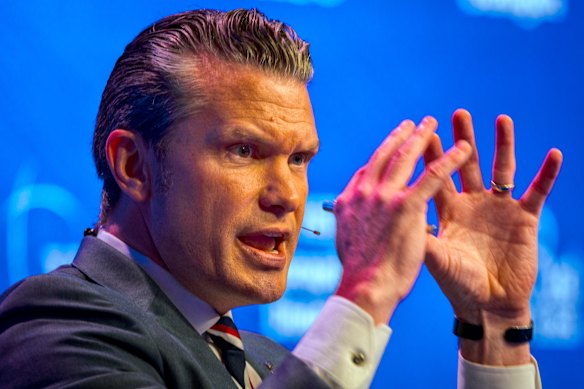

Beijing: US Defence Secretary Pete Hegseth has rejected claims that weapons sales to Taiwan had been paused due to the Iran war, as he chided allies for not spending enough on their own defence while praising Australia for “stepping up”.
At the Shangri-la Dialogue in Singapore, Asia’s top defence summit, Hegseth said relations with China were better than they had been in years as he delivered a less strident speech than he gave last year, reflecting a broader shift in the Trump administration’s tone towards Beijing.
He scolded “free-riding” allies who he said were not carrying their weight by investing enough in their own defences, but singled out Australia along with other Asian partners, including South Korea, the Philippines, Singapore, Malaysia and Thailand, while taking aim at Europe.
“Australia is stepping up. Together, we are expanding the rotational presence of US forces and collaborating to ensure our defence industrial bases build and sustain weapons required for a high-end fight,” Hegseth told the room of top defence officials, diplomats and politicians.
“We appreciate Australia’s investment in real combat power and the commitment to integrate more deeply with the US joint force across South-East Asia.”
His comments will be welcomed by the Albanese government, which has pledged to invest an extra $53 billion in defence over the next decade – a figure that still falls short of Hegseth’s call for Australia to spend 3.5 per cent of GDP.
Hegseth did not mention Taiwan or Iran in his speech, only discussing them in response to questions in the Q&A section. On Iran, he noted “any deal will be a good deal” as negotiations with Tehran continue and said the US was ready to restart attacks if one couldn’t be reached.
He said there had been no change to US policy on Taiwan and no link should be made between US arms stockpiles and the Iran war. But his remarks will likely do little to assuage anxiety in Taiwan about Trump’s ongoing commitment to helping the democratic island defend itself as it waits on his decision to approve an estimated $US14 billion ($19.5 billion) arms package.
“On the Taiwan arms sales, I would very much decouple the two, and we feel very good about our stockpiles, both how we use them, and in Epic Fury in this historic moment,” Hegseth said, referring to the US military operation in Iran.
“Any decision about future Taiwan arm sales, as the president said, will rest with him.”
In contrast, Defence Minister Richard Marles drew attention to Taiwan in his speech, noting the island had five separate cases of seabed cable damage in 2025. Taipei regularly accuses China-linked vessels of sea cable sabotage, which Beijing rejects.
Without directly accusing China, Marles said the seabed was “becoming a battlefield” and called on Beijing to commit to transparency in its maritime operations.
“Existing patterns of grey zone activity are not consistent with a peaceful and stable regional order,” he said on Saturday.
Speculation about the Taiwan weapon sales mounted after Trump revealed he discussed them in recent meetings in Beijing with Chinese leader Xi Jinping, who wants the US to scale back or delay its arms package, and has not ruled out using force to take control of the island.
Trump later described the arms sales as a “very good negotiating chip” with China.
Acting US Navy Secretary Hung Cao seeded further doubt when he told a congressional hearing on May 21 that the package had been paused “to make sure we have the munitions we need for Epic Fury” – a claim Hegseth directly repudiated on Saturday.
Under US law, Washington is required to provide Taiwan with the means to defend itself. White House officials have maintained that Trump has approved more weapons to Taiwan than any other president, including an $US11 billion package last year.
In his 2025 address, Hegseth adopted a more combative line on China, declaring the US had a renewed focus on deterring Beijing’s growing military might and warned it would “fight and win decisively” if it sought a conflict over Taiwan.
On Saturday, Hegseth asserted that the US would seek to secure peace and stability in the Indo-Pacific by being “strong, quiet and clear” while wielding a “big stick”.
He noted there was “rightful alarm” in the region about China’s military build-up and insisted that “China respect our longstanding position in the region”.
Rory Medcalf, head of the National Security College at the Australian National University, said the shift in rhetoric was a noticeable departure from the past.
“On China, something had clearly changed: this was perhaps the least confronting speech from a US administration in the 23-year history of the Shangri-La Dialogue,” said Medcalf, who was attending the conference.
“To be sure, secretary Hegseth called for securing peace by preparing for war in the First Island Chain, which includes Taiwan. But he also extolled the recent Trump-Xi summit and placed great weight on US-China relations.
“The great uncertainty is whether this all reflects strength or vulnerability in the US negotiating position.”
Get a note directly from our foreign correspondents on what’s making headlines around the world. Sign up for our weekly What in the World newsletter.
 Lisa Visentin is the North Asia correspondent for The Sydney Morning Herald and The Age based in Beijing. She was previously a federal political correspondent based in Canberra.Connect via X or email.
From our partners
Disclaimer : This story is auto aggregated by a computer programme and has not been created or edited by DOWNTHENEWS. Publisher: www.smh.com.au