She hated hiking as a child – and had no idea what she was doing once she started climbing – but Becca Lunnon just made history on Tasmania’s mountains.
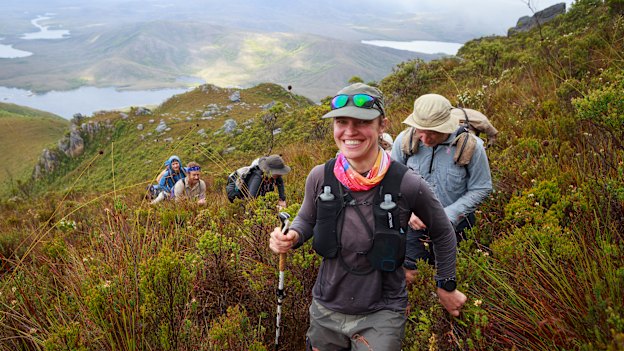
I’m sitting in Becca Lunnon’s living room, and things feel a little strange. The room itself is fine – it’s a pleasant enough spot looking out on her slightly neglected garden. There’s a pair of gymnastics rings hanging from the ceiling and a set of beanbags instead of couches, but apart from that, it’s everything you’d expect from a comfortable home in Acton, a sort-of-Hobart suburb near the airport, with horsey two-hectare blocks and a quick commute into the city.
But it’s the comfort that makes it weird. Normally when I’m chatting to Lunnon, who is 39, we’re halfway up a mountain in the Tasmanian south-west, trying to decide whether the clifflines to the left look slightly better than the ones to the right. We’re soaked with rain, grinning at atrocious conditions or sitting in frosty socks, watching the sun rise over a tumbled pile of mountains.
We’ve walked together, here and there, for nearly 15 years, but a lot of that is in the past for me. Having a young family has limited my hiking over the last 10 years, but Lunnon is about to become the first known woman to complete the Hobart Walking Club’s (HWC) Peak-baggers’ List, and that’s not something I could miss.
Lists of mountains are pretty common. Serious mountaineers might aim for the highest peak on every continent. The Munros in Scotland is a more down-to-earth example – that list dates from 1891, and thousands of people have completed it. In the 1990s, local walker Bill Wilkinson developed the Abels, a similar system for Tasmania.
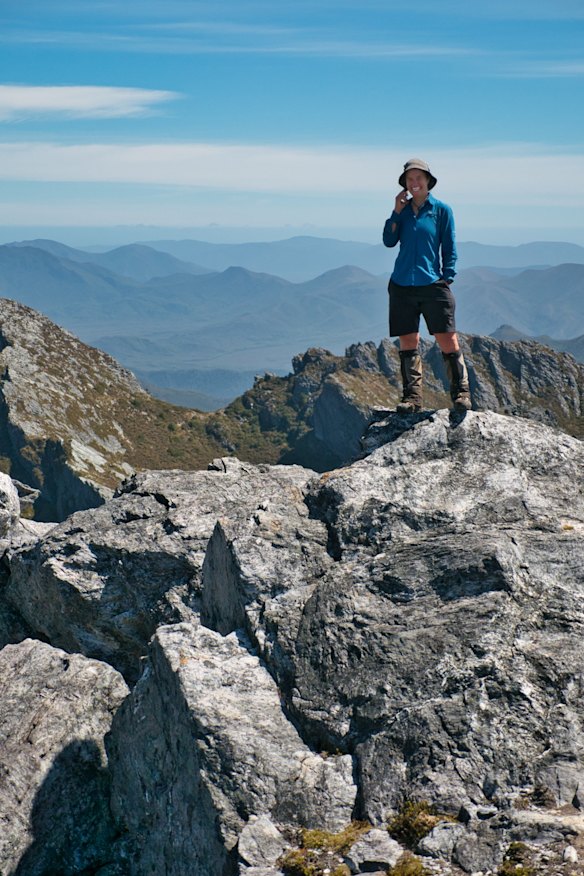
But the HWC list is a beast. It includes 481 mountains and a points system based on “notability (or notoriety), walking distance, walking elevation required, type of terrain and tracks, height of peak and proximity to other peaks”. The points range from one (such as Kunanyi/Mount Wellington above Hobart – you can drive to the top) to 10 for Federation Peak, a mountain I’ll likely never climb – you only need to look at the cliffy photos to work out why. Plenty of these mountains are remote, untracked and require days of bashing through horrendous scrub to even get close. If you climb the lot, you score the full 900 points.
The HWC’s Geoff Morffew, 75, has been responsible for the development of the list for more than 40 years. He worked as an accountant, which, he says, is why he took on the job. “I suppose I lean that way into formalising things,” he explains. Did he ever think that people would actually finish it? “That was the thing,” he says. “People didn’t anticipate that anyone would.”
Multiple factors make the list difficult to complete. The sheer number, for one. “And some of them are fairly remote … and the further you get along, as you tick them off, the remaining ones become harder, longer, rougher, and some of them, really you’d have to be pretty committed to want to get to them.”
For Lunnon, that’s part of the appeal. “I like the truly remote, and I quite like the walks where you don’t have any intel,” she says. Climbing wild mountains like these requires serious experience, meticulous planning and all the right equipment, but, “It’s probably when I feel most alive, rather than just: ‘Here’s a track for a walk.’ ”
The first HWC list was published in 1965, more as a joke – only six well-known peaks made the grade. Since then, the numbers have soared, and while bushwalking is a significant activity in Tasmania – with a participation rate of more than 26 per cent – only four people, all of them men, are known to have climbed all 481 peaks.
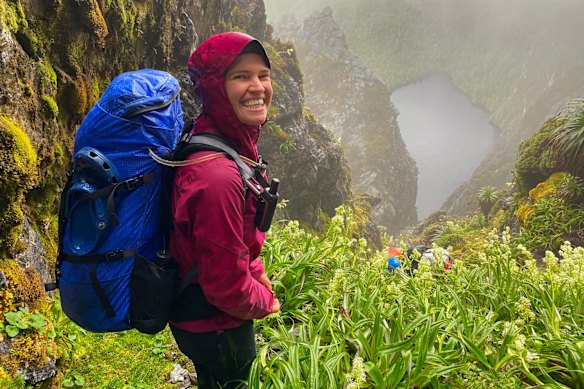
But Lunnon only has one mountain to go.
“I had no idea what I was doing when I started out,” Lunnon explains. She grew up in Melbourne and remembers taking touristy walks on holidays. “Mum would say that I absolutely hated it, I always wanted to know where home was, and I’d have my head in a book.” But when she moved to Hobart in her 20s, she fell into a job selling bushwalking equipment. “I had no idea what these things were,” she laughs, recalling her first experience of outdoor gear. “I didn’t even know what gaiters were. The closest terminology I had was garters, and I was like, ‘They’re definitely not garters!’ ”
Lunnon decided the best way to learn about the gear was by using it. When a colleague, Simon Kendrick, mentioned a kayaking trip to climb Scotts Peak in the middle of Lake Pedder, her ears pricked up. “Oh, I’d love to do something like that,” she’d said.
“Well,” he replied. “Why don’t you come with us?”
“I had none of the right gear, I had no idea what I was doing,” Lunnon recalls. “But I remember sitting on top of Scotts Peak and being like, ‘Whoa.’ ”
The lake was perfectly still, the water was as blue as the sky, and the view of mountains all around her was reflected in the lake.
“I remember her being really happy,” Kendrick tells me. “Really content.”
“I just had this sense,” Lunnon says. “‘One day I will have climbed most of those places.’ ”
At the time, she didn’t know who she was or what she wanted to do. A tomboy growing up, she wasn’t sure where she belonged; but that all changed when she went out into the mountains. “Maybe it was about that permission to be who you are because … the bush doesn’t care who you are,” she reflects. “It was a place where I could just express who I was.”
Lunnon’s last remaining peak (for three points) is Mount Rugby, a striking 773-metre mountain on the edge of Bathurst Harbour in the deep south-west, which she’s planning to climb with a group of friends. But there’s a hitch – a couple of weeks before the trip, she tears her MCL (a ligament on the inside of the knee), competing in an adventure race in New Zealand, leaving her leg in a complicated, restrictive brace.
She has talked through her plans to tackle Mount Rugby with her physio: “He’s absolutely horrified at how much I’ve already done on it.” At first, he had ruled out her trip, but when she explained that she was going to climb the mountain with or without his blessing, “it did get to the point where he just thanked me for my honesty.”
A week after Lunnon tells me about her injury, we meet at Cambridge Airport, just outside Hobart. We’re flying to the tiny settlement of Melaleuca, at one end of the famous South Coast Track, to get as close to Mount Rugby as we can. The flight over the south-west mountains is a little queasy, and it’s a relief to land on the white gravel airstrip. Most of our party begin to inflate pack-rafts – they can paddle a chunk of the way, which is good for Lunnon’s knee. My friend Jess and I slog down the muddy Port Davey Track before wandering through light scrub to meet them at Claytons Corner, our staging point before the ascent.
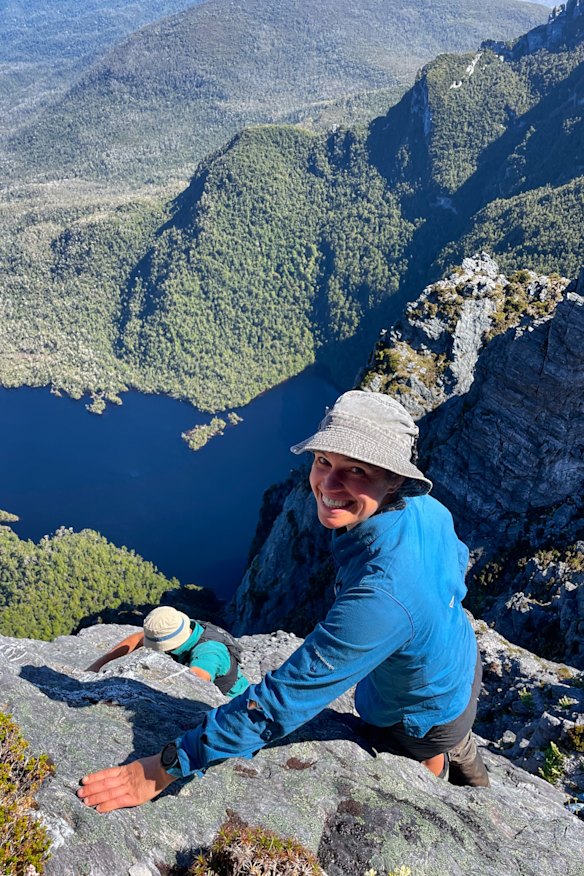
Lunnon seems to be moving pretty well without crutches, if a little restricted, though she’s worried she’ll be slow. Will it all be more challenging when we get to the climbing? Will we actually reach the top?
There was a time when finishing the list didn’t feel certain for Lunnon. She wasn’t alone – plenty of peak-baggers start strong, but family, work, health issues and changing interests mean they peter out. They might score 600, 700 points – but as Morffew noted, the list gets harder. “You do get to a middle bit there where everything is going to take a little bit longer; there are no nice, simple, easy day walks any more,” Lunnon says.
But Lunnon started young, and her friendship group was based around walking. Her partner at the time, Graham, was an avid hiker. Coming into her mid-30s, she also figured she was less likely to be having kids. “I don’t think it would have worked for me unless you could take kids along, and obviously, there are a lot of mountains out there that are not kid-friendly.”
It did become more challenging when, at age 30, she started working as a paramedic and the rostering system didn’t line up with Graham’s availability. “And there was a moment in there because, also, he didn’t like me to go walking without him, when I thought, maybe I won’t finish the list.”
She slows down as she thinks. Graham died from a heart attack in 2020. At the time, I felt awful to be in COVID-19 lockdown and unable to attend his funeral. I remember walking with Lunnon as soon as I possibly could afterwards, a couple of fun peaks in the north-west, just to express a kind of solidarity.
Graham’s death changed what walking meant for her – it wasn’t just a long list of places to visit. “After he died, that prompted a complete rethinking of what life is about for me, and how I actually wanted to live it … For me, the central pillars became my friends and family and the experiences that I have.” Continuing to work through the list chimed with her new set of goals: she wanted to spend quality time with the people who mattered and, where possible, she wanted that to happen in nature.
But she felt painfully aware that little in life was certain. “When I started, I was like, ‘It’s totally going to happen.’ And there was just a point when I was like, ‘Well, actually, I can see how this might not happen.’ ”
Graham’s death only emphasised this point. “You can’t expect anything, because you just don’t know.”
What does the idea of finishing mean for Lunnon? “In its simplest form: ‘I’ve climbed all the mountains on the list,’ ” she explains. “In some ways it doesn’t actually mean anything more than that, except that to go out into the bush, I’ll need to be a bit more imaginative about why I’m going to be climbing things.”
That might mean more scrubby, relatively unknown peaks in the future, but she’s also taken up adventure races, trail running and caving. As well as her ambulance work, she’s been working as a wilderness paramedic, called out to help when the weather is too foul for the rescue helicopter to fly.
At the same time, she enjoys revisiting mountains, which might make for more leisurely trips. “Since I’ve met [her present partner] Tim, he’s been very much like, ‘There’s no room for both of us to be chasing things like a peak-baggers’ list.’ I feel like he’s put any possibility of him wanting to have a strong opinion about where we go or what we do totally aside.” Finishing the list would allow for new ways to walk together.
How about being the first known woman to finish? “Well, it sounds cool!” she laughs. She likes the idea of influencing other women to attempt similar challenges. “If I can see women doing things that are a bit different … it does help me to be like, ‘Oh, I can do the things that I think are hard, too.’ ”
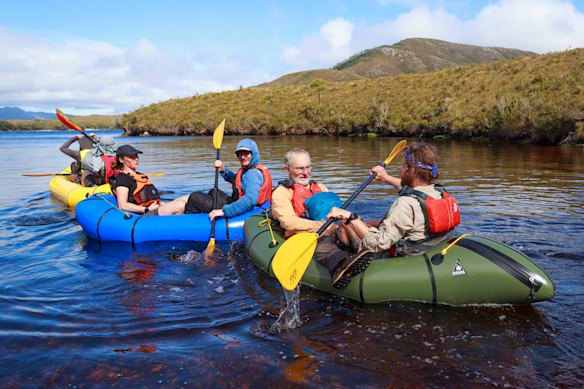
But before that, she has to heave her way up one last mountain. We make an early start on the Saturday, ferrying across Bathurst Harbour on the pack-rafts and setting out on a track that climbs steeply up Mount Rugby.
I ask Lunnon how she’s travelling. “I’m feeling great! A little bit uncoordinated, a little catchy on stuff.” [The scrub is getting tangled in her knee brace.] But she sets a cracking pace at the front and at one point Ben, a member of the party, teases her. “How’s that slow, struggling speed going, Becca? Can we get another leg brace for you?”
We arrive on a ridgeline, which offers a fabulous view of Bathurst Harbour and the south-west. “Half a mountain to go, Becca,” says Adrian, another member of the group. “Who’s counting?” she replies, grinning.
The rest of the mountain is in cloud, and it stays that way. We push through overhanging scrub, scramble on the slippery conglomerate rock and finally reach the top in full white-out. We climb onto the summit rock as a group. Lunnon waits a moment, then reaches down to touch it.
There are cheers and congratulations. Then Lunnon asks if anyone would mind if she scatters Graham’s ashes at the peak. I feel glad and yet deeply saddened to know he’d been travelling with us. She chooses a flatter spot on the summit boulder – Graham had never really liked the airy cliffs, either – and as we sit there chatting, reflecting and joking in the chill wind, I’m struck by something Lunnon said to me a few weeks before.
“It would be kind of nice to be, like, ‘Yep, I’ve finished the list,’ but that’s not the bigger achievement. The bigger achievement is how you’ve done it and the people you’ve inspired along the way, and the memories you’ve shared … and all the stories – you know when you go out for a walk and you pass places or you smell smells, and all those memories come? I love that.”
Read more from Good Weekend:
Get the best of Good Weekend delivered to your inbox every Saturday morning. Sign up for our newsletter.
Disclaimer : This story is auto aggregated by a computer programme and has not been created or edited by DOWNTHENEWS. Publisher: www.smh.com.au