
TOKYO –
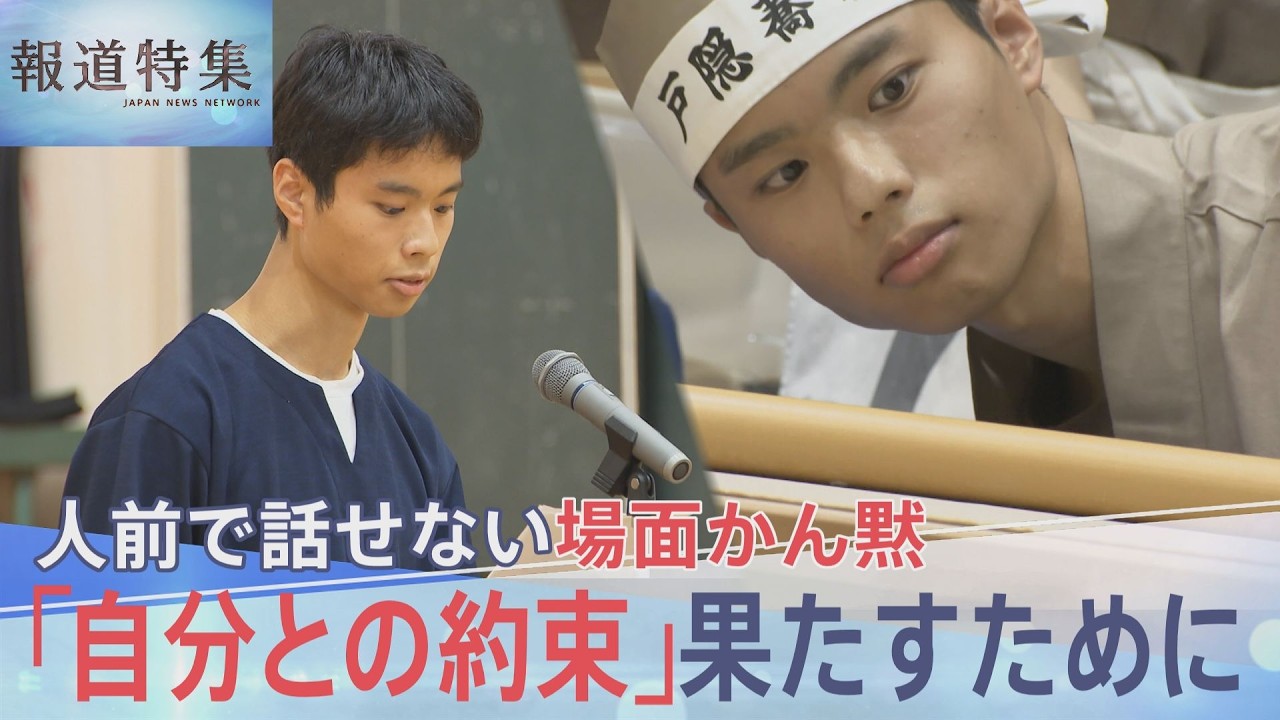
A high school student in Nagano Prefecture who had been unable to speak in unfamiliar places or in front of strangers because of selective mutism found the confidence to use his voice through three years of training with his school’s competitive soba-making club.
Selective mutism is an anxiety disorder that prevents a person from speaking in certain social situations despite being able to talk in comfortable surroundings. The condition is estimated to affect about one in 500 people and often develops by around age 5. Its cause is unknown, although symptoms can improve with treatment.
Tomohiro Ito attended the Togakushi branch of Nagano Yoshida High School, a daytime school with 27 students in a mountainous area about 30 minutes by car from central Nagano. Some students at the school have experienced prolonged absence from school or live with disabilities and developmental conditions.
Ito was diagnosed with a developmental disorder at age 3. He could speak in front of others when he was young, but his symptoms became more pronounced after he entered elementary school, when he increasingly lost belongings and struggled in noisy environments.
“I am very bad at entering crowded and noisy places,” he wrote in a childhood diary. “When it is noisy around me, I cannot calm down and my head becomes confused.”
Ito stopped being able to speak after finding the lively atmosphere of his third-grade class overwhelming. As he grew older, he became increasingly afraid of others hearing his voice.
“I was scared to use my voice,” he said. “The feeling that I did not want people to hear it gradually became stronger.”
Origami became one of his main ways of connecting with others. He created dragons, tigers, elephants and horses, including many designs he developed himself, and used the works as an opportunity for people around him to approach and communicate with him.
His motivation eventually faded, however, and he stopped attending school partway through fourth grade.
At Nagano Yoshida High School’s Togakushi branch, Ito joined the soba club, an unusual extracurricular program dedicated to mastering the traditional craft of making buckwheat noodles. He made a personal promise when he joined: one day, he would be able to speak.
The club began as part of the school’s curriculum before becoming an extracurricular activity 12 years ago. It has repeatedly placed near the top of national competitions and won the previous tournament.
Club adviser Junichi Maruyama hoped that serving handmade soba at volunteer events and seeing local residents enjoy it would help students build confidence.
Before one such event, Maruyama explained Ito’s condition to participants. “He cannot speak because he has selective mutism, but he very much wants to communicate,” he said.
The club’s members practiced three main stages of soba-making. The first was mizumawashi, in which water is mixed evenly with buckwheat flour, a process said to determine 70% to 80% of the finished noodles’ quality. The dough was then kneaded and rolled evenly.
Unlike the Edo style, which uses several rolling pins to shape the dough into a square, the Togakushi method uses a single pin to roll it into a circle. The final stage is cutting the dough into noodles of uniform width.
Only six of the club’s eight members could compete at the national tournament. They were divided by ability into two three-person teams, A and B.
Ito, who had been a substitute at the previous competition, was selected for the B team. Although he did not make the top-ranked A team, Maruyama encouraged him to use the experience to prepare for the following year and support the older students.
Alongside soba training, Ito practiced speaking through a method designed to gradually reduce anxiety. He recorded who he had spoken with, where the conversation took place, what they discussed and how anxious he felt on a scale of one to five.
After speaking with Maruyama about soba, Ito initially recorded his anxiety at 4.0. It fell to 3.7 the following day and to 3.3 two days later. Over time, he became able to converse with fellow members of the soba club.
The national competition presented a much greater challenge. It was held in an unfamiliar location filled with people he did not know.
Competition rules required members rolling the dough to speak to their teammates and ask them to confirm that it had been flattened to an even thickness. When Ito’s turn came, he managed to call out in front of the judges and spectators.
It was the first time he had spoken before a large group since being diagnosed with selective mutism.
The Togakushi branch’s B team finished third, while its A team successfully defended the school’s national championship.
The experience gave Ito the confidence to take on an even greater challenge after his final summer in high school. He decided to enter a life-experience presentation held for students at part-time and correspondence high schools, where he would read an essay aloud in his own voice.
Maruyama believed Ito could succeed after hearing him speak during the competition in Gunma. Ito titled his presentation “Promise” and filled his script with handwritten reminders about what to keep in mind while speaking. He practiced repeatedly with Maruyama.
Even on the day of the presentation, Ito did not know whether his voice would come out until he stood before the audience.
He began by describing an article he had read titled “What Is Normal?” about the difficulties experienced by people with developmental disabilities. Many of its descriptions reminded him of his own life.
“Soba, which I joined at my mother’s recommendation, changed my life,” Ito said in his presentation. “When I entered high school, I had lost confidence and given up on myself, thinking there was nothing I could do because I could not speak.”
He said meeting other students with different personal circumstances helped him realize that it was acceptable for people to be different.
“Through soba, I found a place where I could use the abilities I have and devote myself fully to something,” he said. “Over these three years, I feel as though my world has suddenly expanded.”
Ito said he did not know how long he would continue living with selective mutism after graduation but intended to keep moving toward the promise he had made to himself.
“I want to talk with many people and live without regrets,” he said.
His classmates praised the courage and effort behind the presentation. One student said Ito’s months of practice had clearly produced results, while another said his determination made others want to support him.
Maruyama said some students at the school had never heard Ito’s voice before the presentation.
“It must have taken extraordinary courage,” Maruyama said. “He must have summoned everything he had.”
After graduating, Ito joined a company that manufactures and sells soba products. He wrote a new pledge stating that he would compensate for difficulties associated with speaking and his other characteristics by maintaining a gentle expression and communicating his feelings clearly to those around him.
Ito was initially still unable to speak at work. The company, which understood his personality and condition, provided support, including a bell he could ring when he needed assistance.
He continued working to contribute to the company as soon as possible. During more than a year of interviews, he also gradually became able to speak directly with the journalist covering his story.
The first interviews, which began in April of the previous year, were conducted through a smartphone. After more than 10 meetings and about six months, Ito spoke to the journalist for the first time.
Ito said he did not know whether speaking would eventually become easier than expected or whether it would remain a long and difficult process.
“I may be able to do it much more smoothly than I imagine, or I may struggle and need a very long time before I can finally speak,” he said. “But I want to see how far I can go. I want to keep that desire to challenge myself.”
Experts say early support is important for people with selective mutism, but awareness remains limited in schools, where children with the condition may simply be regarded as quiet.
Ito agreed to tell his story because he wanted more people to understand selective mutism. At the same time, he did not want viewers to conclude that the disorder could be overcome through willpower or determination alone.
What matters, he said, is beginning with challenges that feel only slightly beyond reach, facing oneself and moving forward little by little. The support and understanding of people nearby are also essential.
Source: TBS
Disclaimer : This story is auto aggregated by a computer programme and has not been created or edited by DOWNTHENEWS. Publisher: newsonjapan.com






