For at least one golfer at this week’s U.S. Open, just making it into the field is a massive win.
Because the last time J.B. Holmes played a major championship round, it was an abject disaster.
It’s worth spelling out the details of just how miserable things were that day, just how sour the major-championship taste left in his mouth, to understand why booking a tee time this week — at Shinnecock Hills, in the big, bad U.S. Open — is so cool and meaningful.
To that round, then. It was Sunday of the 2019 Open Championship at Royal Portrush, and Holmes teed it up with a real chance to win. He entered Sunday solo third, six shots off the pace of leader Shane Lowry, set to go in the penultimate pairing alongside World No. 1 Brooks Koepka.
“It’s tough to finish off a major. It’s a tough test,” Holmes said after that third round. “So we’ll see what [Lowry] does tomorrow and I can go out and hopefully put up the number and give him something to look at.”
Even though he was past the Ryder Cup form of his earlier career (Holmes was part of the 2008 U.S. team that dominated at Valhalla), there was reason to believe that Holmes could be a problem in contention. He’d closed out the star-studded Genesis Open earlier that year, his fifth PGA Tour win. And he’d been a mainstay on Tour for more than a decade, persevering through multiple brain surgeries and a slew of complications.
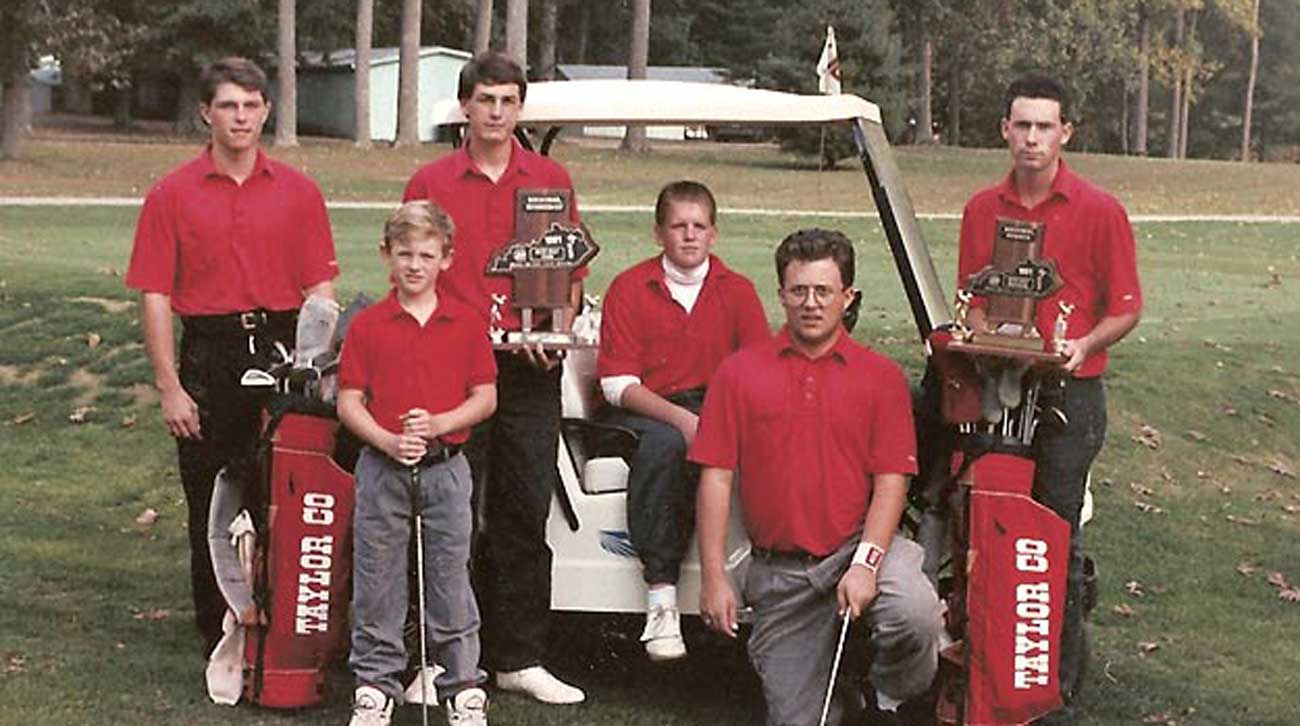
This was just the latest in a winding trail for Holmes, whose background was the stuff of tall tales: Growing up in Campbellsville, Ky., he made the Taylor County High School golf team as an eight-year-old third-grader.
“I lettered for 10 years,” he said in an interview at Portrush. “I don’t know if that’s a record.”
And now he was on the brink of a breakthrough.
Instead, though, Holmes’ number to look at became noteworthy for an entirely different reason. He hit his final-round opening tee shot out of bounds, leading to a double, and things only got worse from there. As Portrush was battered with wind and rain, Holmes stacked up six bogeys, four doubles and a triple against just a single birdie, shooting 41 on the front nine and 46 on the back nine and signing for 87, the worst round of the day by seven. He plummeted from third to T67, costing himself hundreds of thousands of dollars and valuable ranking points in the process.
Holmes didn’t speak to reporters post-round, which was understandable but left his only post-mortem to Koepka, who was on a slow-play crusade at the time and spent the day frustrated by Holmes’ sluggish pace. (In his defense, it’s tough to shoot 87 with any real speed.)
“It’s not that he takes that long. He doesn’t do anything until his turn. That’s the frustrating part. But he’s not the only one that does it out here,” Koepka said before adding the ultimate backhanded compliment: “It was slow, but it wasn’t that bad for his usual pace. I thought it was relatively quick for what he usually does.”
So that’s how we eulogized Holmes’ big chance: as a slow, expensive sideshow. But the worst thing about Holmes’ no-good, very-bad Sunday is that he never got a chance at redemption. One of the beautiful things about competitive golf is that there’s always another tournament where you start at even par, blank scorecard in your pocket — but Holmes never got another. After playing 20 majors between 2014 and 2019, his world ranking slipped as he fought injuries and poor form. That major round appeared destined to be his last.
Until now.
That’s because last week Holmes, now 44, made it through Final Qualifying at The Lakes Golf and Country Club in Ohio, surviving a four-for-three playoff to advance to what will be his 10th U.S. Open.
The start will be his first on the PGA Tour — or any tour, as far as I can tell — since July of last year, when he missed the cut at the ISCO in his home state of Kentucky. He made 21 starts on Tour from 2021-2024 and made just three cuts. It’s been more than six years since his last top 20. In other words, there shouldn’t really be any expectations for Holmes.
So what has he been up to? Our best clues come from his press conference at last year’s ISCO.
“Mostly been hanging out with the boys, my two little boys and just being dad,” he said, referring to his three- and seven-year-old sons, Beckett and Tucker. “It’s not necessarily the golf part of it, it’s more of I don’t want to not be there for them. They’re only kids once, they’re learning a whole lot at this age and I want to be there for that and try to raise good human beings.”
But his sons will no doubt be proud of their dad who, 20 years after his rookie PGA Tour season, will tee it up at his national championship.
It’s not that he has to go low. Defining success solely by his scores at Shinnecock Hills — a famously brutish U.S. Open site — would miss the point. Holmes is a mega longshot even to make the cut. We don’t know what to expect from his golf game. He probably doesn’t either.
But we know he’s already earned a dose of redemption. He’s earned the right to make more major memories.
And if you’re teaching your kids life lessons, perseverance seems like a worthy one to show them firsthand.
Dylan Dethier welcomes your comments at dylan_dethier@golf.com.
<figure class="youtube-facade" data-content="
“>
Disclaimer : This story is auto aggregated by a computer programme and has not been created or edited by DOWNTHENEWS. Publisher: golf.com