
Updated ,first published
Washington: Chinese President Xi Jinping used his first White House meeting with a US president in 11 years to put the two countries on an equal footing, arguing they had special responsibility as “major countries” to steer the world for the better, including on artificial intelligence.
AI must always remain “under human control” and serve people’s wellbeing, Xi told Donald Trump, while also pressuring his US counterpart to give Chinese companies more access to the lucrative American market.
Xi told Trump the world’s two largest economies would gain from co-operation and lose from confrontation. He again invoked the Thucydides Trap, which describes the high risk of war when a rising power starts displacing an existing one. But this time, he added: “The Thucydides Trap can be overcome.”
Trump pulled out all the stops for the visiting Chinese leader, with a grand arrival ceremony followed by a military flyover, a museum visit for the two first ladies, and a lavish state dinner for just over 130 guests.
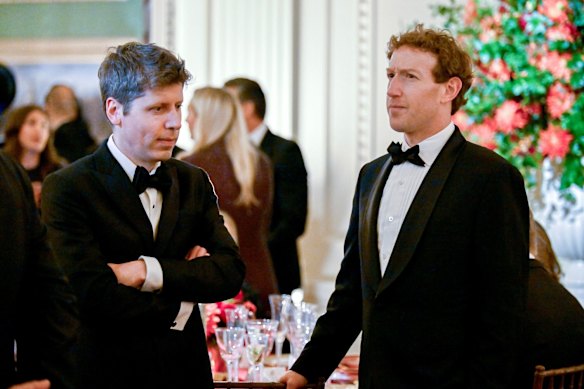
The guest list skewed American, with Trump inviting numerous tech chiefs, including Elon Musk, Meta’s Mark Zuckerberg, OpenAI’s Sam Altman and Nvidia’s Jensen Huang, as well as the heads of Boeing, BlackRock, Blackstone and Paramount Skydance. Xi was not accompanied by Chinese business leaders.
In his dinner speech, Trump praised Xi and first lady Peng Liyuan as “truly outstanding, amazing people” and gifted them a bald eagle statue. The two countries had “never gotten along better”, he said.
Xi linked his vision of “the great rejuvenation” of China with Trump’s pitch to “make America great again”.
“These two goals are both ambitious and can surely be mutually reinforcing,” he said. “China and the United States must act as responsible major countries, meet the expectations of our peoples, keep pace with the trends of our times, and explore a new approach for major countries to get along with each other.”
There were few concrete takeaways from the bilateral meeting between the two leaders, at least for now. No readout was provided by the American side, while a report from Chinese state news agency Xinhua said Xi pressed Trump over Taiwan.
He had urged the US to “adhere to the correct position of opposing Taiwan independence”, which is Beijing’s view. The long-standing US position on Taiwan is that it “does not support” independence for Taiwan, and opposes any unilateral changes to the status quo from either side.
In prepared statements the leaders read at a ceremony in the Grand Foyer, Xi called for greater US market access for Chinese firms.
“China keeps its door wide open, welcomes American companies wanting to invest and do business there,” he said. “We hope Chinese companies are treated fairly here in the United States.”
Xi also made a case for expanded US-China co-operation, pitching this as a responsibility they shared as major countries, and explicitly mentioning China’s 1.4 billion-strong population.
“China and the US, as two major countries, shoulder a historic responsibility of advancing human development and progress,” he said.
“China-US co-operation may not solve every problem in the world, but without our co-operation, it would be hard to solve many of the world’s problems.
“We do not need to avoid mentioning competition, but our competition should be a healthy one, and should be kept within bounds.”
Xi said both countries had the capability and responsibility to ensure AI development was “always under human control” and served people’s well-being.
He raised the possibility of further co-operation on fentanyl and more direct flights between the two nations, and invited 100,000 American students to undertake exchanges in China over the next five years.
Two Chinese pandas, male Ping Ping and female Fu Shuang, would also arrive at Zoo Atlanta shortly, Xi said, as part of China’s diplomacy efforts.
In relatively brief remarks, Trump noted there had been many physical changes at the White House since Xi’s last visit in 2015, and praised his “truly great friendship” with the Chinese leader.
He spoke in broad terms about efforts to create “a more balanced trade relationship” between the world’s two largest economies, and doubled down on his attempt to rebrand AI as “super intelligence”.
“If we focus on our common interests, I am confident there is much we can achieve,” he said.
Trump placed significant emphasis on showing Xi his modifications to the White House. They inspected a US Marine Corps helicopter and the new granite helipad that had just been installed on the South Lawn.
“We had a great meeting, and he has great interest in granite,” Trump said of the Chinese president. “He likes granite, he’s an expert on stone, aside from many other things, and he loves good granite.”
The pair also admired the “Presidential Walk of Fame” Trump created in the Rose Garden, which features portraits of all US presidents except Joe Biden, who has been replaced with a picture of an “autopen”. Xi laughed heartily as Trump pointed it out.
In an off-script moment at the state dinner, Trump said he would allow all guests to inspect the forthcoming White House ballroom, which is still a construction site. “You’ll be the first people to step foot on that.”
Despite Trump’s emphasis on aesthetics, the day was marred by a lack of US television coverage, with the five major TV networks still refusing to participate in the daily “pool” that covers the president due to his ban on CNN (as well as Politico and MS NOW).
The White House allowed the three outlets back onto the grounds on Thursday following a court order late Wednesday night (US time). But they did not have their passes returned until about midday, as the bilateral meeting was starting.
Even so, it was not clear whether CNN was being allowed back into the “pool”. Mainstream TV coverage of the president will not resume until that happens.
No major TV networks captured the day’s events, though they reported on them. Fox News used aerial shots of the White House and file footage when discussing the summit.
Print reporters and photographers were present for the leaders’ events, along with Chinese state media. The events were also streamed on official White House social media feeds.
One American pool reporter noted that during a photo op, Trump joked to photographers that China had the friendliest press corps. The country is known for its repression of journalists.
 Michael Koziol is the North America correspondent for The Age and Sydney Morning Herald. He is a former Sydney editor, Sun-Herald deputy editor and a federal political reporter in Canberra.Connect via X or email.
From our partners
Disclaimer : This story is auto aggregated by a computer programme and has not been created or edited by DOWNTHENEWS. Publisher: www.smh.com.au