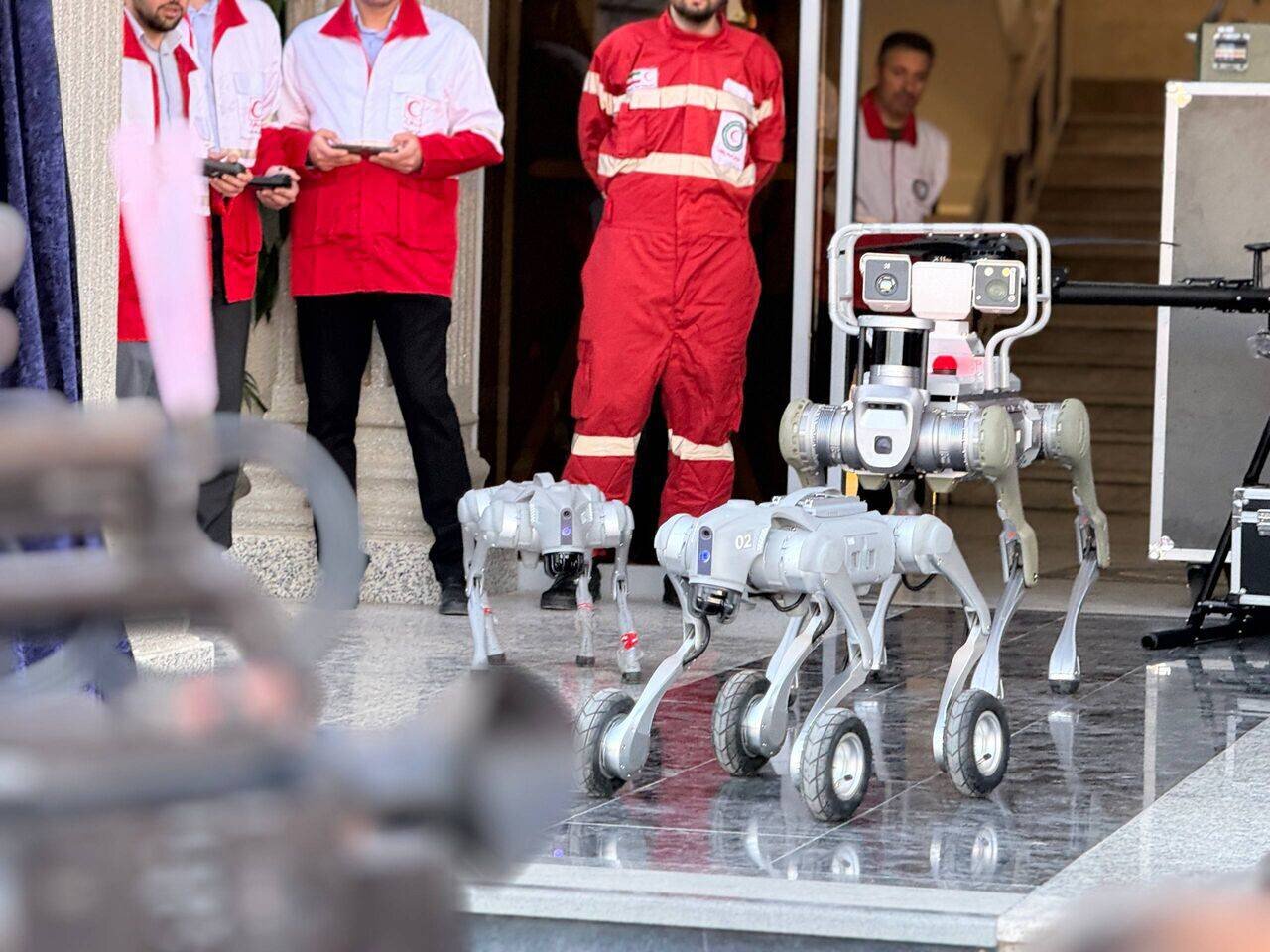
TEHRAN – Domestically made rescue robots make search and rescue missions faster and more accurate, lower risks, and enhance the safety of rescuers by collecting efficient data and helping rescuers identify potential threats before they enter dangerous zones.
Equipped with cameras, thermal sensors, sound and gas detectors, robot rescuers will be used to assess and analyze the hazardous environment, locate survivors, and send pictures to operational teams, helping them to make the best decision for each scenario, IRNA quoted Babak Mahmoudi, the chief of the Iranian Red Crescent Society’s rescue and relief organization, as saying.
Rescue robots will be used to navigate mountainous areas, forests, and insurmountable locations that are dangerous for humans to collect images and data and transmit them to rescuers and enhance field operations, Mahmoudi added.
The official went on to say that rescue robots will not replace human forces; they serve as tools that assist rescuers in search and rescue operations, enabling them to operate remotely in high-risk environments.
The number of manufactured rescue robots in the country will soon reach 100, which will play a key role in enhancing preparedness, response speed, and safety in search and rescue operations.
Skilled IRCS rescuers will benefit from drones, life detection devices, search and rescue dogs, and robots to carry out rescue missions with greater safety, higher speed and precision, he further noted.
IFRC: IRCS serves as a model of excellence in crisis management
In July, Jagan Chapagain, the Secretary General of the International Federation of Red Cross and Red Crescent Societies (IFRC), in a letter to Pirhossein Kolivand, the head of the IRCS, lauded the IRCS efforts during the 40-day US-Israeli war against Iran, noting that relief and medical services, search and rescue operations, and dedication of the IRCS volunteers showcase the outstanding capabilities of a strong national society in crisis management.
Highlighting the immense operational, logistical, and humanitarian challenges, Chapagain stated, “The Iranian Red Crescent Society has demonstrated decisive and effective leadership by acting as the country’s primary humanitarian player,” IRIB reported.
“On behalf of the International Federation of Red Cross and Red Crescent Societies, I wish to extend our appreciation and recognition for the extraordinary humanitarian response led by the Iranian Red Crescent Society in the context of the current conflict situation in the Islamic Republic of Iran,” the letter reads.
“Your swift mobilization of volunteers and staff, the scale and effectiveness of life-saving assistance, and the steadfast commitment to our fundamental principles have ensured that those in need of urgent assistance have received timely and dignified support.
The coordination of emergency health services, round-the-clock relief operations, psychosocial assistance, and community outreach, as well as the courageous and highly professional search and rescue operations, reflect not only technical excellence but also deep-rooted trust within communities. Such trust is the cornerstone of effective humanitarian action and underscores the unique auxiliary role of IRCS and its footprint in the wide Iranian territory.
We are deeply saddened by the loss of four dedicated IRCS volunteers who tragically lost their lives in the line of duty. Their selfless commitment to saving lives stands as a powerful testament to our values. On behalf of the IFRC, I wish to express our heartfelt solidarity with the IRCS, as well as our deepest condolences to the families, friends, and colleagues of these selfless individuals. Their sacrifice will not be forgotten.
Your response stands as a powerful example of what a strong National Society can deliver in times of crisis- saving lives, alleviating suffering, and preserving human dignity.
The IFRC remains fully committed to supporting IRCS in its ongoing efforts and in addressing the evolving humanitarian needs. We stand in solidarity with you, your dedicated staff, and your vast network of volunteers, whose courage and commitment continue to inspire the entire IFRC network.”
Also, Hossam Elsharkawi, the IFRC Regional Director for the Middle East and North Africa (MENA), in a letter to Kolivand lauded the IRCS for its significant achievements, highlighting that the IFRC seeks to strengthen strategic partnership with the IRCS to turn agreements into action.
The official also commended the IRCS’s constructive role in the expansion of humanitarian efforts, describing the IRCS as a role model for other societies, the IRCS website reported.
MT/MG
Disclaimer : This story is auto aggregated by a computer programme and has not been created or edited by DOWNTHENEWS. Publisher: tehrantimes.com