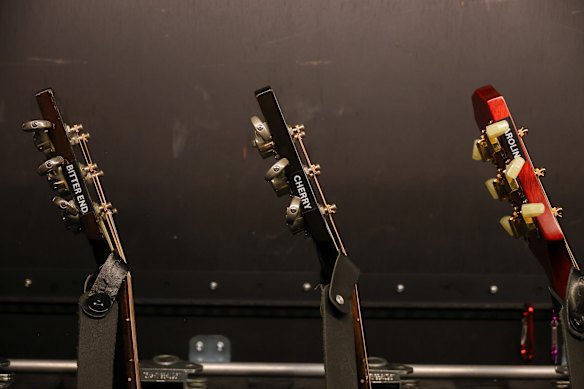
Backstage at the Princess Theatre, a row of guitars lines the wall, each one tagged with the name of the song that will be played on it. There is a guitar for Sweet Caroline, another for Cracklin’ Rosie and one for Cherry, Cherry. The crew swaps them in and out through the night without missing a beat.
A Beautiful Noise: The Neil Diamond Musical tells the story of Neil Diamond’s life and career through 25 of his songs, including all the classics – performed by Broadway star Will Swenson – tracing his journey from struggling songwriter to international rock star.
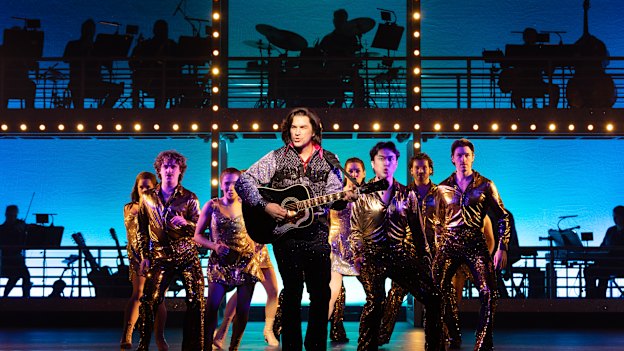
From the seats of the historic venue, the audience watching the jukebox musical sees Swenson burst into song after song from Diamond’s career. For much of the night, the crowd isn’t just listening: many sway and dance in their seats, and sing along to the tunes they know by heart.
Behind the scenes, a live nine-piece band is turning that performance into a full-blown concert, the noise hitting the back of the room as hard as it leaves the stage.
That line of labelled guitars is the result of precision by a guitar technician, just one member of the huge army of unseen labour behind the show, which has been selling out during its Melbourne run (it finishes there on November 7 before its Sydney opening on November 14, before heading to Brisbane next year).
The Princess Theatre, which seats 1500 people, has welcomed more than 100,000 theatregoers since the show’s Australian premiere in August, and many performances have come close to selling out, with the “House Full” sign a regular sight out front.
That’s a change in a particularly tough season for musical theatre, with two blockbuster productions cancelled in June. Waitress scrapped its Sydney season because of weak ticket sales, a week after national dates for Beetlejuice were axed.
So why is this show the exception? We went behind the scenes to find out.
The man who watches
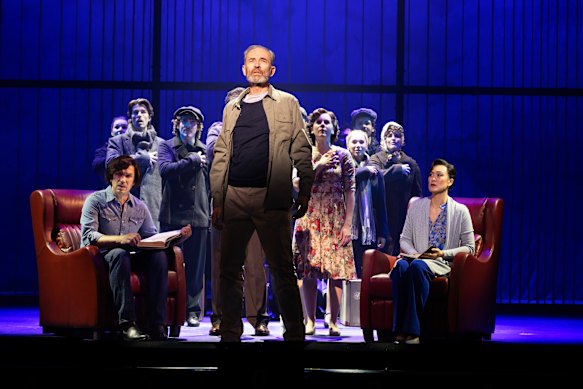
Sunk into a chair, a man dressed in muted attire leans forward with a heavy, bowed posture. There is no showmanship here, only an unvarnished sense of sadness and exhaustion. Before an audience anticipating spectacle, the man sits under a cool wash of lilac light – and begins to speak. It is one of the few moments all night when he is asked to do so.
The musical follows Diamond as a Brooklyn kid with a guitar who becomes one of the bestselling artists of all time. The older Diamond (played by Terence Crawford) watches on with a reflective eye, occasionally attempting to intervene in his own past.
It is framed by a present-day therapy session, in which the older Diamond reluctantly sits down with a therapist (Monica Sayers), who tries to encourage him to open up about the feelings behind his lyrics. A veteran of Australian stage and screen, Crawford plays Neil Diamond in the present. He is the musical’s fixed point: a man seated in a therapist’s office, watching his youth erupt behind him in song.
From the top of the show to the final bow, Crawford is absent for just two numbers. It is a strange brief. He must convey the weight of a life’s memories without the words to articulate them.
“The thing I discovered during rehearsal is that the bits where I’m not talking are actually the role,” Crawford says. “The real journey is in the watching.
“I do most of that in silence, in other people’s words, as I receive them,” he says. “That’s the hardest bit.”
Crawford approached the role with a researcher’s diligence.
“I’ve always been aware of him, but I wasn’t a huge fan. I was a huge fan of just about everybody except Neil Diamond,” he says.
So he did the homework: more than 30 albums and a playlist of favourites – “a very pleasant research exercise”, as he puts it. What struck him was the lack of ornament; feelings expressed in plain words.
“Neil Diamond’s great gift is that he speaks very directly,” Crawford says. “It’s directly from the heart, and it goes directly into that.”
But the music alone cannot narrate an entire life. Before each performance, Crawford fills the gaps with a backstory of his own invention. He imagines Diamond sitting by a pool, where his wife’s command to get his act together sobers him up to the realisation that he has hit rock bottom.
“That’s just a little imaginative place that I go to as the curtain’s about to go up,” he says.
When the curtain rises, his private world meets a public one. Crawford digests an uncanny reality: a colleague inhabiting the same character, a singular but fluid identity split between them. As Swenson kneels in a tearful confession to his wife, Crawford silently mirrors the movement, holding the posture as if absorbing the blow himself. It is a delicate arrangement, one that depends, Crawford says, on “a bond that you can trust”. Without it, “it’d be harder for me to look at it as being my former self.”
Watching his younger counterpart, Crawford sees a familiar, probing fear: the terror of the work running out.
“Sam Neill says before he died that he feared retirement much more than death,” he says. “The idea of not being able to work as an actor, I think, for me, and I think for a lot of us, is pretty terrifying.”
Yet, the show does not succumb. Crawford offers audiences a resolution, a vision through Diamond’s eyes of a life reborn rather than concluding. “I’m speaking for all of our generation,” Crawford says. “Kind of saying, ‘We’re not finished’.”
The man who watches, it turns out, has been speaking all along.
Maintaining the shimmer
The sparkle of thousands of rhinestones, all placed by hand, is reflected under the stage lights. The bold sequined button-down shirts that Swenson wears on stage make it instantly clear who he is portraying. They are unmistakably classic Neil Diamond attire. It’s in this outfit that Swenson has a character-defining moment as he hits the stage in attire that immediately transports the audience back to the 1970s. The woman who makes sure these eye-catching costumes are stage-ready is Freya Allen, the show’s head of wardrobe.
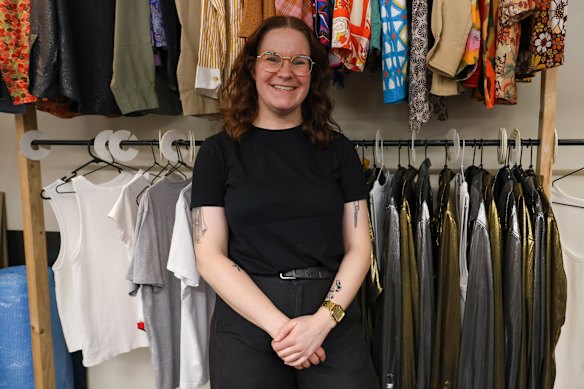
Work began on the costumes months ago, well before the show first opened, and continues day to day with the wardrobe team doing regular touch-ups. Allen ensures smooth sailing while also making sure each piece is maintained properly throughout the run.
Australian costume supervisor Christine Martin is in charge of shaping the local wardrobe, often working with her team to create each piece by hand. Even when sourcing pieces from vintage shows, she has to make sure each outfit goes together and fits into the time period.
“A lot of the made pieces, her [Martin’s] team made them in Sydney, so it’s a really local Australian make, which is really special,” Allen says.
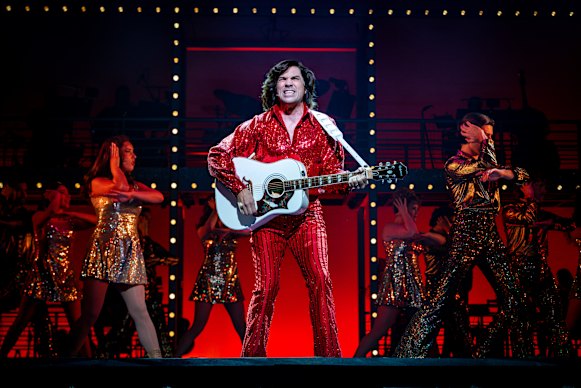
Touch-ups are also a constant throughout the show. Kelly Fratta, the deputy head of wardrobe, was working on rhinestoning a pair of boots for Swenson just moments before one of the performances. Allen estimates that there were nearly a thousand rhinestones on the one pair of boots alone.
“We get to do a lot of rhinestoning, Kelly’s doing some at the moment on a pair of the Neil Diamond boots,” Allen says when we visit.
Each rhinestone is stitched by hand, labour that generates thousands of hours of work for the wardrobe staff. For the backstage team, consistency from night to night is paramount. Whether it is ensuring Swenson’s tear-away pants rip down their intended seam on cue, or belts are not missed in a costume change, perfection is a non-negotiable.
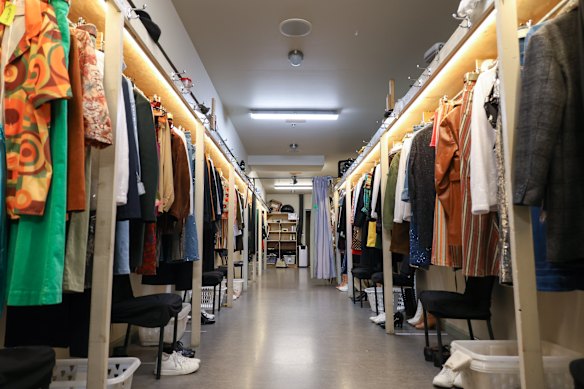
With one costume change being as fast as 30 seconds, each moment is meticulously prepared. The process becomes second nature with thorough organisation and planning.
“Once you start getting through the technical process and you start doing it more and more times, it just becomes this perfect choreographed almost dance,” Allen says.
“The backstage choreography is just as intricate and interesting as what’s happening on stage.”
No costuming mishaps have taken place during the Melbourne shows – “knock on wood,” Allen says – but wardrobe still has to be prepared in case of any setbacks. Thinking on the fly and being ready for any situation is what keeps the peace. If swing performers, who step in when other performers are unavailable, take the stage, each individual has their own set of costumes and runs through staging at the same time as the main cast.
“The way the fastenings are, sometimes you might need to change those and just be able to alter them, but sometimes it just comes down to practice,” Allen says.
Life in the wings
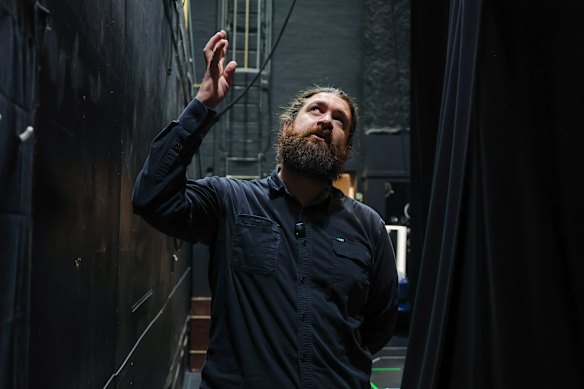
For Maddison Ohl, theatre isn’t about being in the spotlight or on the stage. Instead, you’ll find him backstage working on the technical scenic aspects of a show. And it has always been his passion.
“From the beginning, it was the only thing that I was ever going to do,” Ohl says.
As the head mechanist on A Beautiful Noise, his prime responsibility is installing, operating and maintaining staging equipment. He began planning for the show about a month before it opened.
His involvement in theatre started when he was still “in single digits”. After a year at the National Institute of Dramatic Art, he dropped out and went to work on numerous shows.
It’s the pressure that keeps him hooked. “There’s an urgency … once the show has started, and the pressure of making that work, despite circumstances,” Ohl says. “That is my closest addiction to it.”
Despite this, A Beautiful Noise is a bit of a break for him. The show is relatively light on reset, meaning there isn’t much for him to prepare for the next performance after the curtain comes down. He spends most of the show in the wings, keeping an eye on anything going on and off the stage, especially the physical set elements.
With the quick post-show routine, he gets the unique experience of being out the stage door before patrons have left, so he can sometimes hear what audiences think, which “is very rewarding”.
This isn’t always possible, though. He worked on Harry Potter and the Cursed Child for two-and-a-half years, also at the Princess Theatre, which was a very different beast, including complicated set changes and tonnes of equipment.
Even from behind the scenes, he can still feel the energy the show generates. “You still do get fed backstage by the power of the audience and what they’re bringing to the room, and we have very keen audiences, which is great,” Ohl says.
What’s most important to him, especially in shows with a lot of moving parts, is mutual respect between everyone involved. With cast members pushing objects onto the stage and timing the tracks that move heavy or large set pieces, the backstage crew are often doing their own dance.
“The backstage choreography is very consistent if people are doing it well,” Ohl says. “If you start to slip on that, then the flow-on effects can start to mount up pretty quickly.”
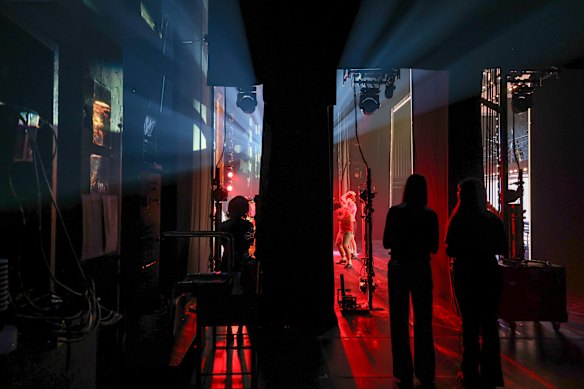
He thinks the best way to create this consistency is through community.
“A lot of it is the rapport that you build in the company,” Ohl says. “We try to breed an environment of making everybody aware of what other departments are doing, so that they can help us keep those on the tracks.”
He says this show got lucky because many of those employed on it already knew each other, or had worked with the same cast members, before opening. He says there is a “mesh” on this one that made it easier to build community than in other shows he’s worked on.
Ohl is looking forward to the Sydney and Brisbane runs because shows at this scale often play the same theatres, which he says creates “a mini homecoming” for the theatre communities in each town.
The other rock stars
As the curtain flies up in the second act, the audience finally lays eyes on the band making all that beautiful noise.
“You hear this roar come at you from the audience,” says music director Nigel Ubrihien. “It’s just this sort of wall of sound that goes whoosh at you … It’s honestly like a wave.”
The band’s stage presence immerses the audience in the show, blurring the line between watching a musical and experiencing a full-blown concert.
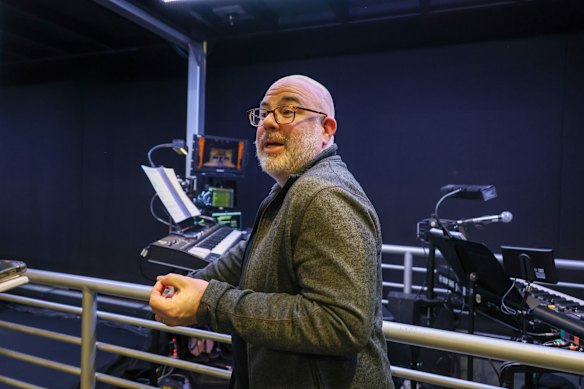
Ubrihien plays keyboard and leads eight other musicians with unwavering energy. He doesn’t miss a beat, flipping through the 300-plus page musical score with a swish that occasionally gets picked up by his microphone.
“There is a lot of multitasking,” Ubrihien says. Performing and conducting come automatically to him after doing the show nearly 60 times, so much so that he is able to write notes to other musicians while keeping in time with the actors.
“It does kind of do my head in a little bit,” Ubrihien says. “I think, ‘Oh, this is nutty.’ But sometimes you have to.”
The band becomes the backdrop to the second act, performing from a two-level structure at the back of the stage.
Out of the hundreds of Neil Diamond songs, the show features 25 that encapsulate not just the artist’s life, but the lives of those around him.
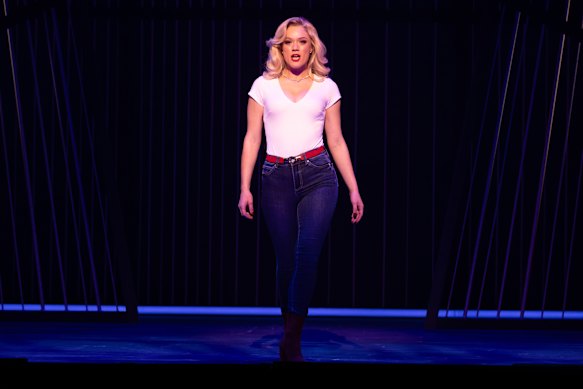
You Don’t Bring Me Flowers is sung as a heartbreaking exchange between Diamond and first wife Jaye Posner (Alana Tranter) and the smooth country sound of Forever in Blue Jeans is reimagined as a powerful solo by his second wife Marcia Murphey (Ashleigh Rubenach).
Ubrihien says that at its core, the musical’s songs “need to still be occupying his aural space”, meaning that even if they sound a bit different from the original, audiences should be able to recognise them.
In musical theatre, pre-existing songs will sometimes differ in orchestration, speed and structure because they serve a dramatic purpose, says Ubrihien. In this case, Diamond’s songs are generally slower than what audiences hear.
“The songs are like little bricks,” Ubrihien says. “You can have them as individual bricks as he would in an album, but in a theatrical context those bricks get stacked together and they build a house.”
Ubrihien has been directing music since the mid-1990s and says one of the most difficult parts of the job is learning the timing of different actors.
That sentiment was echoed by the audio operators at their booth in the back of the theatre.
Head of sound Anthony Shaw says that with repetition, the crew gets a feel for how particular actors like to play their roles; whether they prefer to take a dramatic pause or hold that last high note. When the entire cast changes for a technical rehearsal or a show, the pressure is on.
Deputy head of sound Niamh Sinclair says that sometimes her adrenaline starts pumping and doesn’t slow down until the final curtain.
During the technical rehearsal we sat in on, Sinclair ran point, adjusting for volume of the control groups while Shaw stepped in every once in a while to tweak treble and bass for different actors.
The goal is to keep the sound as smooth and consistent as possible for a pleasant listening experience, from the high-energy, hand-clapping gospel sound of Brother Love’s Travelling Salvation Show to Diamond’s brooding, emotional intensity in I Am … I Said.
The musical is fitting for the venue, where the seats come right up to the stage.
“The audience is never very far away from you,” Ubrihien says. “So you have such a beautiful intimacy with the audience in … the Princess [Theatre], it’s a beautiful space to play.
“This is one of my favourite theatres in Australia. If I can see things here, I generally will come here because of the intimacy.”
During the encore, before the curtain falls, the audience finally gets to join in, and a venue-wide sing along ensues to the most iconic song in the Neil Diamond canon – Sweet Caroline.
Patrons rise to their feet and sway to the beat, some with their arms slung around each other’s shoulders, as they close out the night loudly chanting the song’s signature refrain: “Bah bah bah!”
Ubrihien praises Diamond for “the way he writes these earworm bangers … they’re very simple, but, god, they’re perfect.”
A Beautiful Noise: The Neil Diamond Musical is at Melbourne’s Princess Theatre until November 7; Sydney’s Lyric Theatre from November 14; and Brisbane’s Lyric Theatre, QPAC from March 20, 2027.
Disclaimer : This story is auto aggregated by a computer programme and has not been created or edited by DOWNTHENEWS. Publisher: www.smh.com.au