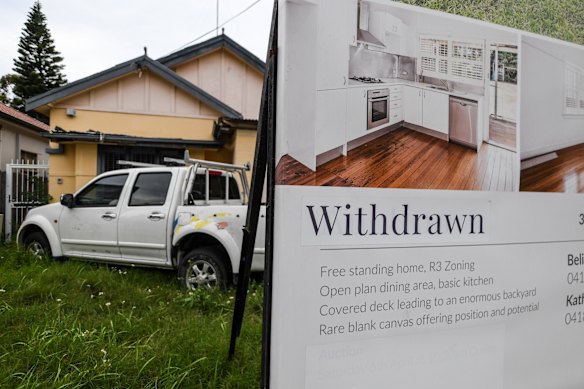

Australia’s twin urban giants – Sydney and Melbourne – are leading a broad-based downturn in house prices.
Nationally, dwelling values have fallen by 2 per cent since their peak in March, according to data published last week by property information firm Cotality. In both Sydney and Melbourne the decline has been a little over 5 per cent.
Rising interest rates triggered the slump. The Reserve Bank of Australia’s three rate hikes between February and May lifted its benchmark cash rate to 4.35 per cent, the equal highest level in 15 years.
Federal government reforms that will introduce a less-generous method for calculating capital gains tax and curbs to negative gearing from July next year have also affected investor demand for property.
The price slump has prompted some breathless predictions of property market doom. But corrections have always been a feature of the housing market. Indeed, in our story by Shane Wright today, Westpac chief economist Luci Ellis predicts that the current “airpocket” will likely dissipate by next year.
Domain price data shows that Sydney’s median house prices fell by 14 per cent between June 2017 and March 2019 after authorities introduced targeted lending restrictions to curb risky borrowing. Prices took off again in mid-2020 when interest rates were slashed to “emergency” levels near zero amid the economic disruptions of the COVID-19 pandemic (Sydney’s median house price rose by about 35 per cent between June 2020 and June 2022).
There was another downturn in 2022 when the Reserve Bank lifted interest rates sharply in a bid to combat the inflationary surge that followed Russia’s invasion of Ukraine; house prices in Sydney fell by about 8 per cent that year.
The latest decline in home values should also be weighed against longer-term price trends – Domain’s latest figures show Sydney’s median house price is 66 per cent higher than a decade ago, despite the recent market weakness.
There is broad agreement that high house prices have locked many young people out of the property market, especially in Sydney.
Recent polling for this masthead by the Resolve Political Monitor found 61 per cent of respondents supported a decline in home values. A majority across every age, political and income group agreed that prices were too high. Federal government changes to capital gains tax and negative gearing aim to assist first home buyers to get a foothold in the market.
So far, households are coping well with higher interest rates and lower house prices. In a speech last month, Reserve Bank governor Michele Bullock said that the number of home borrowers experiencing negative equity (when a property is worth less than the mortgage secured against it) “remains very limited”.
Some economists warn that further house price declines could undermine consumer confidence and dampen household spending.
But there is no evidence of that happening so far – figures made public by the Australian Bureau of Statistics on Tuesday showed discretionary spending by households rose by a robust 6.7 per cent in the year to June, the fastest pace of annual growth since mid-2023.
Even if the housing downturn starts to take a toll on the broader economy, the RBA’s recent steps to tighten monetary policy mean it has plenty of scope to cut interest rates to support activity.
Jordan Baker sends an exclusive newsletter to subscribers each week. Sign up to receive her Note from the Editor.
 The Herald’s View – Since the Herald was first published in 1831, the editorial team has believed it important to express a considered view on the issues of the day for readers, always putting the public interest first.
From our partners
Disclaimer : This story is auto aggregated by a computer programme and has not been created or edited by DOWNTHENEWS. Publisher: www.smh.com.au