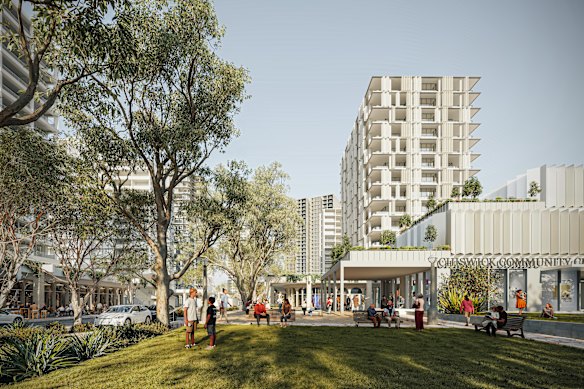

NSW Planning Minister Paul Scully says he is aiming to strike a balance between heritage and housing uplift in Woollahra, as street-view images reveal how the suburb would be transformed under controversial plans to add 9400 homes to Sydney’s east.
The Minns Labor government earlier this month unveiled draft rezoning plans to concentrate housing density around Woollahra and Edgecliff train stations, building towers up to 32 and 34 storeys. It marks the most significant rezoning of the eastern suburbs in decades and has sparked debate among supporters of density and also critics who say the plans are excessive and should be scaled back.
Many heritage-listed buildings that fall within the development precinct have been described as “highly sensitive” in the government’s site analysis, owing to the diversity of the architectural styles, including inter-war and modern-period residential buildings. The precinct contains seven state heritage items, 200 local heritage items and three heritage conservation areas.
The council has locked horns with the state government over the rezoning plan, something Liberal Mayor Sarah Dixson said would result in a “devastating loss of local heritage buildings”.
Scully rejected Woollahra Council’s claim the area would end up with the same population density as Green Square and said the government was “very conscious” of its built form and character.
“We have taken a view that heritage and housing can coexist, and it should,” Scully said, pointing to how 40 per cent of homes would be built within 200 metres of Edgecliff and Woollahra train stations.
“It’s why we’ve taken into account how sight-lines and the like are taken into it, and the view-sharing arrangements that can be considered.”
The government’s heritage analysis clarified that heritage items would be generally retained and that direct demolition was not the main risk. Instead, bigger heritage risks lay in demolishing “contributory fabric” – items that weren’t individually important but added to the significance of a heritage item. Another risk was substantial uplift affecting direct views of heritage items and conservation areas.
The precinct also did not have “uniform capacity” for uplift, and Queen Street, East Woollahra, the Plateau, Woollahra Centre and Trumper Park were particularly sensitive for their low-scale streetscapes, mature landscapes and sandstone walls. Instead, more developed areas were better placed for “carefully managed uplift”.
This is highlighted in renders showing how future buildings could significantly change streetscape views on residential roads, at Trumper Park and near Rushcutters Bay Park. The most affected views would be between 500 metres and 1 kilometre from key development clusters – close enough to see sections of significant height and also observe a change in immediate skyline views.
The report stated any future impacts on views would be mitigated by clustering height and density, which would create more visual compatibility. And while the specifics of building designs have not been determined yet, the location and heights of the buildings in the renders are accurate.
The council’s Deputy Mayor Sean Carmichael said the government’s plans were “in the wrong form, and in the wrong place” and has pushed for fewer, taller and thinner towers up to 45 storeys instead, which he says would take up less land and save more heritage items.
“We’ve been demonising height for such a long time, I think we’ve forgotten to ask whether it could be the solution to this problem,” Carmichael said. “I think it’s completely right that residents feel confronted by this [plan] – I feel confronted by this.”
Sydney YIMBY’s Justin Simon said many councils had “taken too broad a brush with heritage” and that they should instead prioritise a smaller percentage of the LGA to be heritage-protected.
“You choose a high street or a particularly unique set of houses. You don’t choose everything that’s more than 100 years old and preserve that. If you try to paint half your LGA as being a heritage conservation area then where is the housing going to get built?”
Start the day with a summary of the day’s most important and interesting stories, analysis and insights. Sign up for our Morning Edition newsletter.

From our partners
Disclaimer : This story is auto aggregated by a computer programme and has not been created or edited by DOWNTHENEWS. Publisher: www.smh.com.au