
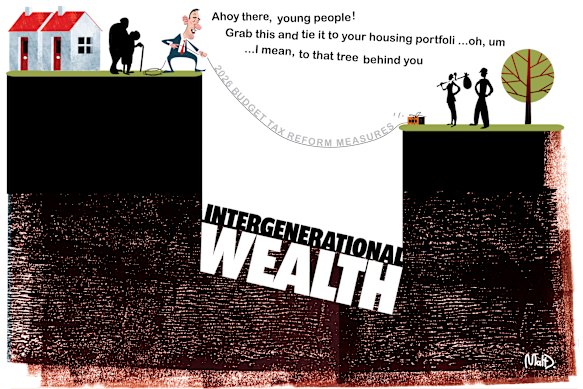
When we debate intergenerational fairness, it often looks like younger Australians lamenting the selfishness of Boomers and those Boomers calling Zoomers “entitled” for wanting more.
But as with most things that are controversial, the story isn’t as simple as David versus Goliath or, for that matter, young people needing to suck it up and pull up their socks.
The truth, as suggested by a report from the Actuaries Institute – which represents the profession that uses maths and data to manage risks – is that life is (broadly speaking) better for all generations than it was several decades ago, but not as fair as some of the “back-in-my-day” retorters might try to make it out to be.
For example, the institute’s research, which draws on data from the Australian Bureau of Statistics and HILDA (Household, Income and Labour Dynamics in Australia) surveys, shows that younger Australians have experienced some big gains in health and education over the longer term compared with older generations.
However, when it comes to economic, housing, social and environmental factors, the trend is less favourable for younger generations, outweighing the positives and ultimately widening the gap between younger and older age groups.
The current gap between generations is narrower than the record reached in 2019, says Dr Hugh Miller, one of the actuaries leading the research. That’s largely thanks to government policies focused on working-age people during the pandemic, such as JobKeeper, as well as lower post-pandemic interest rates which helped some younger Australians get a toehold in the housing market.
Unemployment has also been hovering at its lowest level this century since about 2022, meaning it’s been a great time for many young people to enter the workforce (although we’re yet to see the full effect of AI on jobs).
But economic, housing and social pressures are offsetting some of these wins, Miller says, meaning the gap between older and younger Australians could return to a record level within years.
Another of the lead researchers, Dr Laura Dixie, says that, over the past two years, 65- to 74-year-olds gained an average of $375,000 in household wealth and 45- to 54-year-olds gained $336,000. That’s more than three times the $98,000 made by 25- to 34-year-olds.
“While it’s expected that younger people have lower super balances and home ownership rates, it means they have been less able to benefit from the strong growth in house prices and sharemarket returns in recent years,” Dixie says.
While there’s been some improvement in home ownership rates for younger people, the researchers note housing affordability is still one of the most persistent drivers of worsening intergenerational equity.
Many youngsters still rely on the “bank of mum and dad”. That’s helpful for those who shopped around for the right parents. But it means plenty of young Australians are left behind.
Part of the problem for intergenerational fairness is what the government is doing – and not doing.
Government spending on various age groups has shifted towards older generations, which is the single biggest contributor to worsening intergenerational fairness, according to the institute. That includes higher age pension rates and above-average increases to healthcare and aged care spending – which will probably continue to climb alongside the share of grey hairs among our population.
The problem is that much of this spending has been funded by government debt and taxes which hit working Australians hardest. That is, the government has been borrowing money (not a bad thing in and of itself) to pay for some of the increased spending. As you know, borrowed money has to be returned (with interest) down the line.
That means younger people are increasingly having to shoulder the burden of government spending on older generations – and will have to do so for years to come as the pressure to provide for our parents and grandparents, and the interest bill attached to it, grows.
At the same time, younger generations are facing well-documented housing challenges.
As the institute – and others – have pointed out, young Australians are often trapped paying exorbitant rent (often higher than potential mortgage payments), which prevents them from being able to save up for a deposit: their key to getting a foot in the door of home ownership.
That means that many young Australians, especially those who don’t get a leg-up from their parents, are not only being relied on to cough up cash in the form of income taxes, but missing out on a huge driver of wealth – potentially for the rest of their lives.
We know this is a problem because we already see how it plays out among some of our older Australians. Not all older Australians are wealthy Boomers sitting in multimillion-dollar homes.
While there’s been some improvement in home ownership rates for younger people, the researchers note housing affordability is still one of the most persistent drivers of worsening intergenerational equity.
As the institute points out, we’re seeing increasing rates of homelessness among older Australians and poverty rates are high among retirees without residential property. Get it? Many older Australians who missed out on buying a home have struggled to keep up as property prices and rents have climbed.
Many young people today at least have superannuation balances that will probably eclipse those of their parents and grandparents. But there’s no doubt that locking some Australians out of home ownership will have costly implications for all of us.
Not only do homelessness and poverty often lead to poor health outcomes, which come at big individual and societal costs, but having a system where it is impossible for some people to have a decent standard of living and strive for goals such as home ownership leads to conflicts, more widespread anxiety and some people simply giving up.
While some older Australians might be baffled at why some young people seem to have given up on working hard, it’s partly a psychological consequence of worsening inequality – and a rational response to realising the cards aren’t stacked in your favour.
Higher inequality is linked to feelings of distrust as well as comparing ourselves more unfavourably to those above us on the social ladder, both of which can be a drag on our motivation to work hard. In fact, at times of higher inequality, those who are worse off often give up on trying to achieve their long term goals: why put in the hard yards if it’s clear you’re never going to be able to achieve big financial goals such as home ownership anyway?
Increasingly, older Australians are also realising that huge housing costs are coming at a personal cost, too, including missing out on time with grandchildren whose parents have been forced to live further out from the city.
In under two weeks, Treasurer Jim Chalmers will hand down the federal budget, which he has promised will crack down on intergenerational issues.
But the government has also been trying to dampen our expectations. Don’t let them.
Chalmers earlier this week gave a clear sign any changes to capital gains tax and negative gearing – which disproportionately benefit older, wealthier Australians – will be grandfathered, largely watering down the impact these measures would have on housing affordability.
And Prime Minister Anthony Albanese killed the prospect of a new tax on gas exports when he cosied up to the mining giants in Western Australia this week, raising the question of how the government will fund growing spending pressures without relying even more heavily on channels such as income tax, which put greater burden on younger Australians.
With an election still several years away and an overwhelming majority in parliament, there is no better time for Albanese and Chalmers to make changes that will shape the fairness and prosperity of the country.
Chalmers, despite seemingly ruling out big changes, is still talking a big game on intergenerational fairness. It’s time for the government to go big or go home.
The Market Recap newsletter is a wrap of the day’s trading. Get it each weekday afternoon.
 Millie Muroi is the economics writer at The Sydney Morning Herald and The Age. She was formerly an economics correspondent based in Canberra’s Press Gallery and the banking writer based in Sydney.Connect via X or email.
From our partners
Disclaimer : This story is auto aggregated by a computer programme and has not been created or edited by DOWNTHENEWS. Publisher: www.smh.com.au


