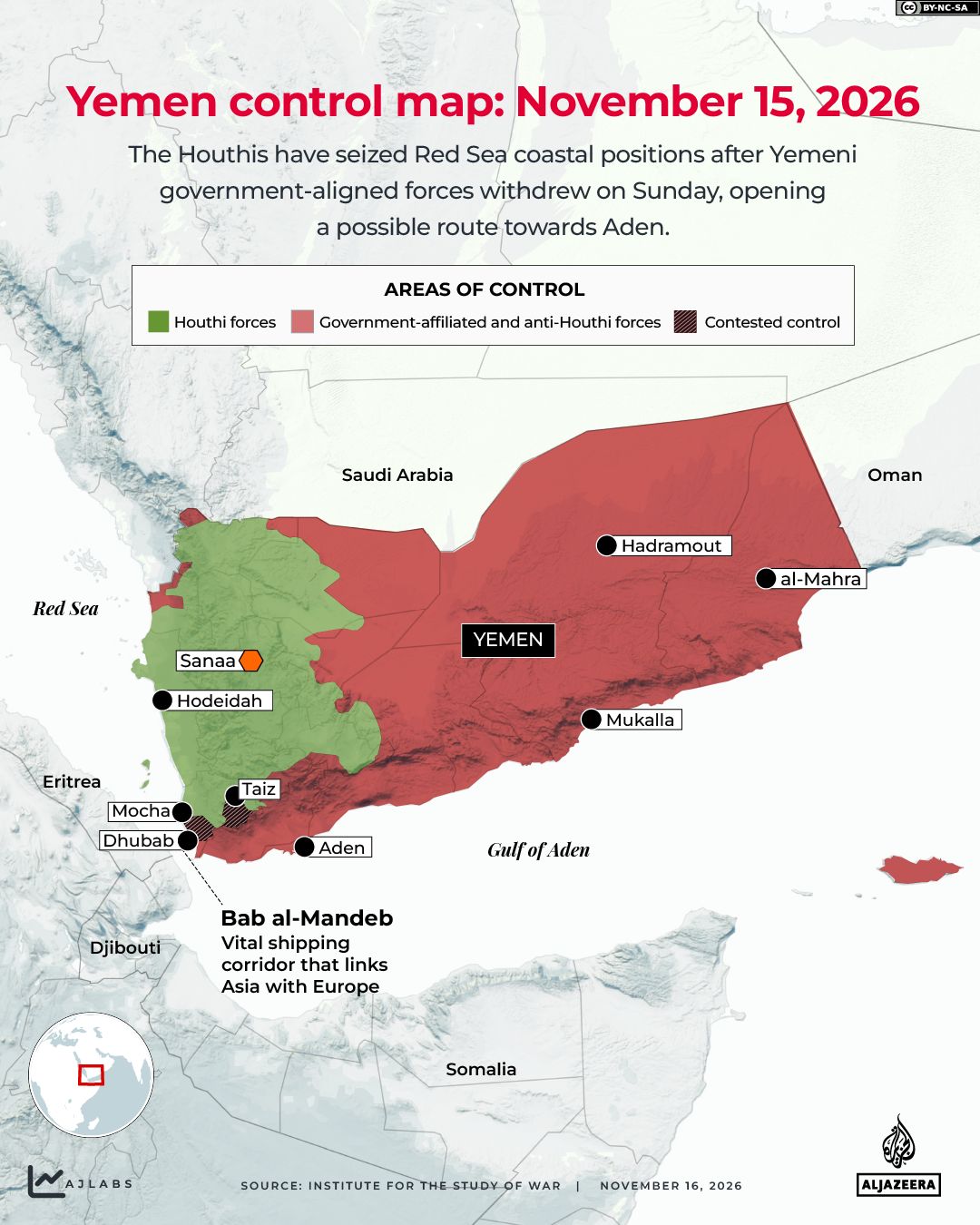
Forces aligned with the internationally recognised Yemeni government face a potentially catastrophic situation, as Houthi forces advance on the southern city of Aden and other strategic areas.
Yemeni government forces said on Sunday they had withdrawn from Dhubab airport and territory they held near the Bab al-Mandeb strait, southwest of Yemen, to defend Aden, the de facto seat of the government.
Recommended Stories
list of 3 itemsend of list
Retired Lebanese Brigadier-General Hassan Jouni, a military and strategic expert, said fighting is now focused on control over a mountainous triangle of territory in southern Yemen, which could decide the outcome of the war.
This area links Aden to Taiz, another city held by the government but encircled by the Houthis – an armed group also known as Ansar Allah (Arabic for Supporters of God) – and Bab al-Mandeb, a maritime chokepoint that connects the Red Sea to the Gulf of Aden.
“This triangle is the strategic centre of gravity for the war in Yemen as a whole,” Jouni told Al Jazeera.
On Sunday, government-aligned forces were withdrawn from Dhubab, which was recaptured from the Houthis in September, to avoid an imminent siege in the coastal strip by the Houthis and to help defend Aden, analysts say.
Houthi advances in this southwestern region now threaten to completely cut off the government’s coastal supply routes, Jouni said.
The Yemen war began when the Houthis, a Zaidi Shia group close to Iran, captured the capital, Sanaa, in September 2014, forcing the government to flee south to Aden. Saudi Arabia launched an Arab coalition military campaign to aid the government in March 2015, launching thousands of air strikes against Houthi forces.
Advertisement
Following a relatively peaceful few years, fighting re-erupted in July when government forces’ jets bombed Sanaa international airport to prevent a Houthi delegation from landing in the Yemeni capital.
A Houthi offensive in September saw the government lose control of Yemen’s Red Sea coast, including the key port city of Mocha. Later Houthi advances also saw Taiz completely besieged by the Houthis.
Yemeni Armed Forces spokesperson Majed al-Nuzaili defended the retreat from Dhubab, saying it was part of a wider tactical manoeuvre.
“[The redeployment] is an extension of the heroic positions of the popular resistance and the southern forces in protecting the temporary capital Aden,” he said on X.
But Jouni believes the situation faced by government forces is grim, with the Houthis reaching Tor al-Baha, just 80km (50 miles) from Aden.
“The Houthi forces have reached this line, meaning that they are indeed in the defensive line area of the city of Aden. We do not say they have approached Aden, but the defence of the city of Aden begins in this area,” he told Al Jazeera.
“The basic combat direction now is in the vicinity of the besieged city of Taiz. On the other hand, of course, the Houthis will focus their attention now on approaching Aden and controlling the first defensive zone.”
Strategic affairs expert Ali al-Dahab gave a less optimistic assessment of the situation than the one presented by the government.
“What happened is a retreat or a withdrawal with the same meaning, and not a redeployment, because the withdrawal left a vast vacuum filled by the Houthis,” al-Dahab stated.
Regional escalation
The government’s “Operation Yemen Dawn” has responded to the situation with a dramatic increase in strikes on Houthi positions, including 900 targeting operations within 24 hours.
The Houthis have responded with ballistic missiles and drone attacks towards Mecca, Riyadh, and the Eastern province in Saudi Arabia. They have announced they will continue operations under a principle of “siege for siege, airport for airport, and escalation for escalation”.
Al-Dahab said this strategy is directed at Saudi Arabia, the Yemeni government’s key international ally, and not at authorities in Aden.
With their recent gains on the coast along Bab al-Mandeb, which has become increasingly significant to global maritime trade since the effective closure of the Strait of Hormuz amid the US-Israel war on Iran, the Houthis have significant geopolitical leverage.
“They now directly and completely control the western Yemeni coastal sector and part of the maritime extension towards Aden,” al-Dahab warned.
Advertisement
“The matter translates the Houthis’ gains in Bab al-Mandeb in large part to the benefit of Iran.”
Disclaimer : This story is auto aggregated by a computer programme and has not been created or edited by DOWNTHENEWS. Publisher: aljazeera.com