
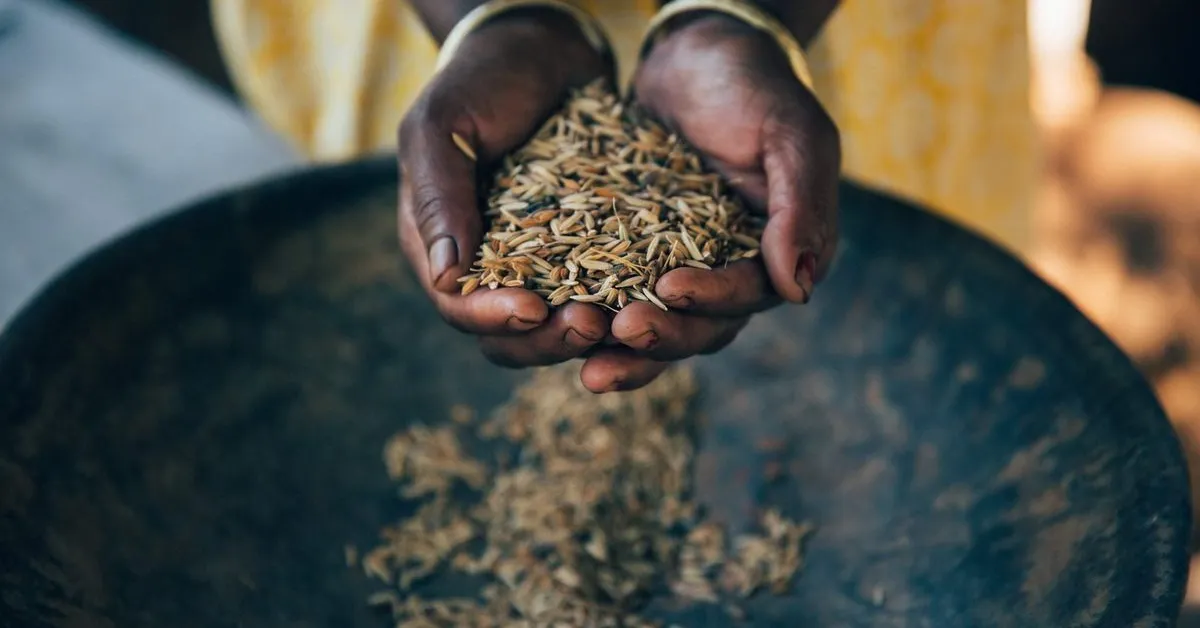
In the villages of Jharkhand, farmers still run handfuls of rice through their fingers before deciding what to cook.
Some grains are black and glossy. Some carry the faint scent of earth after rain. Others turn red once boiled.
Each has a story older than the farms themselves.
For years, many of these rice varieties disappeared from Indian kitchens. Hybrid seeds replaced them. Uniform white grains took over markets.
But across India today, from the cyclone-hit Sundarbans to the dry plains of Tamil Nadu, indigenous rice is finding its way back to fields, dining tables, and even international plates.
The revival is being led by tribal farmers, women-led seed networks, and small farming communities that never completely gave up on their ancestral grains.
They are returning to native rice for practical reasons: better taste, stronger nutrition, resilience to floods and droughts, and lower dependence on chemicals. But in the process, they are also protecting India’s shrinking agricultural biodiversity.
At a time when climate change is making farming increasingly unpredictable, these traditional seeds are becoming more than cultural memory. For many farmers, they are turning into a lifeline.
For most Indians, rice sits at the centre of rituals, festivals, grief, celebration, and memory.
India once cultivated more than 100,000 rice varieties, each adapted to local soil, rainfall, culture, and cuisine.
Kerala had medicinal Navara rice used in Ayurvedic treatments. Tamil Nadu cultivated Kullakar, a hardy red rice known for thriving in poor soils. Manipur’s black Chak Hao appeared in ceremonial meals. West Bengal’s aromatic Gobindobhog became inseparable from festive cooking.
Then came the Green Revolution.
When diversity gave way to uniformity
Beginning in the 1960s, India’s agricultural policy shifted toward high-yield hybrid crops to address food shortages.
Production increased dramatically, but diversity collapsed.
Thousands of traditional rice varieties disappeared from cultivation. Farmers became dependent on purchased seeds, fertilisers, and pesticides. Over time, monoculture farming degraded soil health and weakened ecological resilience.
Today, fewer than 6,000 indigenous rice varieties are believed to survive, many of them endangered.
/filters:format(webp)/english-betterindia/media/media_files/2026/05/25/rice-2-2026-05-25-20-45-55.png)
Yet the same climate crisis now threatening Indian agriculture is also driving farmers back toward traditional grains.
Indigenous rice varieties are often naturally resistant to pests, floods, salinity, and erratic rainfall. Unlike many hybrids, they are deeply adapted to regional ecosystems.
In Karnataka’s coastal belt, Kagga rice survives saline water intrusion. Kerala’s Pokkali withstands flooding and saltwater. In the Sundarbans, farmers are reviving Nona Bokra and other salt-tolerant varieties after repeated cyclones damaged conventional crops.
Many native grains also require fewer chemical inputs, making them better suited for organic and regenerative farming.
The nutritional return
Modern nutrition research is now validating what many farming communities already knew.
Traditional rice varieties often contain higher levels of iron, fibre, antioxidants, and minerals than polished commercial rice.
Navara is valued for its low glycaemic properties. Kullakar is prized for its mineral density. Unpolished black and red rice varieties are increasingly being marketed as nutrient-rich alternatives in urban health-food spaces.
This growing demand is also changing the economics for farmers.
In Jharkhand’s Gumla district, tribal farmers Jhalo Devi and Basu Oraon toldMongabay India last year why they abandoned hybrid paddy cultivation and returned to indigenous rice varieties grown by their ancestors.
Hybrid cultivation, they explained, meant higher costs, pesticide dependence, weaker taste, and lower nutritional value. Traditional varieties such as Kala Jeera, Karhani, Kalamdani, and Mehia proved more resilient during droughts and floods while fetching better prices in local markets.
Jhalo Devi described indigenous black and red rice as healthier and more filling than hybrids, which spoil faster after cooking. Basu Oraon said the traditional grains required no fertilisers and significantly reduced farming expenses.
Last year, Jharkhand received nearly 1,200 mm of monsoon rainfall during the June-September season — 17% above normal and among the highest recorded since 2001. Excess rain damaged large stretches of Kharif crops, especially hybrid paddy and maize.
But some indigenous rice farmers saw a very different outcome.
/filters:format(webp)/english-betterindia/media/media_files/2026/05/25/rice-3-2026-05-25-20-55-53.png)
Dinbharan Nageshiya, a farmer from Latehar district cultivating indigenous paddy across 5.5 acres, told Mongabay that traditional varieties such as Sanpiya, Karhani, Baghpanjara, Jeera Phool, and Rani Kajra survived the erratic weather far better than hybrids.
“All farmers who grew hybrid paddy lost their crops, while those with indigenous varieties had good harvests,” he said.
For Jharkhand, where climate extremes and drought cycles are becoming more frequent, the survival of indigenous seeds is now an agricultural necessity.
What is happening in Bengal — India’s largest rice-producing state?
In the cyclone-prone Sundarbans, repeated disasters such as Aila and Amphan left farmland saline and unsuitable for many commercial high-yield varieties. Farmers responded by reviving traditional rice strains preserved within local communities for generations.
Through grassroots initiatives such as Alor Barta, more than 1,500 farmers are now cultivating nearly 192 indigenous rice varieties once considered close to extinction.
Varieties such as Talmugur, Lal Getu, Dudheswar, and Morichshal are returning to cultivation because they survive saline soils and unpredictable rainfall better than hybrids.
The shift is equally visible in West Bengal, India’s largest rice-producing state, which contributes more than 15% of the country’s total rice output.
The revival has also sparked interest among urban consumers looking for healthier, locally adapted foods.
Organisations working on biodiversity conservation in Bengal are now attempting to bring near-extinct rice varieties such as Kabirajsal, Bahurupi, Marichsal, and Tulaipanji back into circulation.
The grains being revived today are not relics from the past. They are living insurance against an uncertain future.
As climate instability reshapes farming across India, many communities are discovering that some of the strongest answers may already exist in the seeds their ancestors left behind.
Sources:
‘How 1500 Sundarbans Farmers Turned Poisoned Fields Into Farms Growing 192 Rice Varieties’: by
Tribal farmers trace tradition to survive climate variabilities’: by Ashwini Kumar Shukla, Published on 11 December 2025
Disclaimer : This story is auto aggregated by a computer programme and has not been created or edited by DOWNTHENEWS. Publisher: thebetterindia.com



