Welcome to CityChats, where Brisbane Times meets our city’s most interesting characters on our most iconic form of transport. This week, Share the Dignity founder Rochelle Courtenay, aka “Pad Lady”, shares how a pair of button earrings changed a young girl’s life, what it was like to meet her idol, and how she gathered the largest body of menstruation data in the world.
Courtenay is a vision in pink denim when we meet her at the Brett’s Wharf ferry terminal, a short trip from Share the Dignity’s office in Virginia. She’s brimming with positivity about Brisbane as we wait for the boat – so much so that we have to stop her from sharing too much before the cameras roll.
Tell me about Share the Dignity and how it all started.
In 2015, I read an article that talked about how there were 48,000 women in Australia who didn’t have somewhere safe to call home. But what I read next changed me and actually changed Australia forever. It was that they were using socks and newspaper and wadded-up toilet paper to deal with their period.
I couldn’t believe that it was happening in Australia. Back then, I had my own personal training business, so I had all female clients aged between 30 and probably 65. And I asked them all to bring me a packet of pads or tampons for every wine they had in the month of March 2015.
Some ladies would just bring me a bag and say, “Let’s not count them. Let’s just start training.”
In terms of the larger conversation around periods and period poverty, do you feel like we’re at the place that we need to be yet, or we’ve still got work to do?
We’ve still got a lot of work to do. I feel like when Share the Dignity started, nobody talked about periods ever on social media. It was such a hard charity to start, to get off the ground. I mean, people don’t talk openly about periods in the first place, but they also don’t talk openly about living in poverty, right?
You’d never see a woman who was experiencing homelessness say, “Hey, can I get some period products instead of food?” Right?
I feel like Share the Dignity’s given the permission for people to talk about menstruation, but we’ve also backed that up with the data from the Bloody Big Survey. We do a survey every three years – last time, in 2024, our survey had 153,000 responses.
That’s the biggest body of data the world’s ever seen on menstruation. Half the world menstruates, and yet this is the biggest body of data, from the bogan from Brighton. That’s what I call myself.
That data has informed serious changes in Australia. So, things like there is now the provision of period products in nearly every primary and secondary school in Australia because no girl should ever miss out on a day of education because her family either can’t afford period products or she’s unexpectedly got a period at school.
And with that Bloody Big Survey, what findings came out of that really shocked you?
Sixty-four per cent of women don’t go to work or feel anxious about going to work when they have their period.
If a workplace can provide tea and coffee and give you birthdays off and have ping-pong tables, why can’t you just put period products in the bathroom?
No woman should have to sit through a meeting or sit at work wondering whether, one, can she afford them; two, one-in-eight of us suffer from endometriosis, right?
I remember having had about maybe five surgeries in my working lifetime and never telling a boss that I was going in for endo – I reckon I had my gallbladder out four times and my appendix out three times, because I never told anybody.
There was such a shame and stigma around it. Just put period products in the bathroom!
In your line of work, you meet with a lot of people who are experiencing period poverty. Are there any particular stories or things that people have shared with you that have really stuck with you and driven your mission?
We do a campaign called “It’s in the Bag” in November. It’s where we ask you to put together a bag that has things like shampoo, conditioner, toothbrush, toothpaste, deodorant, soap, then period products, and then drop that into Bunnings the first two weeks of November. We then get them out to every woman spending Christmas in a domestic violence shelter or experiencing homelessness.
We’ve now collected 1.1 million of those bags. I hear stories of how a woman receives a bag and how that makes her feel … that’s what gets me up in the morning.
I met this young girl and she was sitting on the edge of a domestic violence shelter on the Gold Coast. She received a mum and bub bag – she had a little 10-week-old baby boy with her. She talked about the fact how she had lived on the streets when she was 14 because it was safer than living in her home.
And I’ll never forget just sitting there, crying, listening to her. And she received this bag. It was the first gift she’d got since she was eight years old as a Christmas gift.
In the bag were these little yellow button earrings … she loved them, and she sat there and said, “This is the first time I’ve felt pretty in my whole life.” She was 24 years old.
You’ve spoken about your experience with domestic violence and feeling disempowered. How has that personal experience shaped what you do?
I feel like there’s been many chapters in my life, and every chapter makes you be who you are. And I feel like as a young girl, I grew up with sibling abuse … violence just seemed to play a constant in my life.
I feel like for a long time I didn’t have a voice, and now I’ve got a voice. And I will be the voice for all the women who need it and the little girls that don’t need it until they can find their own voice.
Is there anything in particular that you’d really like to see moving forward when it comes to conversations around period poverty?
We don’t actually use the terminology “period poverty”. We use “menstrual equity”.
What I want by 2031 is a world where whether you’re on the CityCat, there are period products in the bathroom; whether you’re in your workplace, you’re at school, you’re in hospital.
Like, it’s not guaranteed that you’ll get a pad in a public hospital in Australia. You can get a CAT scan and your head sutured, and you can get morphine or any drug you like, but it’s not guaranteed you’ll get a pad in a place where blood is. That’s not right, right?
We’re really looking for a world where menstrual equity means that there is provision of period products as readily accessible as toilet paper.
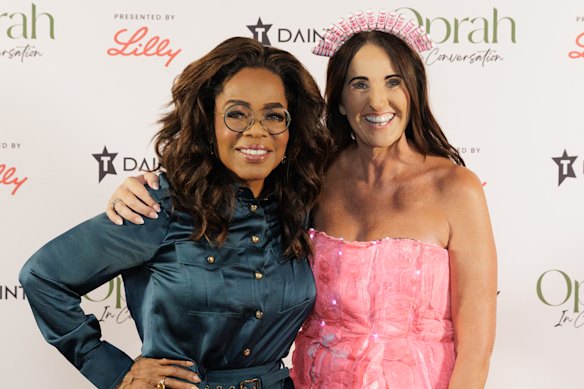
Tell me about what it was like to meet Oprah Winfrey and get her involved with the “It’s in the Bag” campaign?
To have Oprah’s voice and for her to be putting together a bag – her bag is no more important than the bag that you would put together – it’s just that her voice comes with a certain trust.
I don’t know any woman in the world who’s done more for women and girls and humanity like Oprah has, and f— I’m chuffed about it.
How did it happen?
She came to Brisbane last year – she’s been on my vision board since the very beginning – so I feel like I’ve won the lotto.
My job this year is to use Oprah’s voice and people like Luke Bateman and Christian Hull, to help us make sure that wherever you are in Australia, you can put together a bag and drop it to Bunnings and make a difference.
I would have loved to have had a really nice photo of Oprah in a nice outfit, but I’m not. I’m in a dress made of pads that lights up and a tampon tiara.
The dedication is … that’s huge.
I wore it for 30 days.
Really?
Every day for 30 days. When we did the Bloody Big Survey because we wanted 150,000 responses, and it had stalled. And I’m like, what else can we do? And people were really tuning in as to what I was going to do next in my crazy pad dress.
Pad Lady was in a pad dress. That’s really cool.
It ended with doing stand-up paddleboarding at Shorncliffe in my pad dress, and I fell off. And I didn’t mean to fall off! And I had an Akubra that had all tampons hanging down, and when the tampons got wet, they just blew up, and I couldn’t even see. I shook my head, and there was water going everywhere. It was freaking funny.
Start the day with a summary of the day’s most important and interesting stories, analysis and insights. Sign up for our Morning Edition newsletter.
 Neesha Sinnya is the acting social media editor for Brisbane Times.
From our partners
Disclaimer : This story is auto aggregated by a computer programme and has not been created or edited by DOWNTHENEWS. Publisher: www.smh.com.au