
A mysterious piece of paper fluttered out of an Australian World War I soldier’s war diary.
It was a newspaper classifieds notice, containing a poem which read: It is sweet to be remembered, And this my wish will show, We will hold you still in memory, While the years they come and go.
The eerie floating-out of the article came to reinforce for researcher Colin Reid his feeling of being fated to tell the story of Melbourne-born soldier Claude Nuttall.
“It was as if Claude was up there in the universe, was directing my steps,” Reid recalls.
Nuttall, 23, was killed in action in 1918 on a Somme Valley battlefield, in northern France.
In 1996, Reid was curator and manager of Dudley Museum when it called on locals to contribute relics of soldiers from the West Midlands, in central England, and of life on the home front, for an upcoming exhibition on World War I.
A local man, Alan Southall, showed Reid a WWI pocket diary that he had found as a boy on a rubbish tip.
Reid initially thought it didn’t suit the exhibition because Nuttall, its author, was Australian.
But Reid learned that Nuttall’s wife, Violet, whom he had married months before he died, was from a town in the region.
The diary went on display, and the love story captured the public’s imagination.
Nuttall’s diary entries ended abruptly in August 1918, with no explanation. But the diary was pierced by a bullet and had blood on it.
Reid was intrigued by what happened to Nuttall.
“I think it was a case of, this was a mystery to be solved,” he said.
Reid found that in 1916, King George V had presented Nuttall with the Military Medal for risking his life to help rescue two wounded men close to enemy lines near Armentières, on the France-Belgium border.
Reid said there were some amazing moments of serendipity that kept his decade-long research going whenever he hit a dead end.
After the initial WWI exhibition closed, Nuttall gave the diary back, realising years later when he went to relook at it, that its owner, Southall, had moved house.
Reid knocked on doors in a bid to find Southall’s new address and had almost given up, when his wife persisted with one more street, and found someone who knew him.
At another time, Reid wrote to 28 people with the surname Nuttall in Victoria. Jessie Brent, a woman unrelated to Claude, responded and offered, on Reid’s behalf, to put a notice in a Melbourne newspaper seeking Nuttall’s relatives.
The wife of Nuttall’s nephew, Arthur Thomas, saw the notice and saw the family subsequently travel to WWI battlefields and Nuttall’s grave in Harbonnières near Amiens.
Reid eventually discovered that the newspaper fragment that had dropped out of the diary was a memorial notice published in The Age, on February 12, 1918.
Reid found no evidence that Nuttall, from Cheltenham in Melbourne’s south-east, knew 15-year-old girl Lucy Battle, whose death it commemorated.
But in May 1918, Nuttall wrote in his diary that his mother had sent him the newspaper.
Reid’s theory is that the poem’s sentiment struck a chord with Nuttall, and so he kept it.
Nuttall had spent two years in often in terrible conditions, under fire, watching mates die. He was once shot in the thigh.
“He’s thinking, ‘I might not survive this. I just want to be remembered in some way’,” Reid says.
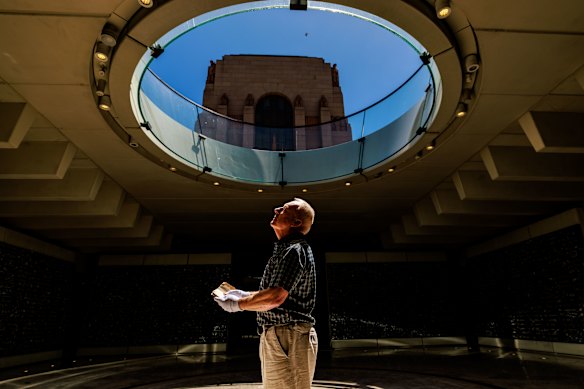
If the latter were Nuttall’s wish, Reid feels he has fulfilled it by writing a new book, The Digger’s Diary, which will be launched at Melbourne’s Shrine of Remembrance on November 12.
“I have a great sense that the task is finally done,” Reid said, referring to the book, the culmination of a quest that began in the West Midlands town of Dudley.
In 2018, as a surprise, Reid organised for an Anglican priest to hand Nuttall’s diary to his family at a church in Cheltenham where Claude once worshipped.
Nuttall’s nephew Arthur Thomas, now 85, said: “It was very emotional.”
Thomas says while the diary has “no intrinsic value, it’s priceless to a lot of people now”.
Asked what he thinks of Reid’s new book, Thomas said: “I think it’s incredible. I find it very moving. It presents both Colin’s drive to find out about the detail of the diary and then there’s the diary itself. So it’s two stories in one.”
He wants the diary to eventually go to either the Australian War Memorial in Canberra or Melbourne’s Shrine of Remembrance.
Start the day with a summary of the day’s most important and interesting stories, analysis and insights. Sign up for our Morning Edition newsletter.
From our partners
Disclaimer : This story is auto aggregated by a computer programme and has not been created or edited by DOWNTHENEWS. Publisher: www.smh.com.au