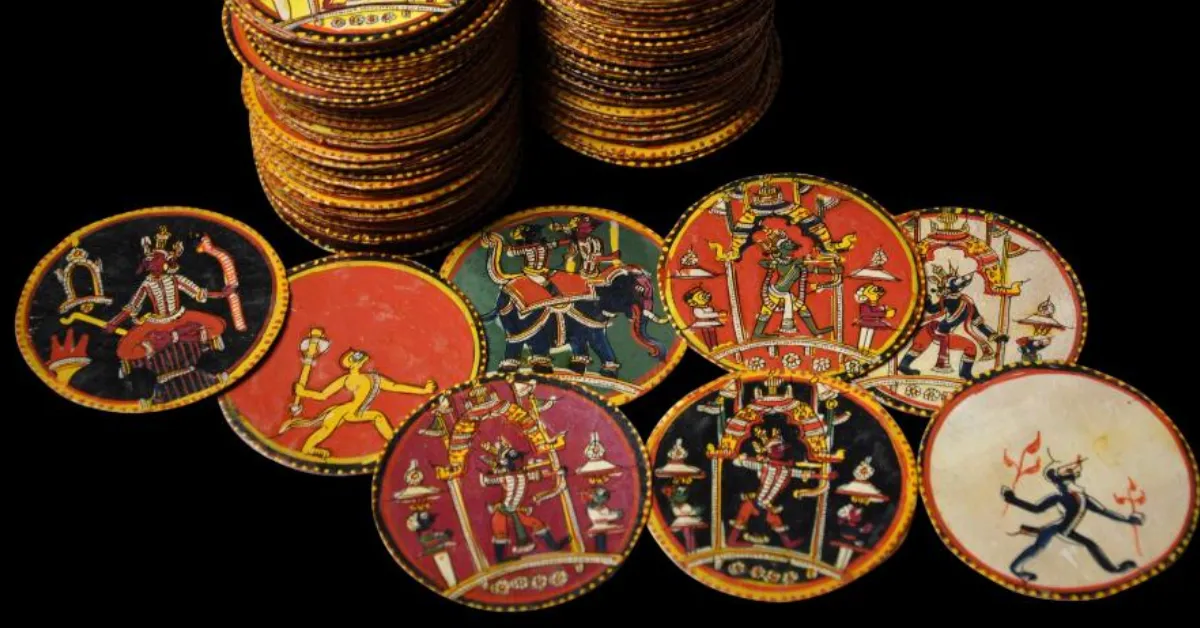
Long before children traded Pokémon cards on school playgrounds, India had its own beloved deck. Ganjifa, a game of hand-painted, circular cards, once entertained Mughal royalty and travelled through princely courts across the subcontinent.
Today, this centuries-old art survives largely because one royal family in Maharashtra refused to let it fade away.
A treasure from Persia
The word Ganjifa comes from the Persian ganj, meaning treasure. The game arrived in India in the 16th century and found eager patrons in Mughal emperors Akbar and Shah Jahan, who turned it into a favoured royal pastime.
Akbar is even credited with standardising a 96-card version played across eight suits of twelve ranks each, while also devising an expanded set that mirrored the branches of his own administration.
Unlike the rectangular decks familiar today, Ganjifa cards were round, and every single one was painted by hand. Suits told stories drawn from mythology, often depicting the Dashavatara, the ten incarnations of Lord Vishnu, alongside kings, chariots, courtly life and, in some regional styles, signs of the zodiac. As the game spread across India, local schools of painting shaped it differently.
The Ganjifa of Mysore, for instance, carried its own distinct visual language under the patronage of the Wodeyar kings, quite unlike the style that took root on Maharashtra’s Konkan coast.
The earliest cards were crafted on ivory, tortoiseshell, and sandalwood, embellished with silver, gold, and precious stones. But as mass-produced playing cards flooded Indian markets through the 20th century, Ganjifa workshops shut down one after another.
By the time of Independence, most artisan families had scattered in search of steadier livelihoods, and the art nearly disappeared everywhere except one town.
One palace keeps a tradition alive
Sawantwadi in Maharashtra’s Sindhudurg district turned out to be the exception. The town’s royal family, the Sawant Bhonsles, noticed Ganjifa slipping away even from the region that had nurtured it for centuries.
Lt Col Raja Bahadur Shivaram Sawant Bhonsle and his wife, Rani Satvashiladevi, decided the only way to save the craft was to learn it themselves. They trained under Pundalik Chitari, then an 80-year-old master artisan, and in 1971 founded Sawantwadi Lacquerwares to formally anchor the revival.
/filters:format(webp)/english-betterindia/media/media_files/2026/07/08/1-2026-07-08-19-38-11.png)
That decision turned the palace’s darbar hall into a working studio. Today, around 20 artisans, including 13 women, carry the legacy forward, painting borders, colours and figures before finishing each card in protective lacquer.
A single set takes over a month to complete, work that demands patience the same way the region’s other dying crafts, like Sawantwadi’s hand-painted wooden toys, always have.
New generation, new audience
When Yuvrani Shraddha Lakham Sawant Bhonsle married into the family in 2019, she began expanding Ganjifa’s reach well beyond Sawantwadi.
She took the craft online, partnered with corporations including Reliance’s Swadesh initiative, and introduced it to audiences who had never encountered the art form before.
Alongside her husband, Yuvraj Lakham Sawant Bhonsle, she also converted part of Sawantwadi Palace into a Ganjifa-themed boutique hotel, where doorknobs, mirrors and furnishings are all hand-painted, and each suite is named after an avatar of Vishnu instead of a room number.
/filters:format(webp)/english-betterindia/media/media_files/2026/07/08/1-2026-07-08-19-40-51.png)
Protecting the craft legally took work, too. The family applied for a Geographical Indication tag in January 2023, a process that meant proving Sawantwadi’s Ganjifa was distinct from versions practised in Odisha, Andhra Pradesh, Rajasthan and Mysore.
Shraddha has said it took one and a half years of work to finally get it, giving the family ownership of an art form patronised by their ancestors for centuries.
The tag came through in January 2024, the first for this craft anywhere in India, placing it alongside other regional revivals such as the Padma Shri-winning return of Chitrakathi art from the same Konkan belt.
From palace walls to postboxes
In 2025, that recognition travelled further still. India Post launched the country’s first-ever circular postcards, designed with Sawantwadi’s artisans and inspired directly by Ganjifa’s Dashavatara motifs.
A craft once confined to royal courts and palace halls can now pass through post offices nationwide, carried in the hands of ordinary people rather than kings.
/filters:format(webp)/english-betterindia/media/media_files/2026/07/08/2-2026-07-08-19-41-26.png)
Modernisation has crept in, too. Artisans now use durable poster colours in place of some natural pigments, ensuring cards withstand time and travel without losing their character.
The essential process, hand-painting, storytelling and lacquering, remains unchanged, much like the homestays and eco-tourism ventures reviving other corners of Sindhudurg through the same instinct to adapt without abandoning tradition.
Ganjifa’s survival makes one thing clear: heritage does not endure on its own. It thrives only when someone chooses, deliberately and patiently, to protect it.
Sources:
‘Against All Odds: How an erstwhile royal family is keeping alive ancient card game Ganjifa‘: by The Indian Express, Published on 15 July 2024
‘Sawantwadi’s Ganjifa Art Gets a New Canvas: India’s First Circular Postcards‘: by Caleidoscope, Published on 24 October 2025
‘Of Revivals and Royals‘: by The Asian Age, Published on 21 July 2019
‘Live in a Konkan Palace! This Royal Couple Run a Boutique Homestay Inspired by 16th Century Art‘: by The Better India, Published on 13 February 2024
‘State Wise Registered GI of India‘: by Intellectual Property India (Government of India), record showing Sawantwadi Ganjifa Cards registered 10.01.2024
Disclaimer : This story is auto aggregated by a computer programme and has not been created or edited by DOWNTHENEWS. Publisher: thebetterindia.com